
Table of Contents
- Innovative Kitchen Gadgets vs Traditional Tools: The 2026 Verdict
- Manual Tools vs Automated Kitchen Tools: Time, Effort and Results
- Must-Have Smart Kitchen Gadgets Worth the Counter Space
- Essential Kitchen Tools for Beginners: Where to Start
- Ergonomic Kitchen Gadgets for Daily Use: Comfort That Pays Off
- Cost, Storage and E-Waste: The Hidden Price of Going High-Tech
- Skill-Building vs Skill-Replacement: What Gadgets Take From You
- Frequently Asked Questions
Last Updated: October 4, 2026
Innovative Kitchen Gadgets vs Traditional Tools: The 2026 Verdict
At Asknik, we sort through smart products and viral gadgets to find the ones that genuinely improve daily routines. This guide weighs innovative kitchen gadgets against traditional tools across time, cost, storage and skill.
The short answer: the best kitchens in 2026 are hybrid. Precision tools win for measuring and repetitive tasks; traditional tools win for anything needing feel, speed and zero maintenance.
What the Comparison Table Reveals
The table below summarises how the two camps stack up across the factors that matter most in daily cooking.
| Factor | Traditional Tools | Innovative Kitchen Gadgets | Winner |
|---|---|---|---|
| Setup time | Instant | Charging or pairing first | Traditional |
| Measuring accuracy | Eyeballed | Digital, precise | Gadgets |
| Maintenance | Wipe and store | Charging, cleaning parts | Traditional |
| Counter space | Minimal | Varies by device | Traditional |
| Repetitive tasks | Tiring | Effortless | Gadgets |
| Cost over time | One purchase, decades of use | Battery and part replacement | Traditional |
| Skill building | Teaches technique | Can replace technique | Traditional |
| Accessibility | Standard grip | Ergonomic, one-hand options | Gadgets |
Gadgets win on precision and effort; traditional tools win on cost, upkeep and space. Most home cooks need a mix of both.
Manual Tools vs Automated Kitchen Tools: Time, Effort and Results
Manual tools give you control and speed for simple jobs; automated kitchen tools remove the physical effort and inconsistency from repetitive ones.
Take grinding pepper. An electric grinder like the Ηλεκτρικός Μύλος Πιπεριού & Αλατιού runs on a 10W motor and a rust-proof ceramic core, so you get the same grind every time with one click.
The real difference shows up over a week of cooking:
- Measuring: a traditional cup set is instant but imprecise; a digital cup converts units and weighs to the gram
- Grinding: manual mills need wrist work; electric grinders need a charge
- Mixing: a whisk builds arm strength; a hand mixer saves it
Neither side wins outright. The question is which tasks you repeat often enough that the effort adds up.
Must-Have Smart Kitchen Gadgets Worth the Counter Space
The smart kitchen gadgets worth owning replace two or three single-purpose tools rather than adding a new job to your routine.
Most ranking guides skip the part that decides whether a gadget survives past January: kitchen real estate.
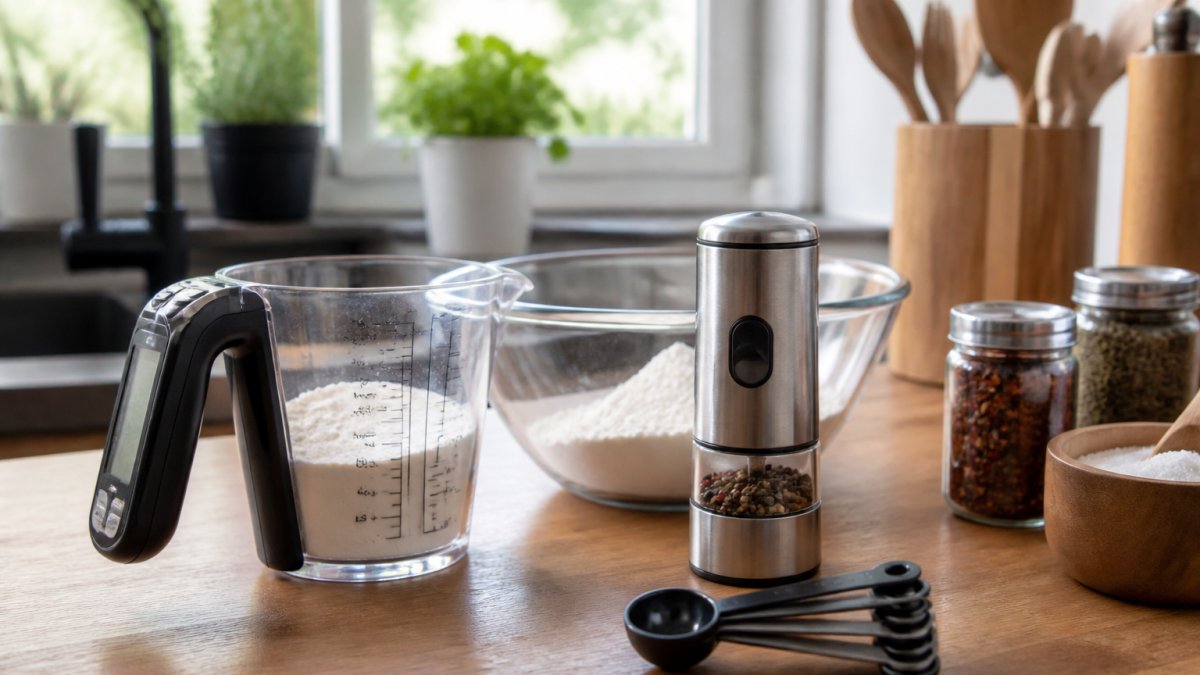
Digital Measuring Cup: One Tool, Five Jobs
The Ψηφιακή Κανάτα Μέτρησης Υγρών και Στερεών is the clearest example of a gadget that earns its space.
Its detachable design makes storage easy, and it runs on an included button battery.
Compare that to the traditional alternative: a stack of nested cup measures, a separate scale and a probe thermometer, three items, three storage footprints, three things to wash.
Electric Spice Grinders: Precision Cooking Without the Wrist Work
The Ηλεκτρικός Μύλος Μπαχαρικών με Αισθητήρα Κίνησης uses a gravity sensor: turn it over and it grinds, no button to hold. Grind size is adjustable from fine to coarse, the clear container shows how much is left, and it runs on USB or a standard battery.
For anyone who grinds spices daily, this removes the wrist strain manual mills cause over time. The trade-off: you gain consistency and comfort, you lose the ability to grind without power.
The Counter-Space Test: How to Judge Any Gadget Before You Buy
Before any smart gadget earns a spot, run it through three questions that most buyers skip:
- Does it fold, detach, or nest? A gadget that stores flat competes with a drawer; one that does not competes with your counter.
- How many tools does it replace? One-for-one swaps rarely justify the space. One-for-three is where the math works.
- Where does it live when not in use? If the answer is "on the counter," it needs to earn that spot every single day, not just on holidays.
A wooden spoon or chef's knife passes all three by default: small, durable, used constantly. A single-purpose gadget that only appears at Thanksgiving fails.
What This Means for Your Kitchen
The pattern across both gadgets is the same: consolidation plus compact storage. The digital measuring cup replaces three tools and detaches for storage; the electric grinder replaces a manual mill and removes wrist strain, but still needs a home.
That is the filter most gadget guides miss. They rank by features and wow factor. The better filter is: does this device reduce the number of things I own, or add to it?
Essential Kitchen Tools for Beginners: Where to Start
Beginners should start with five traditional tools and exactly two gadgets. Building a kitchen around gadgets first is a common mistake: you learn to rely on devices before you learn technique.
The essential traditional set:
- A chef's knife and a paring knife
- A wooden spoon and a silicone spatula
- A set of mixing bowls
Then add two gadgets that teach you accuracy without replacing skill:
- The Πτυσσόμενο Κουτάλι Μέτρησης 3 σε 1 gives you three spoon sizes in one folding tool, so you learn to measure properly without a drawer full of plastic spoons.
- The Ψηφιακό Κουτάλι Ζύγισης με LCD Οθόνη weighs to 0.1g, which matters when you are learning to bake and small errors compound.
This mix keeps technique front and centre while giving beginners the precision they usually lack.


Ergonomic Kitchen Gadgets for Daily Use: Comfort That Pays Off
Ergonomic kitchen gadgets for daily use matter most for people who cook often or have grip, wrist, or mobility limits. Repetitive twisting, gripping, and lifting cause real strain over months and years.
Πτυσσόμενο Κουτάλι Μέτρησης 3 σε 1 για Κουζίνα 🍽️ →
Three design features do most of the work:
- One-hand operation: gravity-sensor or one-click tools reduce the need to grip and twist at the same time
- Lightweight builds: a tool that weighs less is easier to lift and hold for long prep sessions
- Adjustable controls: being able to change grind, speed, or setting without a tool swap keeps your hand in one position
The Ηλεκτρικός Μύλος Πιπεριού & Αλατιού is built around this idea: light, minimal and single-press, so it suits anyone who finds manual mills uncomfortable after a few minutes.
Cost, Storage and E-Waste: The Hidden Price of Going High-Tech
The purchase price is the smallest cost of a kitchen gadget. The real cost is storage, charging, replacement parts and what happens when the device dies, the sustainability angle almost no competitor covers.
The Lifecycle Math: Traditional vs. Gadget
Traditional tools have a fixed cost that lasts decades. A good knife, wooden spoon or cast iron pan can outlive its buyer. Cast iron is the clearest case: a single piece of metal with no battery, motor or proprietary part.
Gadgets have a lower upfront cost per unit but a recurring one: batteries, charging cables and eventual replacement when a component fails or a battery stops holding charge. The failure modes are predictable:
- Battery degradation: lithium cells lose capacity over hundreds of charge cycles, so a device that runs two hours on day one may run twenty minutes after two years.
- Proprietary chargers: a device with a non-standard cable becomes useless the moment that cable is lost or discontinued.
- Sealed electronics: many gadgets are glued shut, so a single failed component cannot be repaired without destroying the housing.
When a gadget has no repair path, it becomes electronic waste. That is the hidden cost the sticker price hides.
Storage: The Second Hidden Cost
Storage is the second hidden cost. A drawer of traditional tools takes up the same space for years. Gadgets vary in size, and a device that does not fold or detach can claim a shelf you needed for something else.
The pattern most home cooks notice: traditional tools consolidate into a single drawer and stay there. Gadgets accumulate. Each new device adds a charger, a manual, and a footprint.
Repairability and the Right-to-Repair Angle
A growing factor is repairability. Traditional tools are repairable by design: a knife can be sharpened, a wooden spoon sanded, a cast iron pan reseasoned. Many modern gadgets are not, because they are sealed, glued or dependent on software.
The more a gadget depends on a battery, an app or a proprietary part, the shorter its useful life; the more it relies on simple mechanical construction, the longer it lasts.
A Buying Checklist That Accounts for the Hidden Costs
Here is how we would weigh it before buying:
- Does it replace at least two tools I already own?
- Does it store flat, detach, or stack?
- Can it run without a proprietary charger or app?
If you cannot tick most of these, the gadget is likely a trend, not a tool. Asknik favours products that pass this test, like the digital measuring cup that consolidates several jobs into one device.

The cheapest kitchen tool is not the one with the lowest sticker price. It is the one you buy once, maintain easily, and still use in ten years. Traditional tools win that math by default. Gadgets can win it too, but only when they are repairable, standard-powered, and consolidate multiple jobs into one footprint.
Skill-Building vs Skill-Replacement: What Gadgets Take From You
Gadgets can either build your cooking skill or quietly replace it, depending on whether the tool teaches you something or hides the feedback.
A digital scale builds skill: you learn what 200g of flour looks like, and that knowledge stays with you without the scale.
A fully automated device can replace skill.
Our rule: automate the tasks you find tedious, and keep manual the tasks you want to understand.
Frequently Asked Questions
Are innovative kitchen gadgets actually more efficient than traditional tools?
It depends on the task. A digital measuring cup with a built-in scale and temperature sensor replaces several separate tools and converts between grams, millilitres and ounces instantly, which saves real time on baking and portioning. An electric spice grinder with adjustable coarseness does in seconds what a manual mill takes a minute to do. But for simple jobs like stirring, chopping or folding, a plain spoon or knife is still faster than setting up a gadget and cleaning it afterwards.
Which traditional kitchen tools are impossible to replace with gadgets?
Chef's knives, wooden spoons, tongs and a sturdy cutting board have no real digital equivalent. A knife gives you control over thickness and angle that no motorised slicer matches for small jobs, and a wooden spoon works in any pan without scratching it. Most professional kitchens keep these staples even when they add smart appliances, because the manual version is faster to grab, easier to clean and lasts for decades.
Do professional chefs use innovative kitchen gadgets?
They use them selectively. Digital scales are standard in professional pastry work because accuracy matters to the gram, and electric spice grinders appear in kitchens where consistency across hundreds of portions counts. What chefs tend to avoid is single-purpose gadgets that add cleaning steps without improving the result. The pattern is worth copying at home: adopt a gadget when it improves precision or consistency, and skip it when a knife or spoon already does the job.
How do I decide if a kitchen gadget is a gimmick or a necessity?
Ask three questions. Does it replace two or more tools you already own? Will you use it at least weekly? Does it fit in a drawer or on the counter without displacing something you need? A folding 3-in-1 measuring spoon passes all three, since it covers three sizes in one small item. A gadget that does one narrow job, needs its own charger and lives in a cupboard fails the test, no matter how viral it looked online.
Are smart kitchen gadgets worth the investment for home cooks?
For measuring and seasoning, yes. A digital measuring cup at 29.99 euros covers weighing, liquid measuring and temperature in one tool, and an electric salt and pepper grinder at 40.99 euros removes the wrist strain of manual grinding for anyone cooking daily. Both are one-time purchases with no subscription. Where the maths changes is high-priced appliances you use a few times a year, since the cost per use climbs fast and the counter space is gone either way.
Cooking well in 2026 is not about choosing a side. It is about knowing which tasks deserve precision and which deserve your own hands. That is the balance Asknik builds its catalogue around: gadgets that make daily routines easier without taking the skill out of them. If you want tools that earn their counter space, from a folding 3-in-1 measuring spoon to a rechargeable electric grinder, explore the Asknik collection and find the ones that fit how you actually cook.