
Inefficient kitchen workflows waste an average of 42% of your meal prep time and lead to frustration when juggling multiple tasks. Whether you’re trying to coordinate side dishes, manage cooking times, or simply find the right utensil when you need it, a disorganized kitchen creates unnecessary stress. Smart kitchen solutions combine strategic zoning, AI-powered meal planning, and intelligent appliances to streamline your cooking process and reclaim valuable time. This guide shows you how to transform your kitchen into an efficient, tech-enhanced workspace that makes cooking faster, safer, and more enjoyable.
Table of Contents
- Key takeaways
- Set up your kitchen zones for efficient workflow
- Leverage AI and smart appliances for recipe planning and automation
- Incorporate IoT safety sensors and robotic aids cautiously
- Apply batching and asynchronous cooking methods with smart support
- Enhance your smart kitchen workflow with Asknik essentials
- What is the first step to optimize a smart kitchen workflow?
Key Takeaways
| Point | Details |
|---|---|
| Zoning for efficiency | Organize the kitchen into prep, cook, clean, and eat zones to minimize steps and save time. |
| AI driven meal planning | AI analyzes preferences, ingredients, and schedules to generate practical meal plans and reduce planning time. |
| Smart appliance synergy | Smart scales, connected cooktops, and automated faucets support zoning by automating tasks and increasing safety. |
| Robotics cost considerations | Advanced robotics promise future efficiency but current costs limit widespread adoption. |
Set up your kitchen zones for efficient workflow
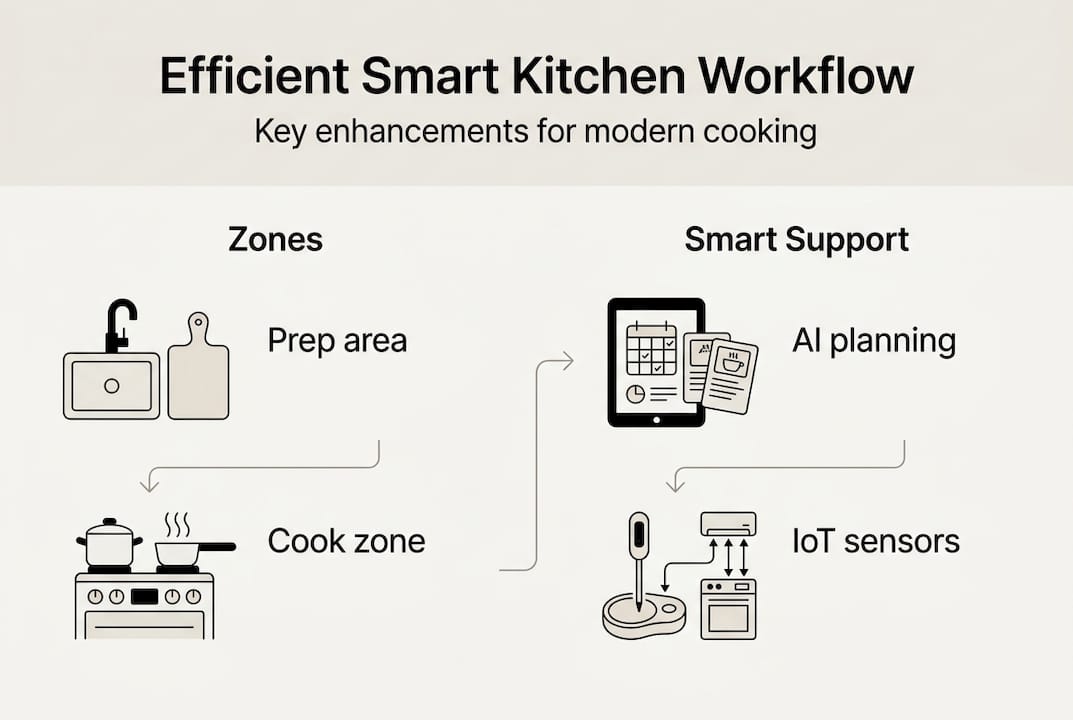
Zoning reduces steps and improves efficiency by organizing your kitchen into dedicated prep, cook, clean, and eat areas. This foundational principle minimizes the physical distance you travel while cooking and ensures every tool and ingredient has a logical home. When your kitchen flows naturally from one task to the next, you spend less time searching and more time actually cooking.
Effective zoning creates four distinct areas. Your prep zone should include cutting boards, knives, mixing bowls, and easy access to your refrigerator and pantry staples. The cooking zone centers around your stove and oven, with pots, pans, cooking utensils, and spices within arm’s reach. Your cleaning zone encompasses the sink, dishwasher, dish soap, and drying racks. Finally, the eating zone includes plates, glasses, and silverware near your dining area.
Smart appliances integrate seamlessly into this zoned approach. Place your smart kitchen devices where they support specific tasks: a smart scale in your prep zone, connected cooktops in your cooking zone, and automated faucets in your cleaning zone. This strategic placement amplifies the efficiency gains from zoning alone.
Consider these practical setup tips for reorganizing your kitchen zones:
- Move frequently used items to the zone where you use them most, even if it feels unconventional at first
- Store backup supplies separately from daily-use items to reduce clutter in active zones
- Use drawer dividers and shelf organizers to create sub-zones within each main area
- Position your most-used appliances on the counter in their respective zones rather than storing them away
- Create landing zones near each area for items in transit between zones
Pro Tip: Start by tracking your movement during one typical meal preparation. Note every time you cross from one side of the kitchen to the other. These crossings reveal opportunities to relocate items and reduce wasted steps.
The beauty of zoning lies in its compatibility with kitchens of any size. Even a small apartment kitchen benefits from mentally dividing the space into functional areas. You might overlap zones out of necessity, but the principle of keeping related items together still applies and delivers measurable time savings.
Leverage AI and smart appliances for recipe planning and automation
AI reduces meal planning time by 42% and substitution errors by 78% through structured recipe parsing and personalized recommendations. These systems analyze your dietary preferences, available ingredients, and schedule constraints to generate practical meal plans that actually fit your life. Instead of spending 30 minutes browsing recipes and making grocery lists, AI handles the cognitive load in seconds.

AI recipe parsing breaks down cooking instructions into structured, sequential steps with precise timing and temperature data. This transformation makes recipes easier to follow and enables smart appliances to automate portions of the cooking process. The system identifies ingredient relationships, suggests substitutions based on what you have available, and scales recipes automatically for different serving sizes.
Smart ovens and cooking appliances take automation further with pre-programmed cooking modes and remote control capabilities. Smart ovens deliver oven-quality results faster through AI-controlled temperature and timing adjustments that adapt to what you’re cooking. These devices monitor internal food temperature, adjust heat distribution, and even send notifications when your meal is ready.
Follow these steps to integrate AI assistants into your current workflow:
- Start with a meal planning app that connects to your existing recipe sources and learns your preferences over time
- Link your smart appliances to the same ecosystem so recipe data flows directly to your oven or cooktop
- Use voice assistants to set timers, convert measurements, and access recipe steps hands-free while cooking
- Enable grocery list integration so your meal plan automatically generates a shopping list organized by store layout
- Review and adjust AI suggestions initially, then gradually trust the system as it learns your tastes and constraints
Pro Tip: Begin with AI assistance for just one meal category, like weeknight dinners, rather than trying to automate your entire cooking life at once. This focused approach lets you build confidence and refine the system without feeling overwhelmed.
The combination of smart kitchen gadgets and AI planning creates a multiplier effect. Your smart scale measures ingredients precisely while the AI ensures you’re making the right dish for tonight’s schedule. Your connected oven preheats automatically when the AI knows you’ll start cooking in 15 minutes. These small automations compound into significant time savings and reduced mental effort.
“AI doesn’t replace the joy of cooking. It eliminates the friction that makes cooking feel like a chore, so you can focus on the creative and satisfying parts of preparing a meal.”
Incorporate IoT safety sensors and robotic aids cautiously
IoT sensors improve gas and fire detection accuracy while robotics show promise but carry significant costs and practical limitations for home use. Safety sensors represent the most immediately valuable IoT addition to your kitchen, providing early warnings that prevent accidents and property damage. These devices monitor continuously and alert you to problems you might miss while multitasking.
Common IoT sensors include gas leak detectors that identify natural gas or propane before concentrations become dangerous, smoke and fire detectors with improved sensitivity and fewer false alarms, and water leak sensors that catch plumbing failures early. Multi-sensor fusion systems combine data from multiple sensors to distinguish between normal cooking smoke and actual fire, reducing nuisance alarms while maintaining safety.
Robotic arms and automated cooking assistants represent the cutting edge of kitchen technology, but their practical value for home cooks remains limited. These systems use force control and computer vision to perform tasks like stirring, flipping, and plating. However, they struggle with the unstructured environment of a home kitchen where ingredient sizes vary, counter space changes, and unexpected situations arise frequently.
Consider these pros and cons before investing in kitchen robotics:
- Pros: Handles repetitive tasks, maintains consistent technique, frees you for other prep work, impressive for entertaining guests
- Cons: High upfront cost ($1,000-$10,000+), requires dedicated counter space, limited recipe compatibility, complex setup and maintenance, slower than skilled human cooks for most tasks
| Feature | IoT Safety Sensors | Robotic Kitchen Aids |
|---|---|---|
| Cost | $30-$200 per sensor | $1,000-$10,000+ |
| Installation | Simple, often wireless | Complex, requires space and power |
| Practical value | High - immediate safety benefits | Low - limited current capability |
| Maintenance | Minimal - battery replacement | Moderate - cleaning, calibration |
| Recommended timing | Implement now | Wait for technology maturation |
Pro Tip: Prioritize smart gadgets for safety like gas and water leak detectors before considering robotic assistants. The safety sensors deliver immediate, measurable value at a fraction of the cost.
The future of kitchen robotics looks promising as costs decrease and capabilities improve, but today’s home cook gains more value from smart appliances and sensors. Focus your budget on technology that solves real problems you face daily rather than futuristic solutions still seeking practical applications. The smart home workflow guide offers additional perspective on prioritizing home automation investments.
Apply batching and asynchronous cooking methods with smart support
Batch cooking with warehouse principles cuts cooking time while asynchronous planning optimizes multitasking by treating your kitchen like an efficient production facility. Batching means preparing multiple meals or large quantities of components at once, then storing them for quick assembly throughout the week. Asynchronous cooking involves starting tasks that run independently, like slow cooker meals or marinating proteins, while you focus on other activities.
Warehouse principles applied to home cooking include mise en place at scale, where you prep all vegetables for the week in one session, and assembly line techniques for repetitive tasks like forming meatballs or portioning snacks. These methods reduce the cognitive switching cost of moving between different types of tasks and minimize the time spent on setup and cleanup.
Follow these steps to implement batching with smart devices:
- Plan your week’s meals on Sunday using an AI meal planner to identify common ingredients and compatible recipes
- Batch prep all vegetables, proteins, and grains in dedicated sessions using smart scales for precise portioning
- Use smart storage containers with freshness sensors to track what you’ve prepared and when it needs to be used
- Program your smart oven or slow cooker to start cooking while you’re away, timing meals to finish when you arrive home
- Label and organize batched components in your refrigerator by day or meal type for easy assembly
| Cooking Approach | Weekly Time Investment | Daily Effort | Meal Variety |
|---|---|---|---|
| Traditional daily cooking | 7-10 hours | 60-90 min/day | High |
| Batch cooking without smart tools | 4-6 hours | 15-20 min/day | Medium |
| Batch cooking with smart support | 3-4 hours | 10-15 min/day | Medium-High |
Smart kitchen tools amplify batching efficiency by automating the monitoring tasks that typically require your attention. Your smart oven maintains precise temperature for batch roasting vegetables while you prepare proteins. Connected slow cookers let you start dinner remotely when your schedule changes. Smart timers track multiple simultaneous processes without mental overhead.
Asynchronous cooking works particularly well with smart appliances because you can initiate and monitor tasks remotely. Start your rice cooker from your phone 30 minutes before leaving work. Check the internal temperature of your slow cooker roast without opening the lid and releasing heat. These capabilities transform passive cooking time into productive time for other activities.
The smart home workflow guide explores how kitchen automation integrates with broader home systems. Your smart assistant can coordinate cooking times with your commute, suggest batch cooking sessions based on your calendar availability, and even reorder ingredients when supplies run low. This ecosystem approach maximizes the value of each individual smart device.
Enhance your smart kitchen workflow with Asknik essentials
Transforming your kitchen workflow from chaotic to streamlined becomes easier with the right tools supporting your efforts. Asknik curates kitchen and cooking essentials that fit seamlessly into zoned layouts, complement AI meal planning, and enhance safety without overwhelming complexity. Whether you’re implementing your first zone reorganization or adding smart sensors to an existing setup, practical tools make the difference between good intentions and lasting improvements.

Start small with versatile essentials like the folding measuring spoon tool that saves drawer space in your prep zone while delivering precise measurements for recipe success. Build your smart kitchen incrementally, adding solutions as you identify specific workflow bottlenecks. Asknik offers the innovative gadgets and practical tools that support efficient cooking without requiring a complete kitchen overhaul.
What is the first step to optimize a smart kitchen workflow?
What is the first step to optimize a smart kitchen workflow?
Start by zoning your kitchen into dedicated areas for prep, cooking, and cleaning to reduce unnecessary steps. This foundational organization costs nothing but delivers immediate efficiency gains by minimizing the distance you travel while cooking. Zoning works in any kitchen size and creates the structure needed for smart appliances to amplify your workflow improvements. Visit the smart kitchen guide for detailed zoning strategies.
Can AI meal planners completely replace human cooking decisions?
AI reduces planning time and errors but works best as a tool supporting your creativity rather than replacing it entirely. These systems excel at handling repetitive decisions, suggesting recipes based on available ingredients, and scaling portions accurately. However, they lack the intuition to adjust seasoning by taste, accommodate last-minute ingredient substitutions based on quality, or understand your family’s evolving preferences. Use AI to eliminate friction in meal planning while keeping the creative and adaptive aspects of cooking under your control.
Are kitchen robotics practical for home cooks today?
Robotic kitchen aids are promising but currently expensive and limited in unstructured home environments. Most home cooks gain more value from prioritizing IoT safety sensors and AI meal planning tools that solve immediate problems at accessible price points. Robotics require dedicated counter space, complex setup, and frequent maintenance while offering capabilities that skilled home cooks already perform faster manually. Wait for the technology to mature and costs to decrease before investing in robotic assistants.
How does batching save time compared to cooking individual meals?
Batching consolidates repetitive tasks like chopping vegetables or cooking grains into single focused sessions, eliminating the setup and cleanup time required for each individual meal. When you prepare ingredients for five meals at once, you wash cutting boards once instead of five times and organize your workspace once instead of repeatedly. Smart storage containers and programmable appliances extend these savings by preserving batched components safely and automating the final cooking steps throughout the week.
What smart kitchen investment delivers the best value for beginners?
IoT safety sensors like gas leak detectors and smart smoke alarms deliver immediate, measurable value at low cost while requiring minimal setup or learning curve. These devices protect your home and family 24/7 regardless of your cooking skill level or how often you use other smart features. After establishing safety monitoring, add AI meal planning tools and smart scales to reduce planning friction and improve cooking precision before considering expensive appliances or robotic systems.