
Many people confuse multifunctional gadgets with ordinary single-use devices, missing the core innovation that makes them valuable. A multifunctional gadget integrates multiple tools into one compact device, combining convenience with smart technology to streamline daily tasks. Instead of carrying separate items for different jobs, you get one versatile solution that saves space, time, and effort. This article clarifies what multifunctional gadgets truly are, how they work through innovative design, and practical examples that show their real-world benefits. You’ll learn to recognize genuine multifunctional value and avoid common misconceptions that lead to poor purchasing decisions.
Table of Contents
- Key takeaways
- Understanding what a multifunctional gadget is
- Popular multifunctional gadgets examples and features
- How multifunctional gadgets work: design and technology
- Practical limitations and expert considerations
- Discover top multifunctional gadgets for your home and kitchen
- What is a multifunctional gadget?
Key Takeaways
| Point | Details |
|---|---|
| Definition and benefits | A multifunctional gadget combines three or more tools into one compact device to save space, time, and effort while improving daily convenience. |
| Multiple tools in one | These devices integrate several distinct tasks such as cutting, illumination, measurement, or power delivery into a single form factor. |
| Smart design and tech | Sensors adjust power and modes while app connectivity lets users customize settings and monitor usage. |
| Assess daily tasks | Identify the tools you use most and target gadgets that combine those functions rather than buying devices for features you rarely use. |
| Popular real world examples | Examples like Jetbeam E28 flashlight and Leatherman multitools show how combining functions delivers practical value for specific needs. |
Understanding what a multifunctional gadget is
A multifunctional gadget replaces multiple single-purpose items to enhance convenience, portability, and efficiency in your daily routine. Think of it as consolidating your toolbox into one smart device that adapts to different tasks without requiring separate equipment. The core appeal lies in reducing clutter while maintaining functionality across various scenarios.
These gadgets typically combine three or more distinct functions within a single form factor. A multifunctional flashlight might include standard illumination, emergency strobe modes, UV light for detection, and a built-in power bank to charge your phone. Kitchen gadgets merge slicing, grating, julienne cutting, and measuring into one compact tool. The integration happens through clever mechanical design and electronic controls that switch between modes seamlessly.
The convenience advantage becomes obvious when you consider daily scenarios. Instead of hunting through drawers for different tools, you grab one device that handles multiple jobs. This saves physical space in your home, reduces the mental load of organizing numerous items, and cuts down the time spent switching between tools. For people living in small apartments or traveling frequently, consolidating functions into fewer devices makes practical sense.
Efficiency gains extend beyond just space savings. Modern multifunctional gadgets incorporate smart technology that optimizes performance for each mode. Sensors detect which function you’re using and adjust power output accordingly. App connectivity lets you customize settings and monitor usage patterns. This intelligent adaptation means you’re not just getting multiple tools in one package, but tools that work together more effectively than separate items would.
Pro Tip: Assess your daily tasks to identify which multifunctional gadget suits you best. List the tools you use most frequently and look for devices that combine those specific functions rather than buying gadgets with features you’ll never use.
Understanding why choose gadgets for daily benefit helps you recognize when multifunctionality adds genuine value versus marketing hype. The best multifunctional gadgets solve real problems by combining tasks you already perform regularly. They don’t force you to adopt new behaviors, they simply make existing routines more efficient. Exploring the benefits of smart gadgets reveals how technology integration elevates simple tools into intelligent assistants that adapt to your needs.
Popular multifunctional gadgets examples and features
Real-world examples include Jetbeam E28 flashlight, RASPINI multifunctional slicer, Jackery Explorer 1000 V2 power station, and Leatherman multitools. Each demonstrates how combining functions creates practical value for specific user needs.
The Jetbeam E28 flashlight exemplifies modern multifunctional design by packing nine distinct light modes into a pocket-sized device. It includes white LED for standard illumination, red light for night vision preservation, UV light for detecting stains or verifying currency, and multiple brightness levels for each mode. A rotary dial lets you switch between functions instantly without cycling through unwanted options. The integrated power bank function means you can charge your phone during power outages, transforming a simple flashlight into an emergency preparedness tool.

Kitchen multifunctional gadgets like the RASPINI slicer consolidate multiple cutting tasks into one ergonomic tool. Interchangeable blades handle slicing vegetables into uniform thickness, grating cheese or chocolate, and creating julienne strips for salads. The design includes a safety guard that protects your fingers while maximizing the usable portion of each vegetable. Storage compartments built into the device keep all blades organized, eliminating the drawer clutter that comes with separate tools.
Portable power stations represent the high-capacity end of multifunctional gadgets. The Jackery Explorer 1000 V2 provides 1500W output with 4000 charge cycles, enough to run laptops, mini fridges, and power tools during camping trips or emergency situations. Multiple output ports (AC outlets, USB-C, USB-A, car socket) let you charge different devices simultaneously. Solar panel compatibility adds renewable charging options for off-grid scenarios. The built-in LED flashlight and emergency power modes make it function as both a power source and safety device.
Leatherman multitools have set the standard for combining hand tools in a pocket-sized package. A typical model includes pliers, wire cutters, multiple knife blades, screwdrivers (both flathead and Phillips), bottle opener, can opener, file, and saw. The folding design keeps sharp edges safely tucked away while maintaining quick access to each tool. For outdoor enthusiasts and DIY practitioners, this eliminates carrying a full toolbox for basic repairs and adjustments.
| Gadget Type | Key Functions | Standout Feature |
|---|---|---|
| Flashlight (Jetbeam E28) | White/red/UV light, power bank, 9 modes | Rotary dial for instant mode switching |
| Kitchen Tool (RASPINI) | Slice, grate, julienne, measure | Interchangeable blades with safety guard |
| Power Station (Jackery) | AC/DC/USB charging, solar compatible | 4000 cycles, 1500W output |
| Multitool (Leatherman) | Pliers, blades, screwdrivers, saw | 15+ tools in pocket-sized design |
Pro Tip: Match gadget functionality to your lifestyle needs to maximize usefulness. A power station makes sense for camping enthusiasts but wastes money for urban dwellers who rarely lose electricity. Choose gadgets that combine tasks you already perform weekly, not aspirational activities you might try someday.
Selecting smart gadgets easily requires evaluating which combinations genuinely simplify your routine versus adding complexity. The best multitool review criteria emphasize build quality and practical tool selection over sheer quantity of features, a principle that applies across all multifunctional gadget categories.
How multifunctional gadgets work: design and technology
Modular designs, rotary dials, LiFePO4 batteries, and hydrogel composites enable multifunctionality and durability that previous generations of tools couldn’t achieve. The technology stack combines mechanical innovation with electronic intelligence to create devices that adapt seamlessly between different modes.
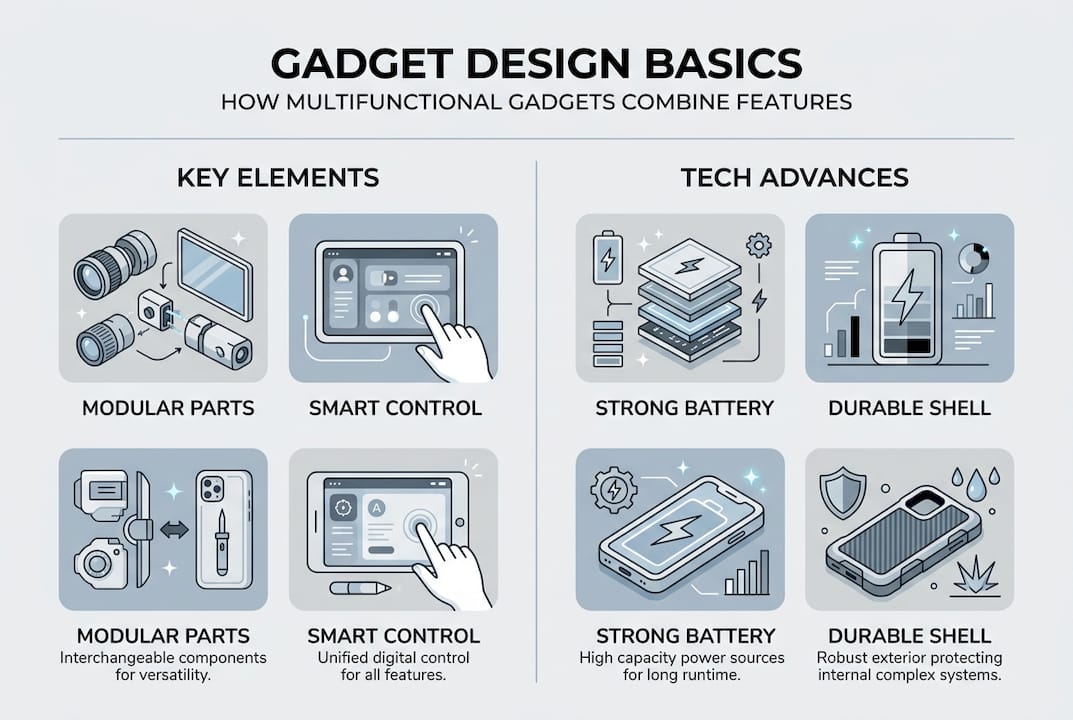
Modular components form the foundation of multifunctional design. Instead of permanently fixing each element, engineers create interchangeable parts that snap together in different configurations. A kitchen gadget uses blade cartridges that slide into the same housing, letting you switch from slicing to grating in seconds. Flashlights employ LED modules that can be swapped or repositioned to change beam patterns. This modularity also simplifies repairs, since you can replace a single worn component rather than discarding the entire device.
Battery technology has evolved dramatically to support multifunctionality. Modern LiFePO4 (lithium iron phosphate) batteries deliver higher energy density, longer cycle life, and better thermal stability than older battery chemistries. These improvements mean a compact power bank can charge your phone multiple times while also powering the gadget’s primary functions. Smart battery management systems monitor charge levels, temperature, and discharge rates to optimize performance and prevent damage from overuse.
Smart technology features elevate basic multifunctional gadgets into intelligent assistants. App controls let you customize settings, create usage schedules, and monitor performance metrics from your smartphone. Some devices incorporate AI algorithms that learn your preferences and automatically adjust to your typical usage patterns. Motion sensors detect when you pick up the device and activate the most recently used mode. Voice control integration means you can switch functions hands-free while cooking or working on projects.
Material science innovations enable flexibility and durability that seemed impossible a decade ago. Hydrogel composites offer stretchability greater than 400% for flexible wearables, allowing devices to conform to curved surfaces and withstand repeated bending without breaking. Advanced polymers resist impacts, chemicals, and temperature extremes while remaining lightweight. Corrosion-resistant coatings protect electronic components in harsh environments, extending the functional lifespan of outdoor and kitchen gadgets.
| Technology Component | Function | Performance Metric |
|---|---|---|
| LiFePO4 Battery | Power storage and delivery | 4000 charge cycles, 1500W output |
| Modular LED System | Switchable light modes | 9 modes, instant rotary switching |
| Hydrogel Composite | Flexible wearable substrate | >400% stretchability |
| Smart Sensors | Automatic mode detection | <0.5 second response time |
| App Connectivity | Remote control and monitoring | Bluetooth 5.0, 30-meter range |
The integration of these technologies creates synergistic effects where the whole exceeds the sum of its parts. A multifunctional gadget isn’t just several tools sharing a housing, it’s an intelligent system that optimizes each function based on context. Sensors detect ambient conditions and adjust output accordingly. Battery management ensures power-hungry functions don’t drain reserves needed for basic operations. User interfaces adapt to show only relevant controls for the active mode, reducing confusion.
Understanding professional gadget tips reveals how experts leverage these technological capabilities to maximize efficiency. The key lies in recognizing which features genuinely enhance your workflow versus gimmicks that add complexity without proportional benefit.
Practical limitations and expert considerations
Overloading power stations risks failure; multitasking can reduce quality beyond certain thresholds, showing a U-shaped performance curve where moderate multifunctionality enhances value but excessive feature-cramming degrades the user experience. Understanding these limits helps you set realistic expectations and choose gadgets that balance versatility with reliability.
Load capacity limits affect power-focused gadgets most severely. A portable power station rated for 1500W continuous output will shut down or suffer damage if you connect devices that collectively draw 1600W. The safety margins built into quality gadgets provide some buffer, but consistently pushing limits accelerates wear and reduces the total number of charge cycles you’ll achieve. Heat buildup during high-load operation can trigger thermal protection circuits that force the device into cooling mode, interrupting your work.
Task overload effects emerge when gadgets try to do too many things simultaneously. A multifunctional kitchen tool that attempts to slice, dice, spiralize, and blend in one session may jam or produce inconsistent results as food particles migrate between mechanisms. The mechanical complexity required to support numerous functions introduces more potential failure points. Each additional feature adds weight, bulk, and cost, eventually reaching a point where the gadget becomes less convenient than the separate tools it replaces.
Single-task devices can outperform multifunctional alternatives in specialized scenarios. A dedicated chef’s knife will always cut more precisely than the blade attachment on a multitool. Professional photographers choose purpose-built cameras over smartphone camera arrays despite phones offering more total features. The tradeoff involves depth versus breadth: multifunctional gadgets provide adequate performance across many tasks, while specialized tools excel at one thing.
Expert advice emphasizes avoiding mode switching beyond practical thresholds. If you find yourself constantly cycling through eight different functions to complete routine tasks, the gadget’s complexity may be hindering rather than helping. The sweet spot for most users involves three to five core functions that you’ll use regularly, with additional features serving as occasional bonuses rather than primary selling points.
“The best multifunctional gadget isn’t the one with the most features, it’s the one that combines the specific functions you use daily into a form factor that’s genuinely more convenient than carrying separate tools. More isn’t always better when it comes to multifunctionality.”
Practical considerations extend to maintenance and repair complexity. A gadget with twelve functions has twelve potential points of failure. If one component breaks, you may lose access to multiple features or find the entire device unusable. Replacement parts for multifunctional gadgets can be harder to source than for single-purpose tools with standardized components. Warranty coverage may not extend equally to all functions, leaving you partially covered for some failures.
Battery degradation affects multifunctional gadgets disproportionately since many functions depend on the same power source. As battery capacity declines over time, you’ll notice reduced runtime for all features simultaneously. The high-drain functions (like power tool operation or high-brightness lighting) will become unusable before low-power features (like basic illumination or measurement) reach their limits. Planning for battery replacement costs and availability should factor into your purchase decision.
User interface complexity grows with feature count. A device with twenty functions needs a control system that lets you access each one without excessive button presses or menu navigation. Poor interface design can make a feature-rich gadget frustrating to use, negating the convenience benefits. Touch screens, rotary dials, and app controls each offer different tradeoffs between simplicity and flexibility.
Exploring gadget usability at home provides context for evaluating whether a multifunctional device will genuinely improve your daily routine or just add another complicated item to manage. The goal is finding tools that reduce friction in your life, not create new learning curves that offset their benefits.
Discover top multifunctional gadgets for your home and kitchen
After understanding what makes multifunctional gadgets valuable and their practical limits, you’re ready to explore options that enhance your daily routine. Our curated collection focuses on devices that combine genuine utility with smart design, eliminating the guesswork from finding tools that actually deliver on their multifunctional promises.

The kitchen and cooking essentials category showcases gadgets that consolidate meal preparation tasks into streamlined workflows. You’ll find tools that handle multiple cutting techniques, measurement conversions, and food processing functions without cluttering your countertops. Each product has been selected for durability and ease of use, ensuring the multifunctionality enhances rather than complicates your cooking experience.
For a specific example of thoughtful multifunctional design, the 3 in 1 folding measuring spoon combines three common measurement sizes into one compact tool that stores flat in your drawer. It demonstrates how effective multifunctionality solves real problems (drawer clutter, searching for the right size spoon) without adding unnecessary complexity. Browse the full collection to discover similar innovations that make daily tasks more efficient through smart consolidation.
What is a multifunctional gadget?
What exactly defines a multifunctional gadget?
A multifunctional gadget combines three or more distinct functions within a single device, using shared components and intelligent design to eliminate the need for separate tools. It must genuinely enhance convenience by consolidating tasks you perform regularly, not just add features for marketing purposes.
How do multifunctional gadgets differ from regular tools?
Regular tools excel at one specific task with maximum performance, while multifunctional gadgets provide adequate performance across multiple related tasks in a more portable package. The tradeoff involves sacrificing some specialized capability for the convenience of carrying fewer items and reducing storage requirements.
What are the most practical daily uses for multifunctional gadgets?
Kitchen prep work (slicing, grating, measuring), emergency preparedness (flashlight, power bank, radio), outdoor activities (multitool for repairs), and portable power (charging multiple devices, running small appliances) represent the scenarios where multifunctional gadgets deliver the strongest practical benefits by consolidating frequently used functions.
How do I choose the right multifunctional gadget for my needs?
List the tools you use at least weekly, then find gadgets that combine those specific functions rather than devices with impressive feature counts you’ll rarely use. Prioritize build quality and user interface simplicity over total feature quantity, and verify that the primary functions you need perform at acceptable quality levels.
Do multifunctional gadgets compromise performance compared to specialized tools?
Yes, in specialized scenarios a dedicated tool will outperform a multifunctional alternative. However, for routine tasks where good-enough performance suffices, the convenience and space savings of consolidation outweigh the marginal performance loss. The key is matching the gadget’s capabilities to your actual requirements rather than aspirational professional standards you don’t need.