


5 Alternatives to Bulky Suitcases for International Travel

Table of Contents
- Why a Travel Backpack Beats a Suitcase for International Travel
- The Best Travel Backpack for International Travel: Key Features to Look For
- Option 1: The Vacuum Compression Backpack That Replaces a 24-Inch Suitcase
- Option 2: A 60L Travel Backpack for Longer Trips and Family Travel
- Option 3: The Duffel Bag for City Breaks and Weekend Trips
- Option 4: The Rolling Backpack for Cobblestone Streets and Airport Transfers
- Carry-On Backpack Size Restrictions: What to Check Before You Fly
- Conclusion
- Frequently Asked Questions
Last Updated: October 20, 2026
Why a Travel Backpack Beats a Suitcase for International Travel
This guide to 5 alternatives to bulky suitcases for international travel starts with why a travel backpack beats a suitcase: it moves with you instead of behind you, with no dragging wheels over cobblestone streets, no checking a bag at the gate, and no waiting at the carousel. When you're changing trains in a foreign city or hauling gear up a stairwell with no lift, that difference stops being a preference and becomes the whole trip.
This guide from Asknik covers five alternatives to bulky suitcases for international travel, and it's built around one idea: the best luggage is the kind you forget you're carrying. Below, we'll show you exactly how each option handles airline limits, transit, and realistic trip length, so you can pick the one that fits how you actually move.
Here's what most guides get wrong. They rank bags by capacity and call it a day. Capacity means nothing if the bag won't fit in an overhead bin or turns into a burden on a 20-minute walk to your hotel.
The Best Travel Backpack for International Travel: Key Features to Look For
The best travel backpack for international travel balances four things: legal cabin size, real carrying comfort, smart organization, and weight. Get those right and the bag disappears into your trip.
Start with how it opens. A clamshell or 180° opening lets you see and organize everything at once, like a suitcase, instead of digging through a top-loading sack. Then check these:
- Cabin-legal dimensions. Aim for a bag that fits within common carry-on limits, usually around 55 × 40 × 20 cm.
- Weight when empty. Lighter is better when airlines weigh carry-ons at the gate.
- Carrying system. Curved, padded shoulder straps and a sternum strap make a loaded bag bearable.
- Organization. A separate laptop sleeve, a wet/dry compartment, and a shoe or umbrella pocket save you from chaos.
- Security. A combination lock on the zipper and a water-resistant fabric protect your gear in transit.
A common mistake is buying the biggest pack that technically fits the sizer, then overfilling it until it no longer does. Leave a little margin.
Option 1: The Vacuum Compression Backpack That Replaces a 24-Inch Suitcase
The standout alternative is a vacuum compression backpack that packs like a 24-inch suitcase but travels as a carry-on. Our pick here is the Σακίδιο Ταξιδιού με Συμπίεση Κενού - Χειραποσκευή έως 60L, and it earns the top spot because it solves the exact problem bulky suitcases create: too much air, not enough usable space.

Here's how it works. Clothes go into a dedicated vacuum sleeve, you pull the air out with the included hand pump, and the pack compresses down to hold what a 24-inch suitcase would. That's enough for 5-7 days of travel in a bag that stays carry-on legal.
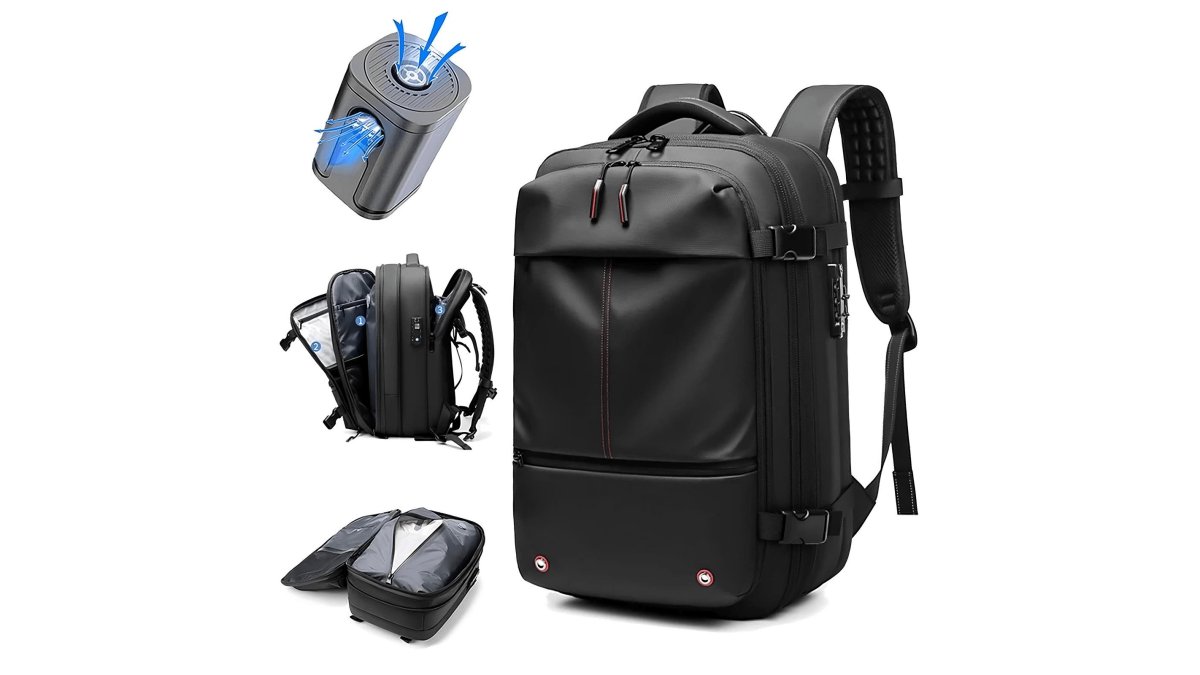
The specs matter here. It measures 49 × 32 × 15 cm, expanding to 20 cm with the extension zipper, so it fits the carry-on limit most airlines use. It weighs about 1.55 kg and comes in black, grey, khaki, and blue. You get a 180° clamshell opening, a separate laptop sleeve up to 16 inches, a combination lock, a wet/dry divider, and an umbrella pocket. The Oxford fabric resists water.
Pros: Genuine space savings from compression, opens like a suitcase, laptop-friendly, hands-free on transit. Cons: The hand pump takes a few minutes of effort, and it won't fit under the seat as a free personal item.
Option 2: A 60L Travel Backpack for Longer Trips and Family Travel
A 60L travel backpack is the answer when a week isn't enough or you're packing for more than yourself. This is the same vacuum backpack pushed to its full compressed capacity, where it holds roughly what a 24-inch checked bag would, but stays on your back. For longer trips and family travel, that capacity is the point: one adult can carry the shared essentials while the kids carry their own small bags.
What most guides miss is that a 60L pack only works if you can actually carry it. A full 60L load is heavy, so use the ergonomic curved straps and the sternum strap, and pack it on your back rather than dragging it. Test it loaded before you commit. If you can't walk ten minutes with it, size down.
Σακίδιο Ταξιδιού με Συμπίεση Κενού – Χειραποσκευή έως 60L →
Option 3: The Duffel Bag for City Breaks and Weekend Trips
A duffel bag wins for city breaks and weekend trips because it's simple, light, and easy to stow. For two or three days, you don't need wheels or a frame. You need a bag that holds a change of clothes, a toiletry kit, and a laptop, then disappears into a train overhead rack or a taxi trunk.
Option 4: The Rolling Backpack for Cobblestone Streets and Airport Transfers
The honest drawback is weight. Wheels and a handle add bulk, so a rolling backpack is heavier empty than a pure backpack. If every gram counts because you're flying low-cost, a lighter carry pack will serve you better. If comfort and versatility matter more, the rolling option earns its place.
Carry-On Backpack Size Restrictions: What to Check Before You Fly
Carry-on backpack size restrictions vary by airline, so check your specific carrier before you fly. Most use a carry-on limit around 55 × 40 × 20 cm, but low-cost airlines often enforce smaller personal-item limits and weigh bags at the gate.
Here's the practical checklist we'd run through before any international trip:
| What to check | Why it matters | Where to confirm |
|---|---|---|
| Carry-on dimensions | A bag over the limit gets gate-checked or charged | Your airline's baggage page |
| Personal-item size | Free under-seat bags are often much smaller | Fare rules for your ticket |
| Weight limit | Some carriers weigh carry-ons at boarding | Airline baggage policy |
| Expansion space | An overstuffed bag may not fit the sizer | Pack it, then measure |
The vacuum backpack at 49 × 32 × 15 cm, expanding to 20 cm, fits within most carry-on limits, but it won't fit the small free personal-item space under the seat. Always confirm the rules for your airline and route, since they change.
Conclusion
The real challenge with 5 alternatives to bulky suitcases for international travel isn't choosing a bag. It's choosing one that fits how you move, through terminals, up stairs, and onto trains, without turning into a burden halfway through the trip.
That's where Asknik comes in. Our vacuum compression backpack gives you suitcase-level packing in a carry-on that stays on your back, with a 180° clamshell opening, a laptop sleeve up to 16 inches, and a combination lock for security. If you want to travel lighter and skip the checked-bag line, start with the vacuum compression backpack and pack for the trip, not the suitcase.
Frequently Asked Questions
What type of luggage is best for international travel?
It depends on your trip. For city breaks, public transit, and cobblestone streets, a travel backpack keeps your hands free and is easier to maneuver than a suitcase. Check your airline's carry-on backpack size restrictions before you buy, since limits vary by carrier and route.
Can you travel internationally with a backpack instead of a suitcase?
Yes. Many travelers use a carry-on backpack for trips of 5-7 days. A vacuum compression backpack, for example, compresses soft clothing to fit roughly what a 24-inch suitcase holds. Confirm the bag's dimensions fit your airline's overhead bin allowance, and pack heavier items like jackets on your body to stay within weight limits.
How do vacuum compression bags help save packing space?
Vacuum compression removes air from soft items like sweaters, hoodies, and underwear. In a vacuum compression backpack, you place clothes in the dedicated sleeve, pump out the air with the included manual pump, and the bag compresses down. This lets you fit more into a carry-on-sized bag, reducing the need for checked baggage and its fees.
Are duffel bags practical for international travel?
Duffel bags work well for weekend trips and city breaks where you carry your bag short distances. They are flexible and easy to store, but they lack wheels and structured support, so they can be tiring on long airport transfers. If you choose a duffel, look for padded straps and a separate compartment for shoes or wet items.