


Star Projector vs Night Light for Kids: Which Is Better?

Last Updated: October 22, 2026
Quick Summary
A night light is the simpler, steadier choice for fear of the dark, while a star projector is the more engaging option for bedtime routines that need a wind-down ritual. Pick a night light for babies and toddlers who wake scared, and a star projector for children roughly three and up who settle well with a visual routine in a dark room.
- A night light keeps a small, steady pool of light in the room without turning bedtime into a light show.
- Our silicone rabbit night light has a 30-minute timer and touch controls a child can use.
- The galaxy projector at €54.99 focuses cleanly from 0.5 to 5 metres and includes 13 discs.
- Set a projector timer for the length of your wind-down routine, often 15 to 30 minutes.
- Never mount a projector directly above a cot or bed; place it across the room instead.
Table of Contents
- Star Projector vs Night Light for Kids: The Quick Comparison
- What the Best Night Light for Kids Needs to Do
- Do Light Projectors Help Babies Sleep?
- Projection Quality, Ceiling Coverage, and Features That Matter
- A Night Light That Stays On All Night: When Constant Light Helps
- Star Projector Safety for Children: What Parents Must Check
- Which One Should You Pick?
- Frequently Asked Questions
Star Projector vs Night Light for Kids: The Quick Comparison
Choosing between a star projector and a night light for kids comes down to one question: does your child need reassurance, or a wind-down ritual? A night light is the simpler, steadier tool for fear of the dark.
| Feature | Star Projector | Night Light |
|---|---|---|
| Main purpose | Bedtime ritual and visual comfort | Constant low-level reassurance |
| Light output | Patterned projection across ceiling and walls | Soft, steady glow in one spot |
| Typical timer | Auto shutoff built in | Varies; some have 30-minute timers |
| Best age range | Roughly 3 years and up | Newborn and up, with supervision |
| Dark room needed | Yes, for a clear image | No |
| Setup effort | Focus the lens, pick a disc | Plug in or charge, switch on |
| Price at Asknik | €54.99 (galaxy projector) | €20.99 to €40.99 |
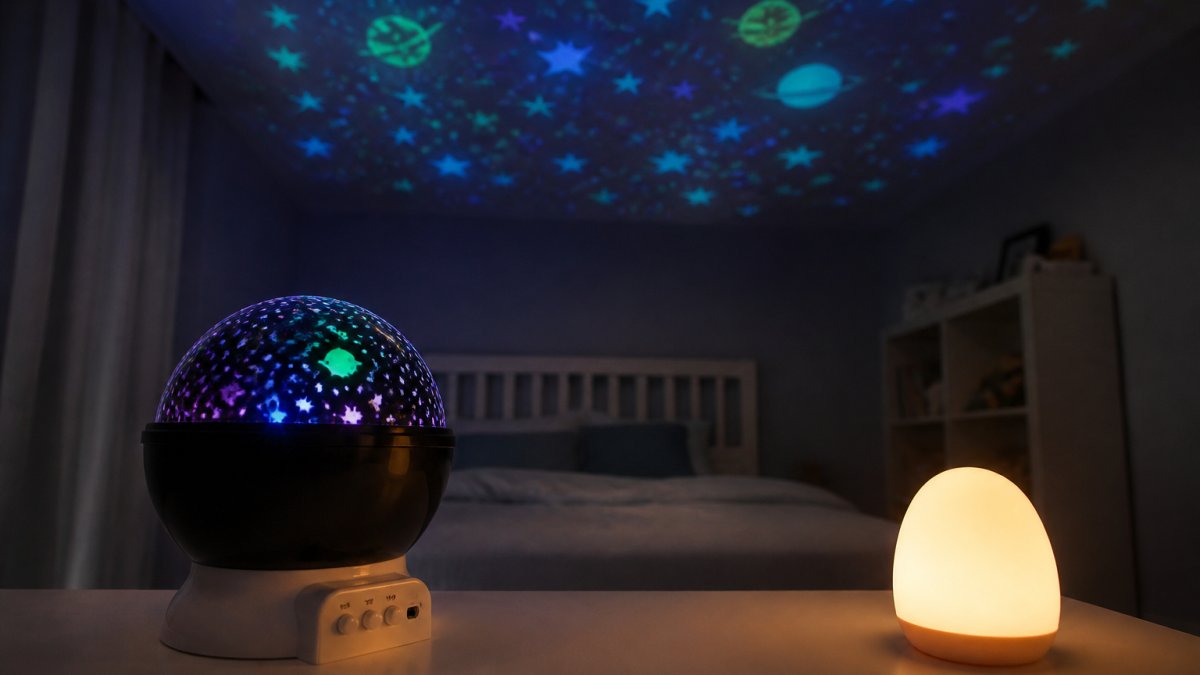
The longer answer depends on your child, your room, and how your evenings run.

What the Best Night Light for Kids Needs to Do
The best night light for kids does one job well: it keeps a small, steady pool of light in the room without turning bedtime into a light show.
Here is what we would check before buying:
- Low brightness, warm tone. A dim glow is enough to take the edge off the dark. A cool white light at full power wakes the brain up.
- A timer or auto-off. Many parents prefer the light to fade after the child settles. Our silicone rabbit night light has a 30-minute timer for exactly this reason.
- Touch controls a child can use. A single tap beats fumbling for a switch at 2am.
- A rechargeable battery. No cable trailing across the floor beside a cot.
A common mistake is buying a night light that is too bright. Parents size up "just in case" and end up with a lamp that lights the whole room. Dim is the point.

Do Light Projectors Help Babies Sleep?
Light projectors can help some babies settle, but they are not a sleep aid in the medical sense, and no projector should be sold to you as one.
Infants under 12 months. At this age, sleep is driven by routine, feeding, and a dark, quiet environment. A simple, dim night light or no light at all is the better default for this age group.
Toddlers (roughly 1 to 3 years). This is where fear of the dark and night waking often appear. A projector can give a toddler a ritual to look forward to, but a steady night light is usually the more reliable tool for reassurance. If your toddler is frightened of the dark, start with a night light; if the struggle is winding down, a projector may help. Supervision still matters, and the device should be on a high shelf or dresser, not within reach of the cot or bed.
Older children (roughly 3 years and up). A child this age can often operate a simple projector or night light themselves, which builds a sense of control at bedtime. This is also when a projector's novelty and themes (space, planets, animals) can carry a routine for months rather than days. Check that the child can reach the controls safely and that removable discs are stored out of reach of younger siblings.
Practical points that apply across ages:
- Use the projector as part of the routine, not as the thing that puts the baby to sleep. The routine is the signal; the projector is the scenery.
- Keep the projection dim and slow. Fast rotation and bright colours work against winding down.
- Pair it with sound if your child responds to it. Our white noise device with a night light combines 28 sounds with a 10-colour light.
- Set a timer so the room goes dark once your child is settled. Constant projection all night is not the goal.
If your child has trouble sleeping and it is affecting feeding, growth or your own health, that is a conversation for your paediatrician, not a product page.
Projection Quality, Ceiling Coverage, and Features That Matter
Projection quality is where cheap star projectors fall apart, and it is the spec most buyers ignore. A blurry galaxy on the ceiling is not calming; it is annoying.
| Criterion | Star Projector | Night Light |
|---|---|---|
| Brightness | Patterned, can be dimmed; needs a dark room for a clear image | Low, steady glow; works in a partially lit room |
| Projection coverage | Ceiling and walls, often 180-degree adjustable | One spot or a soft pool of light |
| Colour options | Multiple colours and modes; can be stimulating if too bright | Usually warm white or a few fixed colours |
| Sound | Some include lullabies, white noise, or nature sounds | Rarely includes sound |
| Timer | Auto shutoff common; essential for bedtime use | Varies; some have 30-minute timers, others stay on |
| Power source | Usually USB; cable routing matters | Rechargeable or plug-in; battery models avoid cables |
| Ease of cleaning | Discs and lenses need dusting; removable discs are a small-parts risk | Wipe-clean surfaces; simpler to maintain |
| Child operation | Older children can pick discs and press buttons | Single tap or switch; easy for toddlers |
Beyond the table, what actually matters in a projector:
- Focus. A manual focus lens lets you sharpen the image for your specific room. Our galaxy projector focuses cleanly from 0.5 to 5 metres, which covers a normal bedroom from a bedside table.
- Coverage. A 180-degree adjustable angle lets you aim at the ceiling, a wall or the floor. Ceiling coverage is what most kids want.
- Darkness. Projectors need a dark room. With the main light on, the projection is faint. Plan for this.
- Disc or slide variety. Our 13-disc planetarium set includes the Solar System, Earth, the Moon, the Milky Way, Andromeda and nebulae, so the novelty lasts longer than a single pattern.
Setup advice applies to both options. Place the device across the room from the bed rather than directly above it, aim the projection at the ceiling, and keep brightness as low as your child will accept.
A Night Light That Stays On All Night: When Constant Light Helps
A night light that stays on all night is the right choice when your child needs reassurance rather than entertainment. Think toddlers who wake and panic in a dark room, or a child who needs to see the door to feel safe.
Προτζέκτορας Γαλαξία & Πλανητάριο με 13 Δίσκους – Φωτιστικό Νυκτός →
Constant light helps in a few specific situations:
- Night waking and disorientation. A familiar glow helps a child reorient without calling for you.
- Hallway and landing trips. A motion-sensor light that switches on as your child walks past is useful for the route to the bathroom. Our wooden PIR night light runs about 15 days on sensor mode per the supplier and needs no wiring.
- Shared rooms. One dim light is easier to manage than a projector that might disturb a sibling.
The tradeoff is real. Sleep researchers generally recommend a dark room for the deepest sleep, and any light exposure at night is a compromise.
Star Projector Safety for Children: What Parents Must Check
Star projector safety for children comes down to three things: heat, cables and small parts. Get these right and the risk drops to near zero.
Heat. LED projectors run cooler than older bulb models, but the housing can still warm up.

Cables. Most projectors run on USB power. Route the cable behind furniture, out of reach of cots and toddler hands.
Small parts. Removable discs are the part to watch.
Placement. Never mount a projector directly above a cot or bed.
Certification. Ask the seller for the CE marking and the relevant test documentation.
Which One Should You Pick?
Pick a night light if your child is a baby or toddler, wakes in the night scared, or needs to see the room to feel safe.
You can also run both: a projector for the wind-down, then a dim night light left on for the rest of the night.
A quick decision checklist:
- Does your child fear the dark or wake disoriented? Choose a night light.
- Does your child need help winding down? Choose a projector.
- Is the room properly dark at bedtime? A projector needs it.
- Is your child under three? Start with a night light and supervision.
Bedtime is one of the few parts of parenting where a small purchase can genuinely change the mood of the whole evening.
Frequently Asked Questions
Do light projectors help babies sleep?
A star projector can help some babies settle by giving them a calm focal point and a gentle glow in a dark room. It works best as part of a consistent bedtime routine, not as a guaranteed fix. Many models include a timer that switches the light off after your child falls asleep, which keeps the room dark for the rest of the night. Every baby responds differently, so try it for a week and watch how your child reacts before deciding.
What is the best night light for kids?
The best night light for kids gives a soft, warm glow, has adjustable brightness, and shuts off on its own. A silicone touch lamp with three brightness levels and a 30-minute timer is a solid choice for younger children who want a friendly shape nearby. For older kids who fear the dark, a projector with rotating stars and a timer can be more reassuring. Match the light to your child's age and what actually helps them settle.
Are star projectors safe for children to use at bedtime?
Star projectors are generally safe when you place them on a stable surface, keep cables out of reach, and choose a model with a timer so it does not run all night. Check that the unit has a CE mark and clear instructions. Avoid leaving a projector on unsupervised near an infant, and keep it away from water. A projector with a manual focus lens and USB power is simple to set up and easy to switch off.
Can a star projector be left on all night?
Most star projectors can run for hours, but leaving one on all night is not ideal for sleep. Constant light in the room can make it harder for children to settle into deep sleep. A timer that switches the projector off after 30 to 60 minutes gives your child the comfort of the stars while they fall asleep, then returns the room to darkness. If your child needs light all night, a dim night light that stays on is the better option.