
Table of Contents
- Why Bedroom Lighting Decides How Well You Sleep
- Color Temperature and Kelvin: The Setting That Matters Most
- Warm vs Cool Light for Sleep: What Your Body Actually Needs
- How to Layer Bedroom Lighting Like a Designer
- Smart Lighting for Bedroom Relaxation: What It Changes
- Lighting for Neurodivergence and Sensory Sensitivity
- Budget-Friendly Lighting Fixes You Can Do This Weekend
- Conclusion
- Frequently Asked Questions
Last Updated: September 16, 2026
Why Bedroom Lighting Decides How Well You Sleep
Most people treat bedroom lighting as a design decision. It's actually a biological one. Your eyes don't just see light; they report it directly to the part of your brain that controls sleep hormones.
Color Temperature and Kelvin: The Setting That Matters Most
Color temperature is measured in kelvin, and it describes whether a light looks warm and amber or cool and blue-white. Lower kelvin numbers mean warmer light; higher numbers mean cooler light. A 2700K bulb glows like candlelight, while a 5000K bulb looks like midday sun.
Why Kelvin Is a Biological Dial, Not Just a Design Choice
Kelvin isn't an aesthetic preference, it's a proxy for how much short-wavelength blue energy a bulb emits. At 2700K, most of the spectral output sits in the amber and red range. At 5000K, a large share of the output lands in the blue band between roughly 460 and 490 nanometers. That band is the one your retina's intrinsically photosensitive retinal ganglion cells (ipRGCs) are tuned to detect.
Reading a Bulb Label in Ten Seconds
You don't need a spectrometer. Every bulb carries a Lighting Facts label, and three numbers tell you almost everything:
- Correlated color temperature (CCT): listed in kelvin. Look for 2700K or 2200K for evening use.
- Lumens: total light output. For a bedside lamp, 400-800 lumens is usually plenty.
- Color rendering index (CRI): how faithfully colors appear. 90+ CRI makes warm light feel richer rather than muddy.
The Dimming Trap
Dimming a cool bulb does not make it warm. Most LEDs dim by reducing current, which lowers intensity but leaves the spectral peak where it was. A 5000K bulb dimmed to 5% still emits proportionally more blue than a 2700K bulb at full brightness. If your goal is deep relaxation, change the bulb, not just the dimmer.
Warm vs Cool Light for Sleep: What Your Body Actually Needs
Warm light supports sleep; cool light delays it. That's the short version, and it's backed by how your body regulates melatonin, the hormone that signals it's time to wind down. Cool light with a high blue content suppresses melatonin production, which pushes your sleepiness later.
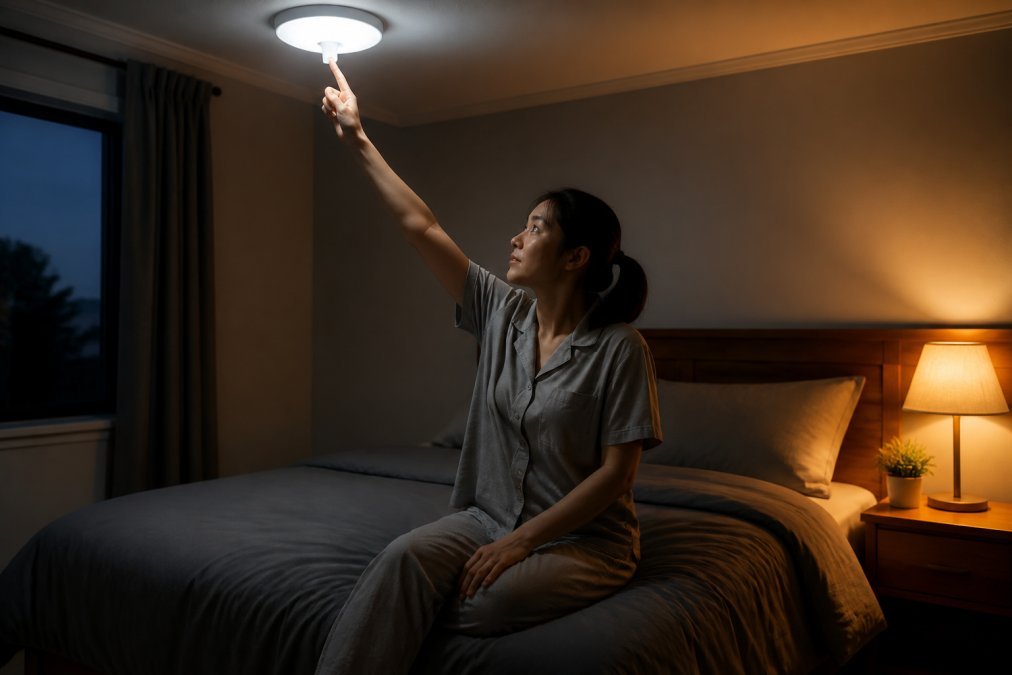
What Blue Light Does After Sunset
Blue light is the short-wavelength part of the visible spectrum, and it's the most disruptive to your body clock. Screens, cool-white LEDs, and even some "daylight" bulbs emit it in abundance.
The Melatonin Mechanism, in Plain Language
Melatonin isn't a sleep switch, it's a timing signal. Your pineal gland releases it in the evening when the suprachiasmatic nucleus stops receiving strong blue-light input from the ipRGCs in your retina. When those cells fire, they send a signal that suppresses melatonin production. The result isn't that you feel alert; it's that your internal clock shifts later, so the sleepiness you'd normally feel at 10:30 p.m. arrives at 11:30 p.m. instead.
Timing Matters More Than Total Exposure
A useful rule most lighting guides skip: the sensitivity of your circadian system peaks in the two to three hours before your natural bedtime. Light at noon barely moves your clock. The same light at 9 p.m. moves it significantly. That means the highest-leverage change isn't buying new bulbs for the whole house, it's controlling the light in the room you're in during the wind-down window.
Pairing Light with a Pre-Sleep Ritual
Lighting works best when it's attached to a habit, not just a setting. Three patterns that fit common routines:
- Reading in bed: a 2700K task lamp at 400-600 lumens aimed at the page, not the room. Turn off the ambient layer entirely.
- Meditation or breathwork: a single amber or candle-style source at under 10% brightness, ideally below eye level so it doesn't shine into your field of view.
- Journaling or planning tomorrow: a warm task light with a shade that blocks the bulb from direct sight. Avoid overhead light, which flattens shadows and raises perceived alertness.
What to Do If You Can't Change the Bulbs
Renters and shared-space sleepers often can't swap fixtures. Three workarounds that preserve the mechanism:
Planetarium Προτζέκτορας Γαλαξίας με →
- Amber glasses: lenses that block the blue band let you keep existing bulbs while reducing ipRGC stimulation. They look odd, but they work.
- Lamp shades and diffusers: a warm-toned shade over a cool bulb filters some short-wavelength output, though less than a true bulb swap.
- Positional control: move the light source behind you or below your line of sight. Even a cool bulb is far less disruptive when it isn't shining into your eyes.
How to Layer Bedroom Lighting Like a Designer
Light layering means using three separate light sources at different heights and intensities instead of one bright ceiling fixture. It's the single technique that separates a room that feels like a hotel suite from one that feels like an office.
Ambient, Task, and Accent: Three Layers, One Calm Room
- Ambient: your base glow, kept dim and warm. A dimmed ceiling fixture or an indirect light source works here.
- Task: focused light for reading or getting ready. A nightstand lamp with a 2700K bulb fits this layer.
- Accent: small pools of warm light for mood. This is where indirect lighting and warm LED strips behind a headboard earn their place.
Smart Lighting for Bedroom Relaxation: What It Changes
Smart bulbs and plugs let you schedule warmth automatically, which removes the daily decision of "did I dim everything?" Scheduling, dimming, and flicker-free bulbs are the three features worth paying for, and everything else is optional. Integrating these lighting controls into your broader smart home decor ensures that your bedroom remains a cohesive sanctuary designed for effortless transition into rest.
Scheduling, Dimming, and Flicker-Free Bulbs
- Scheduling: set your lights to shift to a low, warm setting at a fixed evening time every night.
- Dimming: true dimming to under 10% brightness matters more than maximum output for a bedroom.
- Flicker-free: cheap LEDs can flicker imperceptibly. This causes eye strain and headaches for sensitive people, so look for flicker-free drivers.
If you want a device that pairs lighting with sound and air quality, the 3-in-1 Bluetooth Humidifier with Night Light and White Noise combines a soft night light, a white noise machine, and a humidifier in a single unit for €56.99. For a warmer, firelight-style glow, the LED Flame Aroma Diffuser with Humidifier at €100.99 adds seven lighting colors and a timer.


Lighting for Neurodivergence and Sensory Sensitivity
For people with sensory processing differences, lighting choices can make or break a room's usability. Harsh overhead light, flicker, and cool color temperature are common triggers for discomfort, and standard "bright and cheerful" advice often backfires.
Three adjustments help most:
- Replace any flickering or buzzing fixture first. This is the most common and most fixable complaint.
- Use diffused light instead of bare bulbs. Shades and frosted covers spread the glow and remove glare.
- Keep a single low-warm light source available for evenings, so there's always a gentle option.
Budget-Friendly Lighting Fixes You Can Do This Weekend
You don't need new fixtures to change how your bedroom feels. These are the changes that deliver the biggest shift for the least money and effort.
| Fix | Cost Level | Time Needed | Impact on Relaxation |
|---|---|---|---|
| Swap bulbs to 2700K | Low | 10 minutes | High |
| Add a dimmer plug | Low | 5 minutes | High |
| Move a lamp to a lower surface | Free | 2 minutes | Medium |
| Add warm LED strip behind headboard | Medium | 30 minutes | High |
| Cover a bare bulb with a shade | Low | 5 minutes | Medium |
| Turn off overhead light after dinner | Free | Instant | High |
Conclusion
Getting your bedroom lighting right is less about buying the perfect lamp and more about controlling three things: color temperature, intensity, and timing. Warm light, dimmed low, arriving earlier each evening, is the formula that most reliably supports deep relaxation, and you can start applying it tonight with bulbs you already own.
Frequently Asked Questions
What color light is best for deep relaxation in the bedroom?
Warm white light between 1800K and 2700K works best. That range mimics the amber tones of a sunset, which signals your body to wind down. Cooler light at 4000K and above suppresses melatonin, the hormone that makes you sleepy. For the hour before bed, keep every lamp in the room in that warm range, including the nightstand lamp and any indirect lighting behind furniture.
How does lighting affect sleep quality and relaxation?
Bright or blue-heavy light at night delays melatonin release and pushes your circadian rhythm later, so you fall asleep slower and wake up groggier. Warm, dim, flicker-free light does the opposite: it supports melatonin production and lowers alertness. The practical fix is to dim your bedroom lighting for the last 60 to 90 minutes before sleep and avoid overhead lights that shine directly into your eyes.
Are smart bulbs worth it for bedroom relaxation?
Yes, if you use their scheduling and dimming features rather than just the color-changing novelty. A smart bulb lets you set a warm white scene at 2200K that fades to near-zero over 30 minutes, so the room dims itself while you read. Pair it with a bedside lamp and a warm indirect light source, and you get a repeatable wind-down routine without touching a switch.
How can I make my bedroom lighting more relaxing without changing fixtures?
Swap the bulbs first. Install 2200K to 2700K dimmable LED bulbs in every fixture, add a small nightstand lamp with a fabric shade for diffused light, and place a warm LED strip behind the headboard for indirect lighting. Plug the lamps into a smart plug or dimmer so you can lower everything from bed.