
Table of Contents
- What You'll Need Before You Start Verifying
- Step 1: Read the Label Like a Safety Inspector
- Step 2: Children's Product Certificate (CPC) Requirements Explained
- Step 3: CE Marking for Electronic Toys: What It Really Means
- Step 4: How to Identify Counterfeit Safety Labels
- Step 5: Check the Product Recall Database
- Step 6: Verify Testing Lab Credentials and Documentation
- Common Mistakes to Avoid When Checking Kids Gadget Safety
- Frequently Asked Questions
Last Updated: September 14, 2026
What You'll Need Before You Start Verifying
Learning how to verify safety certifications for kids gadgets takes about ten minutes per product once you know where to look. This guide from Asknik walks through the exact checks parents can run before handing a new device to a child.
You do not need a compliance background, just the product, a phone with a browser, and these reference points:
- The product and its original packaging, including any insert cards
- The label on the device itself, not just the box
- A phone or laptop for checking official databases
- The seller's product page, saved or screenshotted
- A note of the batch or lot number if one is printed
Batch numbers matter more than most parents realize: they let you match a unit against recall notices and are the first thing a manufacturer asks for when you report a problem.
Step 1: Read the Label Like a Safety Inspector
Start with the label on the device itself, not the box. A legitimate children's product label carries the manufacturer's name and address, a model number, age grading, and the relevant certification marks.
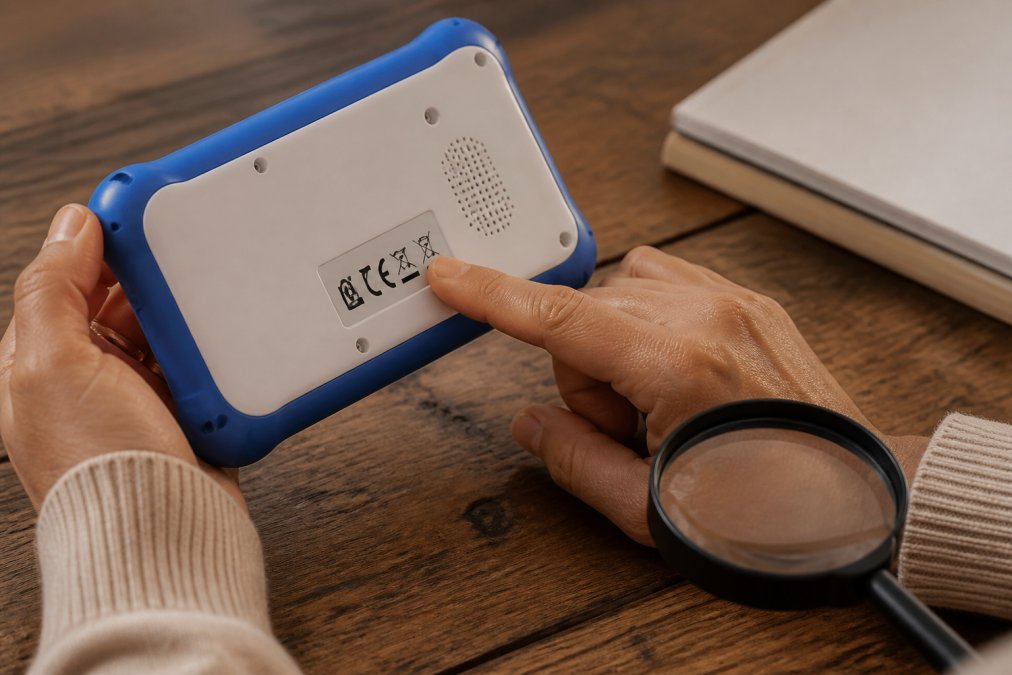
Work through it in this order:
- Manufacturer name and a real, traceable address
- Model or item number
- Age recommendation, stated as a range
- Certification marks for your market
- Warnings in the language of the country you are buying in
A missing address is a red flag. So is a label printed in a single language for a product sold across multiple countries. According to the U.S. Consumer Product Safety Commission's guidance on children's products, children's products must carry permanent tracking information so a unit can be traced back to its production run.
Step 2: Children's Product Certificate (CPC) Requirements Explained
A Children's Product Certificate (CPC) is a document in which the manufacturer or importer certifies that a children's product has been tested against applicable safety rules. It is not issued by a government agency, the manufacturer writes it and is legally responsible for what it says.
That distinction trips up many parents. A CPC is a self-declaration backed by third-party test results, so the test report behind it matters as much as the certificate itself.
What a Valid CPC Must Include
A complete certificate names the product and model, lists each safety rule tested against, identifies the accredited testing laboratory, gives the date and place of manufacture, and names the importer or domestic manufacturer holding it.
If a seller cannot produce a CPC on request, treat that as a no. Ask for it in writing before you buy, not after.
How to Read a CPC Line by Line
A CPC is short, usually one to two pages, and every line maps to a legal requirement. Read it in this order and stop if any line is missing or vague:
- Product identification. The certificate must name the exact product and model number. If it says "children's electronic toy" with no model, it does not cover the unit in your hand.
- Applicable rules. Each rule is listed by its citation, for example, the federal toy safety standard, the lead-in-paint rule, or the small-parts rule. A CPC that lists only one rule for a battery-powered gadget is incomplete.
- Testing laboratory. The lab must be named and must be accredited for the specific standard. A lab name you cannot find in an accreditation database is a stop sign.
- Date and place of manufacture. This is what lets you match the unit to a recall batch later.
- Importer or domestic manufacturer. This is the party legally on the hook. If no U.S. address appears, the certificate is not valid for the U.S. market.
CPC vs. 'Certificate of Compliance'
A generic "certificate of compliance" is not a CPC, it is a marketing document. The tell is the absence of rule citations and a named accredited lab. A one-page PDF with a logo and signature but no rule numbers is a certificate of compliance, not a Children's Product Certificate.
Mobile-First Check: How to Verify a CPC in the Store
Most parents have a phone, not a printer and filing cabinet. Here is the check-as-you-shop workflow:
- Open the seller's product page on your phone and screenshot the listing.
- Message the seller through the marketplace and request the CPC and the underlying test report as PDFs.
- When the PDF arrives, search the text for the word "rule" or "section", a real CPC will have multiple citations.
- Copy the lab name into your phone's browser and search for it alongside the word "accreditation." If the lab does not appear in an accreditation database, stop.
- Save the PDF to a folder named after the product. If a recall is announced later, you already have the paperwork.
This five-step check takes about three minutes per product and works entirely from a phone, the same workflow a compliance officer uses, compressed for a parent in a store aisle.
Step 3: CE Marking for Electronic Toys: What It Really Means
CE marking for electronic toys means the manufacturer has declared the product meets applicable European Union health, safety, and environmental requirements. The letters stand for Conformité Européenne, and the mark is the manufacturer's own declaration of conformity. While this self-certification indicates a baseline of compliance, verifying product quality remains a crucial step for parents who must look beyond regulatory labels to ensure long-term durability and safety.
Two things follow from that. First, the CE mark is not a quality grade and not a government stamp of approval. Second, for toys sold in the EU, the Toy Safety Directive applies, and electronic toys also fall under rules covering electromagnetic compatibility and electrical safety. The European Commission's page on CE marking explains which product groups require the mark and what the manufacturer's declaration must contain.
For Bluetooth and other wireless gadgets, a third layer applies: radio equipment rules. A wireless toy must meet those as well as toy safety rules. A seller advertising "CE certified" as if one certificate covers everything is simplifying to the point of being wrong.
Step 4: How to Identify Counterfeit Safety Labels
Identifying counterfeit safety labels comes down to print quality, placement, and consistency. Fake marks fool a quick glance but fall apart under thirty seconds of scrutiny.
This section goes further: a visual comparison of real versus fake marks, a phone-based verification workflow, and the international mark confusion that trips up parents buying from global marketplaces.
Real vs. Fake: A Visual Identification Guide
Use this side-by-side comparison the next time you are holding a product in a store aisle.
A genuine CE mark:
- The two letters are the same height and the same stroke width.
- The gap between the C and the E is consistent with the spacing of the surrounding text.
- The mark is part of the printed label artwork, not a sticker applied on top.
- The mark appears on the device itself, not only on the outer box.
A counterfeit CE mark:
- The C and E are different heights, or one letter is bolder than the other.
- The gap between the letters is too wide or too narrow compared to the rest of the label.
- The mark is a sticker, often slightly crooked, applied over the original label.
- The mark appears only on the box and nowhere on the device.
A genuine FCC mark (for U.S. wireless gadgets):
- The FCC logo or the FCC ID is printed crisply and the ID is a real, searchable code.
- The ID format follows the standard two-part structure: a grantee code followed by a product code.
A counterfeit FCC mark:
- The FCC ID is missing, blurred, or uses a format that does not match the standard structure.
- The mark is present but the ID cannot be found in the FCC's public equipment database.
The International Mark Trap: CE vs. CPSC vs. ASTM
Parents buying from global marketplaces hit a specific confusion: a product can carry a CE mark and still be non-compliant for the U.S. market, and vice versa.
- CE mark means the manufacturer declares conformity with EU requirements. It says nothing about U.S. rules.
- CPSC is the U.S. regulator. A product sold in the U.S. must meet CPSC-enforced rules, which are separate from EU rules.
- ASTM F963 is the U.S. toy safety standard. A CPC for a U.S. toy will cite it. A CE-marked toy will not.
A product can legitimately carry a CE mark and be legal in the EU while failing U.S. requirements for lead, phthalates, or small parts. If a global marketplace listing shows only a CE mark, treat it as an EU product and check whether the seller provides a CPC for the U.S. market.
Mobile-First Verification: Check a Label in 60 Seconds
Here is the phone-based workflow for verifying a label while you are still in the store:
- Photograph the label on the device, not the box. Zoom in on the certification mark.
- Search the mark. For a CE mark, search the manufacturer's name plus "EU declaration of conformity." For an FCC ID, search the ID in the FCC's public equipment database.
- Search the lab. If the label names a testing lab, search the lab name plus "accreditation." If it does not appear, stop.
- Search the model number in your national recall database before you reach the checkout.
- Screenshot everything and save it to a folder named after the product.
This workflow takes about a minute per product and catches the two most common problems: a mark absent from any official register, and a model number already recalled.
Step 5: Check the Product Recall Database
Recall checks take under two minutes and catch problems labels cannot show you. Search the product name, brand, and model number in your national consumer safety recall database.
In the United States, the CPSC recall database lets you search by product, brand, or hazard. In the EU, the Safety Gate system publishes alerts on dangerous non-food products across member states. Both are free and updated continuously.
Search the model number, not just the brand. A single brand can have one recalled model and twenty safe ones, and a recall notice usually names the specific batch or date range affected.
Step 6: Verify Testing Lab Credentials and Documentation
A test report is only as good as the lab behind it. Ask which laboratory ran the testing and confirm it holds accreditation for the specific standard involved.
Test reports should name the standard, test methods, and sample tested. A one-page "certificate of compliance" with no test data tells you almost nothing; legitimate reports run several pages and include measurements, not just a pass or fail.
For electronics, look for evidence that battery safety and charging behavior were assessed. Lithium batteries in toys are a recurring source of incidents, and a report covering mechanical hazards but skipping the battery is incomplete.
Common Mistakes to Avoid When Checking Kids Gadget Safety
The biggest mistake is treating the box as the source of truth. Packaging is marketing material and the easiest part of a product to fake.
Three more that come up constantly:
- Checking the brand name in a recall database but not the model number
- Assuming a CE mark or a CPC covers every risk, including wireless and battery hazards
- Buying from a marketplace listing with no seller address and no way to request documentation
A common mistake is waiting until after the return window closes to run these checks. Do them the day the package arrives.
For parents who would rather start from products that already carry documented certification, Asknik offers a certified (CE) choking rescue device with a one-button mechanism and three mask sizes, so the safety paperwork is settled before the box reaches your door. The store's free shipping applies to every order.

Frequently Asked Questions
What are the ASTM certification requirements for toys?
ASTM F963 is the mandatory toy safety standard in the US. It covers mechanical hazards, flammability, and toxicology limits like lead content. Manufacturers must test to this standard and issue a Children's Product Certificate. Look for 'ASTM F963' on the label or in the CPC. Without it, the toy has not met the legal safety baseline for sale in the US.
Do all toys need a CE mark?
In the EU and UK, most toys require a CE or UKCA mark under the Toy Safety Directive. Electronic toys also need to meet electromagnetic compatibility and wireless connectivity standards. A CE mark alone does not guarantee safety, but its absence means the product has not passed conformity assessment. Check that the mark is legible and not a sticker placed over another label.
What is a CPC certificate for toys?
A Children's Product Certificate (CPC) is a document issued by the manufacturer or importer, based on third-party testing at an accredited lab. It lists the product, applicable safety rules, and test results. You can request a copy from the seller. If they cannot provide one, the product may not be legally certified for children. Always ask for the CPC before buying expensive electronic toys.
How can I tell if a kids' gadget is safety-tested?
Look for a certification seal from an accredited lab like CPSC-accepted or an EU Notified Body. Check the product recall database for the brand and model. Verify that the label includes a traceable batch number and manufacturer contact. If the packaging lacks these details or the seal looks blurry, treat it as unverified and avoid the purchase.
The hard part of checking kids' gadgets is not the process, it is the patience to run it on every purchase instead of the first one. Asknik curates smart products and safety essentials with exactly that in mind, from certified first-aid devices to everyday home safety tools, all with free shipping on every order. Browse the collection and start with the items your family will actually use.