
Table of Contents
- What a Planetarium Projector Actually Does in a Bedroom
- Benefits of Galaxy Projectors Beyond Pretty Lights
- Best Star Projector for Sleep: What the Specs Tell You
- Optical vs Digital Projection: Which One Belongs in a Bedroom
- Relaxing Bedroom Lighting Ideas That Pair With a Projector
- Price, Maintenance and Long-Term Value: Is a Planetarium Projector Worth It?
- Frequently Asked Questions
Last Updated: September 11, 2026
What a Planetarium Projector Actually Does in a Bedroom
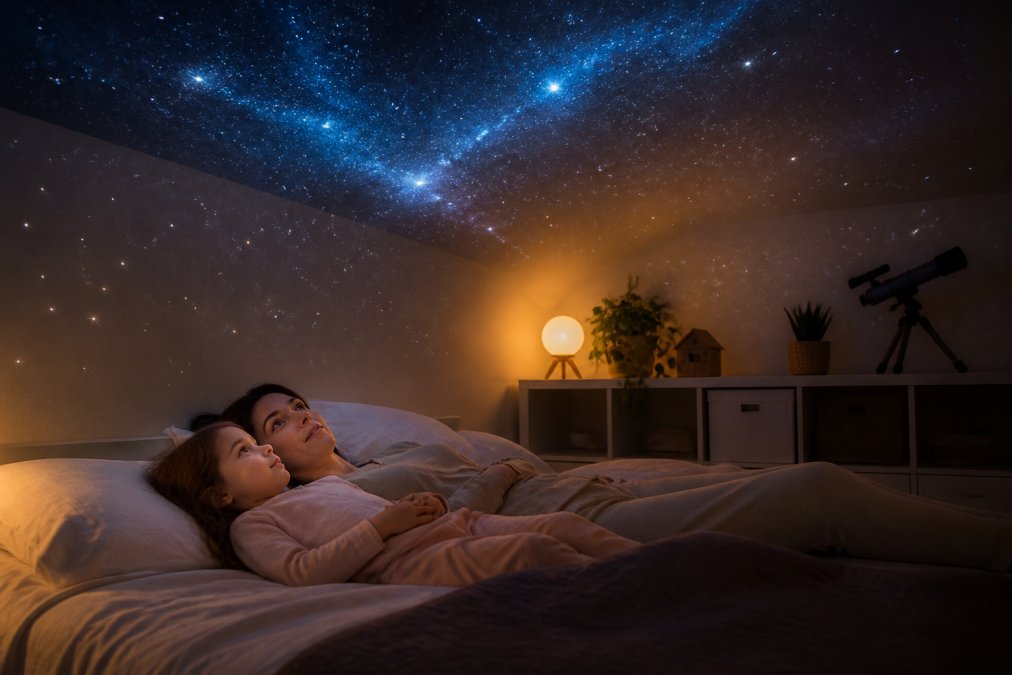
A planetarium projector is a device that projects stars, galaxies, and nebula patterns onto your ceiling and walls, turning a dark room into a simulated night sky (nasa.gov). Asknik carries the Planetarium Προτζέκτορας Γαλαξίας, and it's one of our top-selling products in Q4 for a simple reason: it does exactly what the box promises.
So is a planetarium projector worth it for bedrooms? For most people, yes, with one condition. It has to match how you'll actually use the room. A bedroom projector isn't a toy you switch on once. It's ambient lighting, a nightlight, and a slow wind-down ritual rolled into one device.

Here's what it isn't: a replacement for a real telescope, or a piece of scientific equipment. It's atmosphere. That distinction matters, because the people who end up disappointed are the ones who bought it expecting an observatory.
Benefits of Galaxy Projectors Beyond Pretty Lights
The benefits of galaxy projectors go past decoration. Three things come up repeatedly in how people use them.
First, they give a room a focal point without any furniture. Second, they work as a nightlight that's dim enough to sleep under but bright enough to stop a dark room feeling unsettling. Third, they make bedtime easier for kids who resist it, because the light becomes part of the routine rather than a reward for finishing it.
They suit kids and adults equally. For adults, it's atmosphere. For children, it's a story they can lie under.
Best Star Projector for Sleep: What the Specs Tell You
The best star projector for sleep is one with adjustable brightness, a timer, and quiet or silent operation. Everything else is secondary.
Here's what actually matters when you're buying for sleep rather than for a party:
- Timer function so it switches off after you've drifted off
- Low minimum brightness for a genuine nightlight mode
- No fan noise you can hear from a metre away
- Focus adjustment so the star field stays crisp rather than blurry
- USB power for a simple setup with no batteries to replace
Rotational speed matters more than people expect. Slow rotation feels calm. Fast rotation feels like a fairground. Look for a projector that lets you slow it down or stop it entirely.
| Feature | Why It Matters for Sleep | What to Avoid |
|---|---|---|
| Timer function | Shuts off after you fall asleep | No timer at all |
| Brightness range | Doubles as a nightlight | Only one bright setting |
| Rotation control | Slow movement calms, fast distracts | Fixed fast spin |
| Focus adjustment | Keeps the star field sharp | Blurry, unfocused dots |
| Build quality | Survives nightly use | Flimsy plastic housing |
Optical vs Digital Projection: Which One Belongs in a Bedroom
Optical projection uses a lens and a physical disc, while digital projection renders the image electronically. Both end up on your ceiling. They get there very differently, and the room they land in matters as much as the technology.
Optical models tend to produce a warmer, more natural star field, and the constellation accuracy is usually better because the pattern comes from a real disc. The trade-off is that changing what you see means changing the disc. Digital models offer more variety at the touch of a button, more colour options, and often more scenes, but the image can look flatter and less like a real night sky. large projection screens.
For a bedroom, this is the honest answer: if you want one beautiful scene done well, go optical. If you want twelve scenes and you'll switch between them, go digital.
Room readiness: the factor most guides ignore
Before you blame the projector, check the room. Wall colour, ceiling texture, and ambient light interference change how any projector looks.
- Wall and ceiling colour. Matte white or light grey reflects the most light and keeps stars crisp. Dark navy, charcoal, or textured wallpaper absorbs projection and makes even a good unit look dim.
- Ambient light. A streetlamp through thin curtains, an LED standby light on a TV, or a phone screen at full brightness will flatten the image (peer-reviewed research). Blackout curtains and a dark ceiling are the single biggest upgrade you can make.
- Room acoustics. Hard floors and bare walls bounce fan noise. A rug, curtains, or a fabric headboard absorbs it, so a projector that sounds loud in a bare room can be nearly silent in a soft-furnished one.
- Projection distance and angle. Most bedroom projectors are designed for a ceiling distance of roughly 2-3 metres. Too close and the image is small and bright; too far and it scatters and dims.
Why this matters for the Asknik 360° rotating planetarium
Asknik's 360° rotating planetarium falls into the digital camp, and it's one of our top-selling products in Q4. It projects twelve scenarios, from the Solar System and the Moon through to the Andromeda Galaxy and the Hubble Deep Field, and the rotation covers the full ceiling rather than a single patch.

It suits kids and adults equally, especially at bedtime or whenever you want a nice atmosphere. If you want to see how it looks in a real room, add it to your cart here. New subscribers also get 10% off their first order by joining our newsletter.
Relaxing Bedroom Lighting Ideas That Pair With a Projector
Relaxing bedroom lighting ideas work best when the projector is the only bright object in the room. Everything else should be soft and low.
A few combinations that work:
- Kill the overhead light entirely. Use a small bedside lamp on its lowest setting while you get ready for bed, then switch it off once the projector is on.
- Keep curtains closed and screens face-down. A phone screen at full brightness undoes the whole effect.
- Add white noise underneath. Asknik's 3-in-1 Bluetooth humidifier combines a humidifier, a nightlight, and a white noise machine, so the sound and the light work together rather than competing.
- For younger children, a soft silicone nightlight like the Bunny touch lamp gives a low, warm glow at floor level without washing out the projection above.
Price, Maintenance and Long-Term Value: Is a Planetarium Projector Worth It?
Is a planetarium projector worth it for bedrooms? For most households, yes, provided you buy for how you'll use it and you keep it clean. The real question is not the sticker price. It's the cost per night of use.
The ROI calculation most guides skip
A projector that runs most nights for a year delivers hundreds of hours of ambient light, nightlight, and wind-down routine. A projector that runs twice a year delivers almost nothing. The break-even point is frequency of use, not the number on the box.
When you compare models, look at three things that determine long-term value:
- LED lifespan. Modern LED projectors are typically rated for tens of thousands of hours (energy.gov). At one hour per night, that's years of use before any meaningful dimming. Optical disc models rely on a bulb or LED plus a physical disc, and the disc is the part that wears, scratches, or gets lost.
- Build quality. A stable base, a smooth rotation motor, and a lens that stays clean matter more than extra scenes. Flimsy plastic housings are the most common failure point.
- Serviceability. Can you clean the lens? Is the power cable replaceable? Simple, repairable designs outlast sealed novelty units.
Maintenance that actually matters
Maintenance is simpler than most people expect. The main tasks are:
- Keep the lens free of dust with a soft microfibre cloth. Dust is the number one cause of a dim or blurry image.
- Avoid leaving it running for hours on end in a hot room. Heat shortens LED life.
- Give it a stable, flat surface so the rotation stays smooth and the motor doesn't strain.
- Store the disc or remote safely if your model uses one.
Do those four things and there's very little to go wrong.
Why the Asknik planetarium is built for long-term use
Asknik's 360° rotating planetarium is one of our top-selling products in Q4. It's designed for nightly use, it suits kids and adults equally, especially at bedtime or for a nice atmosphere, and it's simple to keep clean. You can add it to your cart here. New subscribers also get 10% off their first order by joining our newsletter.
Frequently Asked Questions
Are planetarium projectors actually worth the money for a bedroom?
For most bedrooms, yes, if you use them regularly. A planetarium projector replaces a plain nightlight and adds atmosphere for kids and adults at bedtime. Asknik's Galaxy 360° model costs 54.99 and is one of our top-selling products in Q4. If you only want a faint nightlight, a cheaper lamp may be enough.
Do star projectors really help with sleep and relaxation?
They can support a calmer bedtime routine rather than treat insomnia. A slow rotational speed and dim LED brightness give the eyes something gentle to rest on, which fits sleep aid and nightlight mode use. Pairing a projector with white noise, such as the 3-in-1 Bluetooth humidifier with white noise at 56.99, covers both light and sound for a more consistent wind-down.
What features should I look for in a bedroom planetarium projector?
Prioritise focus adjustment, rotational speed control, LED brightness levels and a timer function. Check ceiling coverage for your room size and projection distance so the star field fills the ceiling without blurring. A rechargeable battery or USB power adds flexibility. Constellation accuracy and star density matter more to astronomy enthusiasts than to someone who simply wants relaxing bedroom lighting.
Are planetarium projectors safe for children's bedrooms?
Yes, when you choose a device with certified electrical components and keep it away from bedding and liquids. Look for CE marking and a cool-running LED light source. Asknik's planetarium projector is a certified CE device, and the silicone Bunny touch night light at 40.99 is another child-safe option. Always follow the manufacturer's guidance on placement and cable routing.