
TL;DR:
- Smart homes can provide Greek homeowners with energy savings, improved comfort, and enhanced security.
- Starting with essential devices like thermostats and smart bulbs can maximize benefits and cost-efficiency.
- Greece offers subsidies through the SRI program to support smart home upgrades and energy improvement.
Smart homes are not just for tech enthusiasts or newly built properties. If you own a home in Greece and pay monthly electricity bills, a smart home setup is already relevant to you. The idea that you need to rewire your house or spend thousands of euros to get started is simply not true. In fact, many Greek homeowners are already saving money and gaining comfort with just a few connected devices. This guide breaks down what a smart home actually is, how the technology works, what you can realistically save, and what government support is available to you right now.
Table of Contents
- Defining a smart home
- How smart homes work: Hubs, protocols, and automation
- Smart home benefits for Greek homeowners
- Getting started: Upgrades, subsidies, and smart choices in Greece
- Perspective: The real-world reality and what most guides don’t tell you
- Find your next smart home solution
- Frequently asked questions
Key Takeaways
| Point | Details |
|---|---|
| Smart home essentials | A smart home connects devices and systems for remote control and automation, boosting convenience and efficiency. |
| Greek advantages | Local programs like SRI and high energy costs make smart upgrades especially practical for Greek homeowners. |
| Savings potential | Smart thermostats and lighting can reduce energy use by up to 30 percent, though results vary by home. |
| Start small | Begin with prioritized upgrades and take advantage of subsidies for the fastest return on investment. |
| Be privacy-aware | Smart homes add convenience but bring new privacy and cyber security challenges to manage. |
Defining a smart home
Let’s start with a clear definition. A smart home is a residence equipped with internet-connected IoT (Internet of Things) devices that allow you to control and automate systems via apps or voice assistants for enhanced convenience, security, and energy efficiency. That covers a lot of ground, so let’s break it down.
In practical terms, a smart home includes devices that talk to each other and to you. Your thermostat can learn your schedule. Your lights can turn off automatically when you leave a room. Your front door can send you an alert when someone rings the bell, even if you’re at work in Athens. These are not futuristic concepts. They are available and affordable today.
Here are the most common smart home components:
- Smart thermostat: Controls heating and cooling based on your habits and schedule
- Smart lighting: LED bulbs or switches you control remotely or set to automate
- Smart plugs: Turn any appliance into a connected device
- Smart hub: The central controller that links all your devices (e.g., Amazon Echo, Google Nest Hub)
- Sensors: Motion, door/window, and temperature sensors that trigger automations
- Smart security cameras: Remote monitoring with alerts and recordings
All of these can be explored further through our overview of smart home devices explained.
“A smart home brings together lighting, climate, security, and appliances into one connected system you can manage from your phone or with your voice.”
| Component | Primary benefit | Typical cost range |
|---|---|---|
| Smart thermostat | Energy savings | €60 to €180 |
| Smart bulbs (per pack) | Lighting control | €15 to €50 |
| Smart plug | Appliance automation | €10 to €30 |
| Smart hub | Device coordination | €50 to €150 |
| Motion sensor | Security and automation | €15 to €40 |
How smart homes work: Hubs, protocols, and automation
Now that we know what’s in a smart home, the next step is understanding how these pieces work together. The secret behind true convenience is the way devices communicate.
Every smart home relies on a central hub or controller. This is the brain of the operation. Popular options include Amazon Echo, Google Home, and Apple HomePod. The hub receives commands from your phone app or voice, then sends instructions to your devices.
But devices also need a shared language to communicate. That’s where smart home automation protocols come in. Here’s a quick comparison:
| Protocol | Range | Best for | Requires hub? |
|---|---|---|---|
| Wi-Fi | Long | Cameras, video doorbells | No |
| Zigbee | Medium | Lights, sensors, locks | Yes |
| Z-Wave | Medium | Security devices | Yes |
| Matter | Long | Cross-brand compatibility | Optional |
| Thread | Medium | Low-power mesh networks | Yes |
For Greek homeowners, we recommend prioritizing Matter and Zigbee compatible devices. Matter is a newer universal standard supported by Apple, Google, and Amazon, which means your devices will work together regardless of brand. Zigbee creates a mesh network, so devices strengthen each other’s signal, which is useful in older Greek apartments with thick walls.
Automation is where the real magic happens. Instead of manually controlling each device, you set rules. Here is a simple example for a Greek apartment:
- You leave home at 8:00 AM. Your phone’s location triggers the system.
- The thermostat switches to energy-saving mode automatically.
- All lights turn off. Smart plugs cut power to standby appliances.
- At 5:30 PM, the system detects you’re heading home and starts warming the apartment.
- You arrive to a comfortable home without touching a single switch.
When choosing smart gadgets for your home, always check protocol compatibility before buying.
Pro Tip: Start with one hub and build around it. Mixing multiple ecosystems (e.g., Google Home plus Apple HomeKit) creates unnecessary complexity and compatibility headaches.
Smart home benefits for Greek homeowners
With a grasp on how smart homes operate, let’s explore what Greek homeowners gain day to day and on their energy bill.

Heating and cooling are the biggest household expenses in Greece. Summers are hot, winters can be cold, and air conditioning units run hard. This is exactly where smart technology delivers the most value. Smart thermostats offer roughly 9.6% heating savings and 17.5% cooling savings, which typically translates to €120 to €140 per year for an average Greek household.
Smart lighting adds even more to that number. Switching to smart LED systems can reduce lighting energy use by 75 to 80% compared to traditional bulbs. Combined, smart systems can cut total home energy consumption by up to 30%.
Here are the key benefits at a glance:
- Lower electricity bills through automated heating, cooling, and lighting control
- Remote monitoring so you can check on your home from anywhere in Greece or abroad
- Personalized comfort with settings that adapt to your household’s daily routine
- Improved security with cameras, motion sensors, and smart locks
- Simple automations that reduce daily effort for busy families
- Solar panel integration for homes with photovoltaic systems, maximizing self-consumption
Greece’s push toward energy efficiency also means smart homes align well with national energy mandates. If you’ve already invested in insulation or solar panels, adding smart controls multiplies the efficiency of those upgrades. You can read more about the smart home savings in Greece and find a broader smart home guide for Greeks to plan your next steps.
Getting started: Upgrades, subsidies, and smart choices in Greece
Knowing the advantages, the next question is: how do you actually start building a smart home in Greece, and what financial support is available?
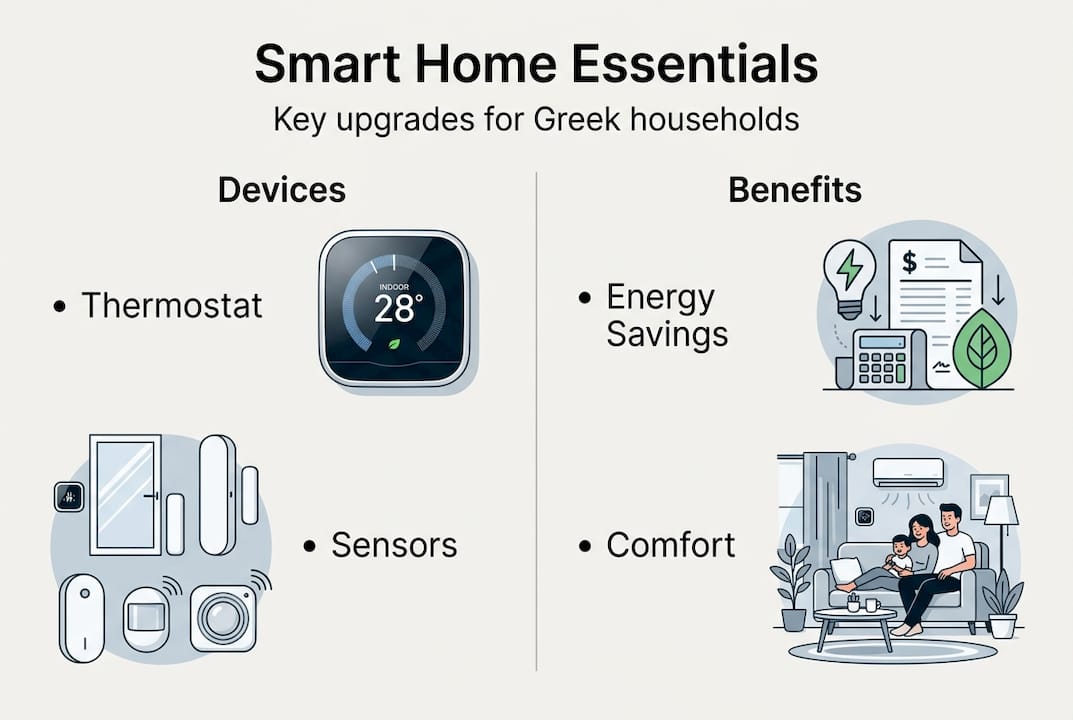
Greece’s Smart Readiness Indicator (SRI) program offers vouchers for smart upgrades including smart meters, sensors, and cabling. This subsidy is designed to help homeowners modernize their properties and improve energy performance ratings. Eligible upgrades include smart energy meters, automated lighting controls, HVAC sensors, and structured cabling for home networks. Applications are processed through smartreadiness.gov.gr, and the SRI program timeline runs through June 2026.
Here is a smart upgrade priority table based on return on investment:
| Priority | Upgrade | Why it matters |
|---|---|---|
| 1 | Smart thermostat | Highest energy savings, SRI eligible |
| 2 | Smart lighting | Low cost, fast payback |
| 3 | Smart plugs | Easy install, cuts standby waste |
| 4 | Motion sensors | Enables automation and security |
| 5 | Smart hub | Ties everything together |
Here is a step-by-step approach for getting started:
- Audit your current energy use. Check your last three electricity bills.
- Identify your biggest cost: heating, cooling, or lighting.
- Start with a smart thermostat if heating/cooling is the issue. Start with smart bulbs if lighting is the priority.
- Choose Matter or Zigbee compatible devices for future flexibility.
- Add a hub once you have three or more devices to coordinate.
- Check SRI eligibility and apply for your voucher before upgrading.
The most common pitfall is buying too many gadgets at once without a plan. Compatibility issues between brands cause frustration. Stick to one ecosystem, expand gradually, and check the SRI smart home subsidy details before purchasing.
Pro Tip: Before buying any device, search its model number plus “Matter compatible” or “Zigbee” to confirm it will work with your chosen hub. This one check saves hours of troubleshooting later.
Perspective: The real-world reality and what most guides don’t tell you
Before you take the plunge, it’s worth pausing for an honest look at what most smart home guides leave out.
First, not every home sees dramatic savings. If you already manage your thermostat carefully and turn off lights consistently, the marginal gain from automation is smaller. Smart tech delivers the biggest wins for households where energy use has been inconsistent or unmonitored.
Second, privacy and security are real concerns. Experts note privacy and security risks with smart home AI, including ethical concerns and the risk that overhyped automation introduces new vulnerabilities. In multi-user households, shared device access can also create conflicts over settings and controls.
Third, AI-driven features are often oversold. Many devices advertise “learning” capabilities that in practice require months of consistent use before they add real value.
Our advice: pick intentionally. Focus on the one or two upgrades that directly address your home’s real needs. A well-chosen smart thermostat and a set of smart bulbs will outperform a cabinet full of gadgets that never get configured properly. For those interested in improving home security, start there and build outward.
Find your next smart home solution
You now have a solid foundation: what a smart home is, how it works, what you can save, and how to get started in Greece. The next step is finding the right products.
At AskNik.gr, we’ve curated a range of smart home solutions that are practical, affordable, and ready to ship to your door in Greece. Whether you’re upgrading your kitchen with kitchen smart essentials or looking for a broader selection of connected devices, you’ll find quality-checked products with free shipping and exclusive offers. Browse more smart home solutions and take your first step toward a smarter, more efficient home today.
Frequently asked questions
What is the main advantage of a smart home in Greece?
The main benefits are energy savings, increased comfort, and access to local support programs. The SRI program offers vouchers for eligible smart upgrades that enhance efficiency, safety, and comfort for Greek homeowners.
Does a smart home always mean big cost savings?
Not always. Savings are highest for homes where energy use has been inconsistent or unmonitored; homes already well-managed may see smaller gains.
Are smart homes secure from hacking?
Smart homes offer strong security features but also introduce new cyber risks. Experts highlight privacy risks and the need for careful device and network management to keep your system safe.
How can I apply for the SRI smart home subsidy in Greece?
Apply via smartreadiness.gov.gr following the eligibility guidelines for device and wiring upgrades. Applications run through June 2026, so check your eligibility and act before the deadline.