
Greece’s smart home adoption is accelerating faster than most people realize. The European smart home market is projected to grow from 31% penetration in 2024 to 42% by 2029, and Greek households are tripling their adoption rate, driven by rising electricity costs and a new wave of affordable, interoperable devices. Yet many tech-savvy Greeks still hesitate, worried about privacy risks, high upfront costs, or complicated setups. This guide cuts through the noise. We’ll walk you through how smart gadgets actually work in a Greek home, which technologies matter, what to buy first, and how to keep your setup secure and efficient.
Table of Contents
- How smart gadgets transform everyday Greek life
- The tech behind smart gadgets: Protocols, platforms, and local realities
- Comparing smart gadgets: From essentials to specialized devices
- Security, privacy, and network strategies for your smart home
- Setting up your Greek smart home: Step-by-step and benchmarks
- Explore smart gadgets at AskNik.gr
- Frequently asked questions
Key Takeaways
| Point | Details |
|---|---|
| Start with basics | Smart bulbs, plugs, and a hub offer the fastest returns for comfort and savings in Greek homes. |
| Choose compatible tech | Prioritize gadgets using the Matter protocol for the best device flexibility and longevity. |
| Focus on privacy and security | Local processing and proper network segmentation significantly reduce hacking and surveillance risks. |
| Measure your savings | Track energy and comfort benchmarks to see real advantages from your smart home setup. |
How smart gadgets transform everyday Greek life
Smart gadgets are not just about turning lights on with your voice. They reshape how you interact with your home every single day. Automated lighting scenes, climate schedules, robotic vacuums, and smart plugs all reduce the mental load of managing a household. The benefits of smart gadgets go well beyond novelty, touching real comfort and real savings.
Energy efficiency is the biggest driver in Greece right now. Electricity prices here are among the highest in the EU, so any device that trims your consumption pays for itself quickly. Smart thermostats, for example, learn your schedule and avoid heating or cooling an empty apartment. User preferences data confirms that convenience, energy efficiency, health monitoring, and security are the four pillars driving adoption globally, and Greece is no exception.
Here is what smart gadgets typically automate in a Greek home:
- Lighting: Scheduled scenes, motion triggers, and dimming for energy control
- Climate: Smart AC controllers and thermostats that adapt to your routine
- Cleaning: Robot vacuums and mops that run while you are at work
- Appliances: Smart plugs that cut standby power and track consumption
- Security: Cameras, smart locks, and doorbell alerts accessible from your phone
The role of smart technology in modern homes includes enhancing personal convenience, energy efficiency, health monitoring, and security, all working together in one connected ecosystem.
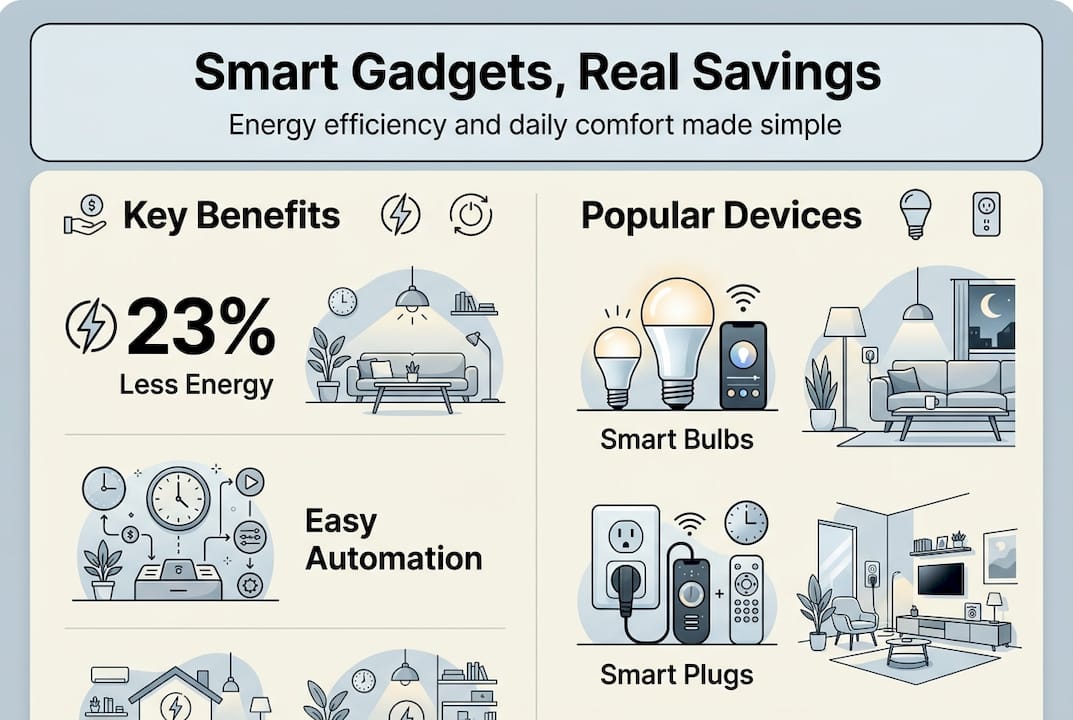
Pro Tip: Start with smart bulbs and smart plugs. They cost under €30 each, require zero rewiring, and deliver visible energy savings within the first month. They are the fastest return on investment for any Greek apartment.
For more practical smart home tips tailored to Greek living conditions, we have a dedicated guide that covers room-by-room strategies.
The tech behind smart gadgets: Protocols, platforms, and local realities
Understanding the impact is easier when you see the technology powering smart gadgets. Every smart device has three layers working together: sensors that perceive the environment, a network layer that carries data, and an app layer where you set automations and check status.
The network layer is where most confusion happens. Smart home protocols include Zigbee, Z-Wave, Wi-Fi, and the newer Matter standard, each with different strengths. Here is a quick comparison:
| Protocol | Range | Power use | Interoperability | Best for |
|---|---|---|---|---|
| Wi-Fi | High | High | Good | Cameras, displays |
| Zigbee | Medium | Very low | Moderate | Bulbs, sensors |
| Z-Wave | Medium | Low | Moderate | Locks, sensors |
| Matter | Varies | Varies | Excellent | All categories |
Matter is the game-changer for Greek buyers. It is an open standard backed by Apple, Google, Amazon, and Samsung, meaning a Matter-certified device works across all major platforms without lock-in. The Matter protocol is now driving device selection in the Greek market, and availability is growing fast on local retailers.
Pro Tip: When shopping, filter for Matter-compatible products first. You protect your investment against platform changes and get the widest device selection for your Greek smart home setup.
Comparing smart gadgets: From essentials to specialized devices
Not all smart gadgets are created equal. Some deliver immediate, measurable value. Others are satisfying but optional. Knowing the difference saves you money and frustration.
Greek households spend €150 to €400 for a basic smart home setup, so prioritizing the right categories matters. Here is a side-by-side look at the main categories:
| Category | Avg. cost | Energy impact | Convenience impact | Complexity |
|---|---|---|---|---|
| Smart bulbs | €10-30 each | High | High | Very low |
| Smart plugs | €15-25 each | High | Medium | Very low |
| Smart thermostat/AC | €80-200 | Very high | High | Medium |
| Robot vacuum | €150-400 | Low | Very high | Low |
| Smart lock | €100-250 | None | High | Medium |
| Smart camera | €40-120 | Low | High | Low |
For most Greek users, here is the recommended order of purchase:
- Smart plugs for immediate standby power savings and appliance monitoring
- Smart bulbs for lighting automation and energy reduction
- Smart AC controller to manage Greece’s intense summer cooling loads
- Robot vacuum for daily cleaning without lifting a finger
- Smart lock or camera for security and remote access
For a deeper look at energy-saving gadgets and how each category performs in Greek conditions, we break it down product by product.
Security, privacy, and network strategies for your smart home
Once you select devices, it is time to keep your data, routines, and home secure. This is where many tech-savvy users have legitimate concerns, and those concerns are worth taking seriously.
Privacy risks affect 41% of potential adopters, while high costs concern 45%, making these the two biggest barriers to smart home adoption. Even among users who already own devices, the fear of data exposure is real.
The main risks in a connected home include:
- Cloud dependency: Most devices send data to manufacturer servers, which can be breached
- Always-on microphones: Smart speakers and some cameras record ambient audio
- Weak default passwords: Factory credentials are a common entry point for attackers
- Unpatched firmware: Older devices with no updates become vulnerabilities over time
“Convenience is a powerful driver, but edge-local storage and network segmentation are the smartest moves for privacy-conscious users.” This reflects the expert consensus from smart home privacy research in 2026.
Here is how to reduce your exposure practically:
- Set up a dedicated IoT VLAN (a separate network segment) so smart devices cannot reach your computers or phones
- Choose platforms with local processing options, such as Apple HomeKit or Home Assistant
- Disable microphone features on devices that do not need them
- Update firmware on every device immediately after purchase and enable auto-updates
- Replace default passwords with strong, unique credentials on your router and each device
For a full breakdown of smart home privacy advantages and how modern platforms handle your data, we cover the topic in detail.
Setting up your Greek smart home: Step-by-step and benchmarks
Ready to apply all this? Let’s walk through setup and performance expectations for your uniquely Greek smart home.
Phase 1: Baseline setup (€150 to €400) Start with three to five smart bulbs, two to four smart plugs, and a Matter-compatible hub such as Apple HomePod Mini, Amazon Echo, or Google Nest Hub. This gives you voice control, scheduling, and remote access within an afternoon.
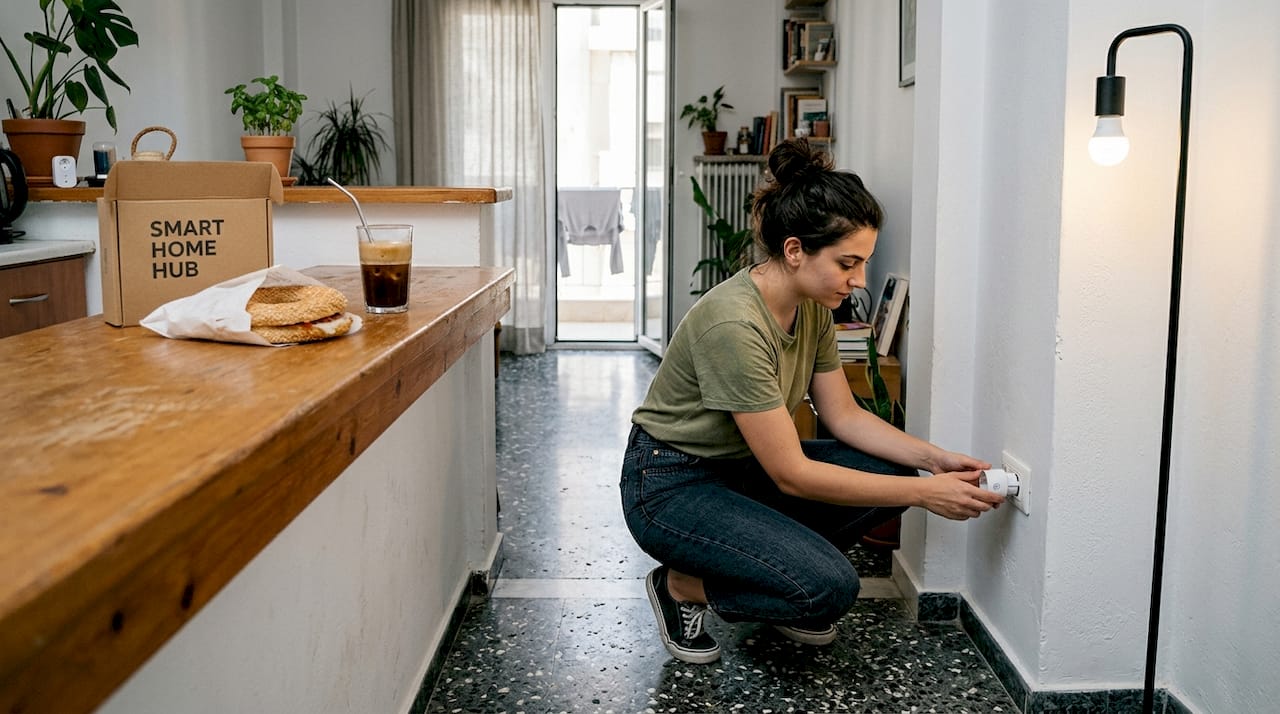
Phase 2: Expansion Add a smart AC controller or thermostat, a robot vacuum, and a smart doorbell or camera. At this stage, set up your IoT VLAN and organize devices into rooms within your chosen app.
Phase 3: Advanced automation Create multi-device routines: lights dim when the TV turns on, the AC adjusts when you leave home, the robot vacuum starts when everyone is out. This is where the real convenience payoff happens.
On performance, real-world energy benchmarks show consumption between 0.15 and 3.59 kWh per square meter depending on device density, with local routine latency between 120 and 180 milliseconds. That latency is fast enough to feel instant. Energy savings of 17 to 23% are achievable with hybrid edge-cloud systems, which balance speed and privacy effectively.
For Greek apartments, summer is the critical test. Air conditioning accounts for a large share of peak electricity bills. A smart AC controller that limits runtime during peak tariff hours (typically 11:00 to 23:00 in summer) can cut cooling costs noticeably. Follow our smart home setup tips for room-by-room guidance built around Greek climate realities.
Explore smart gadgets at AskNik.gr
If you are ready to start building your smart home, we have done the curation work for you. At AskNik.gr, we stock a carefully selected range of smart home devices, tech gadgets, and innovative solutions that are compatible with Greek infrastructure and the most popular platforms.
From smart plugs and bulbs to robot vacuums and security cameras, every product in our Smart Home category ships free across Greece. We quality-check every item before it reaches you, and our team is available to help you choose the right setup for your apartment or house. Whether you are spending €150 on a starter kit or building a fully automated home, we have options at every level. Browse our full range and take advantage of exclusive offers available only at AskNik.gr.
Frequently asked questions
What are the essential smart gadgets to start with in a Greek home?
Smart bulbs, smart plugs, and a Matter-compatible hub are the best starting point. A basic Greek setup typically costs between €150 and €400 and covers lighting, standby power control, and voice automation.
How much energy can smart gadgets help save in Greece?
Real-world testing shows energy savings of 17 to 23% when using smart systems, particularly for heating and cooling management, which is where Greek electricity bills are highest.
How can I secure my smart home devices against hacking or privacy risks?
Segment your network with an IoT VLAN, use platforms with local storage options, disable unnecessary microphone features, and update firmware regularly. Expert recommendations consistently point to local edge processing as the strongest privacy defense.
What is Matter and why does it matter for Greek users?
Matter is a universal compatibility standard backed by all major tech platforms. A Matter-certified device works with Apple, Google, Amazon, and Samsung ecosystems, giving Greek buyers maximum flexibility and long-term device support.