


Are Night Lights Safe for Baby Nurseries?

Last Updated: November 1, 2026
Quick Summary
The safest night lights for a baby nursery are dim, warm amber or red lights with a true low setting, kept under about 5 lux at the crib. Choose a model with a short, secure cord or a properly charged battery, placed out of the baby's reach. Check for a recognized safety certification before buying.
- Choose warm amber or red tones; blue-heavy white light can suppress melatonin.
- Look for a true low setting, ideally under roughly 5 lux at the crib.
- Keep cords out of reach of the crib and never run them under rugs.
- Use only the charger that came with battery-powered night lights.
- Confirm a recognized safety certification on the product or packaging before buying.
Table of Contents
- Why Night Lights Matter in a Baby's Nursery
- Baby Night Light Safety: Heat, Cords and Battery Checks
- Best Color Night Light for Baby Sleep
- Plug-In Night Light for Baby Nursery: Placement and Setup
- Portable Night Light for Baby: When Rechargeable Makes Sense
- How We Compared the Asknik Night Lights
- Choosing the Right Night Light for Your Nursery
- Frequently Asked Questions
Why Night Lights Matter in a Baby's Nursery
Night lights are one of the most common additions to a nursery, and for good reason. A low, soft glow lets parents move around safely during night feeds and diaper changes without flipping on the harsh overhead light. This guide is designed to help you choose a night light that is both useful and safe for your baby's room.
Night lights are a practical tool, but they are not all alike. Brightness, color, power source, and placement all affect how well a night light supports sleep and how safe it is around a crawling or climbing child. The sections below walk through each factor so you can make a clear decision.
Some product types suit a nursery better than others. This guide looks at plug-in models, portable rechargeable lights, and projector-style options, and explains where each one fits.
Baby Night Light Safety: Heat, Cords and Battery Checks
Before you buy any night light, check three things: heat output, cord and plug design, and battery safety. Many nursery night lights use LEDs, but cords and batteries still need attention.
Keep every cord out of reach of the crib and any spot where a baby could pull on it. Look for a short, secure cable, and do not run it across the floor or under a rug. For battery models, use only the charger that came with the product, and stop using any unit that becomes hot, swollen, or smells unusual.
Look for a recognized safety certification on the product or packaging before you buy.
Best Color Night Light for Baby Sleep
Color is the single most misunderstood spec on a night light box. "Warm white," "amber," and "red" are not marketing labels, they describe where a light sits on the visible spectrum, and that position affects how the eyes and brain respond at night.
Why color matters more than brightness alone
Light in the blue end of the spectrum (roughly 460-490 nm) is the most effective at suppressing melatonin, the hormone that signals the body it is time to sleep. White LEDs and cool-white bulbs are blue-heavy by design, which is why a "soft white" bulb can still feel alerting at 2 a.m. Amber, red, and deep-orange LEDs sit at the opposite end of the spectrum and produce far less melatonin suppression at the same perceived brightness. That is the mechanism behind the common advice to choose warm, red, or amber tones for overnight use.
A practical rule: the lower the color temperature in Kelvin, the warmer the light. Most nursery-friendly night lights fall between 1,800 K and 2,700 K. Anything labeled 4,000 K or higher ("cool white" or "daylight") is better suited to a task lamp than a sleep space.
Color by age and use case
- Newborns (0-4 months): Newborns have not yet developed a strong circadian rhythm, but their eyes are still sensitive. A dim amber or red light at the lowest setting is the safest default for night feeds. Keep it under roughly 5 lux at the crib, dim enough that you can see the baby's face but not read a book comfortably.
- Infants (4-12 months): As melatonin rhythms mature, the color/brightness combination matters more. A red or amber light on a dimmer, positioned so it does not shine into the crib, supports overnight wakings without resetting the sleep drive.
- Toddlers (1-3 years): Fear of the dark often appears here. A warm amber light left on all night at a very low level is usually fine; a brighter "fun" color (blue, green, purple) is better reserved for play or as a reward setting, not overnight.
- Older children: Color preference becomes social. If a child insists on blue, choose the dimmest blue setting available and pair it with a timer so it fades after they fall asleep.
Brightness, not just hue
Color and brightness interact. A 2,700 K bulb at full brightness can suppress melatonin more than a 2,200 K bulb at half brightness. Look for lights with at least three dimming steps and a true low setting, many "dimmable" night lights bottom out around 10-20 lux, which is brighter than ideal for overnight use. A light that can drop to 1-3 lux is a better nursery tool than one with ten colors but no true dim.
What about multi-color and projector lights?
Multi-color lights and projectors are useful for toddlers and older children. If you buy one, check whether it has a dedicated "night light" or "sleep" mode that locks to a warm color at low brightness, and use a timer so the room returns to dark after the child settles.
Plug-In Night Light for Baby Nursery: Placement and Setup
A plug-in night light works well when you want a fixed, always-ready light in the nursery. Place it on a low dresser or shelf, well away from the crib, and make sure the cord is routed safely behind furniture.
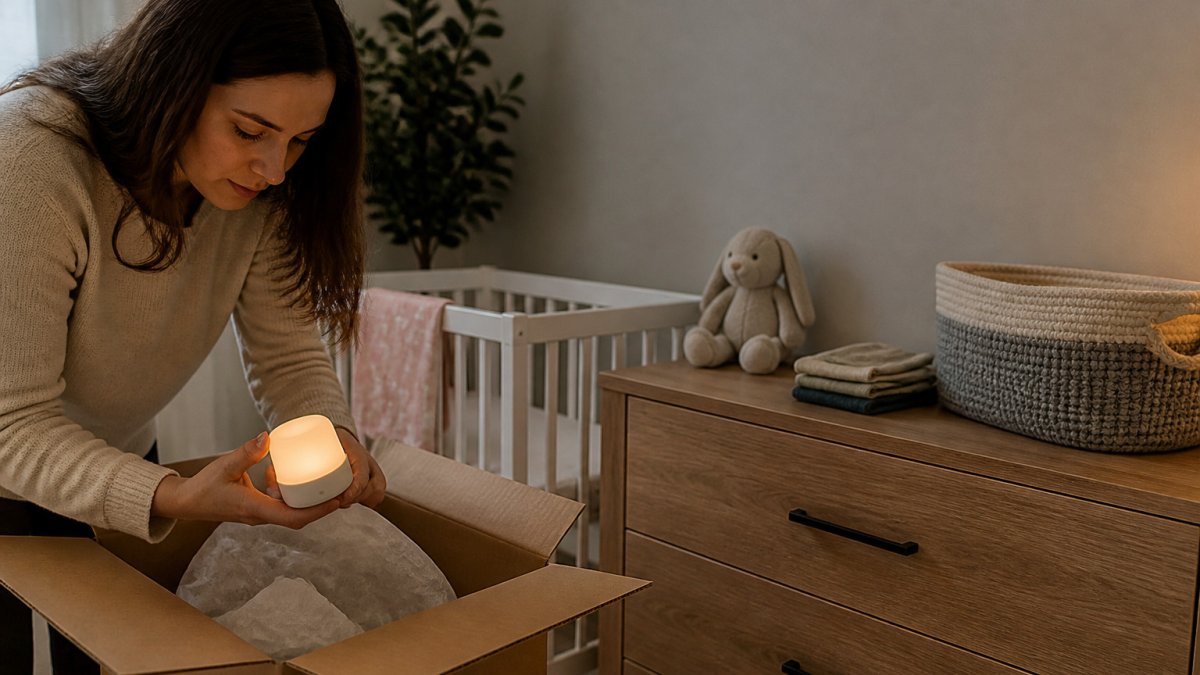
Choose a wall outlet that is not blocked by furniture and is easy to reach for unplugging. Avoid placing the light where a baby could grab it from the crib or climb onto it.
Συσκευή Λευκού Θορύβου με Φως Νυκτός & Αισθητήρα Αφής, 28 Ήχοι →
The Asknik rabbit silicone night light is a soft, touch-controlled option that suits a bedside table. It has three brightness levels and a 30-minute timer.

Portable Night Light for Baby: When Rechargeable Makes Sense
A portable, rechargeable night light is useful when you need light in a room without a convenient outlet, or when you want to move the light around the house. Battery models also let you keep cords out of the nursery entirely.
The Asknik motion-sensor night light is wireless and rechargeable. It switches on when it detects movement and turns off shortly afterward. Charge it before first use.

How We Compared the Asknik Night Lights
Most night light roundups rank products by feature list and price. That distinction matters in a nursery, where "cool to the touch" and "safe cord" are claims you want evidence for, not adjectives.
Our testing criteria
- Ease of cleaning. Silicone and smooth plastic wipe clean; fabric covers and open projector housings trap dust. We note which surfaces need disassembly to clean.
What the table shows, and what it doesn't
The table below summarizes the headline specs for each Asknik light. It is a starting point, not a verdict: two lights with the same "3 brightness levels" can behave very differently at the low end, and a rechargeable light with a long runtime may still have a charging port that is awkward to reach behind a crib. Small variations in design often dictate how effectively a nursery can be illuminated, a nuance that becomes particularly apparent when considering the subtle glow provided by rechargeable tea lights.
| Night Light | Type | Power | Light Control | Best For |
|---|---|---|---|---|
| Sound machine with night light | Plug-in or USB | Rechargeable battery, USB | Touch and buttons, 10 colors | Sleep and soothing |
| Motion-sensor night light | Wireless | Rechargeable, USB | Motion sensor | Night feeds and diaper changes |
| Rabbit silicone night light | Touch | USB Type-C | Touch, 3 brightness levels, 30-min timer | Bedside use |
| LED projection lamp | Plug-in | Rechargeable | Touch | Ambient room light |
| Galaxy projector | Plug-in | USB Type-C | Manual, 13 discs, timer | Older children's rooms |
| Message board night light | USB | USB | Built-in lamp | Decorative use |
Verified versus stated
Where a specification is not confirmed in the product listing, confirm it with the store before purchase.
How to use this comparison
Use the table to shortlist by power source and control type, then compare finalists on the features that matter for your room, such as cord or charging access and controls.
Choosing the Right Night Light for Your Nursery
Start with the room. If your nursery has a reliable outlet near the changing area, a plug-in model is simple and always ready. If you need light in several spots, a rechargeable or motion-sensor model gives you more flexibility without extra cords.
Next, think about the baby's age and habits. A newborn who wakes often benefits from a dim, warm light that you can switch on quickly. An older child who is nervous about the dark may prefer a gentle projection or a sound machine that doubles as a night light.
Finally, confirm the safety basics before you buy: cord placement, battery charging, and certification. For broader guidance, see best bedroom lighting for deep relaxation. Those three checks matter more than any feature list.
Frequently Asked Questions
Are night lights safe to use in a baby's nursery?
Night lights can be used safely in a nursery when they are placed out of the crib and away from cords the baby can reach. Battery-operated and rechargeable models remove the mains connection altogether, which many parents prefer for the room the baby sleeps in. Check that the product carries a recognised safety mark, inspect the cable and plug regularly, and avoid leaving any light unattended with a baby who can pull or mouth objects.
What color night light is best for a baby's room?
Warm, dim tones such as amber, red or soft yellow are generally the least stimulating for a baby's room, because they produce less blue-rich light than bright white. Warm white at low brightness is a practical alternative if you need enough light for diaper changes and night feeds. Keep brightness low, since a steady dim glow is easier to settle beside than a bright or flickering light.
Should a baby's night light stay on all night?
It depends on the light and the routine. Many parents keep a very dim night light on for night feeds and then switch it off once the baby is settled, while others leave it on at the lowest setting. Using a timer or automatic shutoff is useful if you want light only during the early part of the night. Choose the setting that lets you see safely without making the room bright enough to disturb sleep.
Where should you place a night light in a nursery?
Place the night light low on a dresser or changing table, well away from the crib, so the baby cannot reach it and the cord stays out of reach. Avoid positioning it where curtains, bedding or toys could touch the housing. A spot that lights the floor path to the door helps for night feeds without shining directly into the baby's eyes.
Looking for a night light that suits your nursery? Browse the Asknik range, check each listing's specifications, and reach out with any questions about cords, charging, or brightness before you order.
