
Table of Contents
- What Is a POV Camera and Why It's a Year-Round Trend
- POV Camera vs Digital Disposable Camera Apps
- How to Choose the Best POV Camera for Your Needs
- Must-Have POV Camera Accessories for Every Activity
- How to Use a POV Camera: Setup, Mounting, and Framing
- POV Camera App: Setup, Sharing, and Privacy
- Common Mistakes to Avoid with Your POV Camera
- Conclusion: Your Next Steps with a POV Camera
- Frequently Asked Questions
Last Updated: October 5, 2026
What Is a POV Camera and Why It's a Year-Round Trend
A POV camera is a compact, wearable video camera that records from your first-person perspective, hands-free and out of your way.
That hands-free design is why this category is no longer a summer novelty.
Some shoppers want a wearable action camera for sports and travel; others want a digital disposable camera app for a wedding or birthday. This guide separates them.

POV Camera vs Digital Disposable Camera Apps
These two get mixed together constantly. A POV camera is a physical, wearable device that records video you own and control. A digital disposable camera app is software that lets guests scan a QR code and add photos to a shared gallery.
Here is the practical difference:
| Feature | Wearable POV Camera | Digital Disposable Camera App |
|---|---|---|
| What it captures | First-person video | Guest still photos |
| Hardware needed | Yes, a physical camera | Phone only |
| Best for | Sports, travel, daily footage | Weddings, parties, graduations |
| Who operates it | You | Every guest with a phone |
| File control | Local storage on device | Cloud gallery, app terms apply |
If your goal is a first-person perspective of a bike ride or hike, you want hardware. If your goal is 80 guests uploading candid shots to one album, you want an app. Many people use both.
How to Choose the Best POV Camera for Your Needs
The best POV camera for most people is a compact, ultra-lightweight model that records 1080P or 4K video, weighs under 50 grams, and mounts to a cap, belt, or bag without tools. Prioritize weight and mounting flexibility first, resolution second. Achieving stable, high-quality footage during fast-paced movement often requires refining your video analysis techniques to better understand how camera placement impacts the clarity of your athletic performance.
Our Testing Methodology
We evaluate POV cameras on five practical criteria, because specs alone do not tell you how a camera performs in real life:
- Stabilization: We record while walking, cycling, and running on uneven ground to see how well the camera smooths out shake. Some cameras crop the frame to stabilize, reducing your field of view.
- Image quality: We shoot in bright sun, overcast conditions, and indoor lighting to check for noise, motion blur, and color accuracy. A camera that looks sharp in daylight may struggle indoors.
- Audio quality and wind handling: We record outdoors in breezy conditions to test the built-in microphone. Wind noise is the most common complaint in action footage, and only some cameras support an external microphone or wind-reduction settings.
Weight, Mounting, and Resolution
Here is how we decide, in order:
- Weight and size. Under 50 grams disappears on a cap; anything heavier pulls and reminds you it is there. For beginners, lighter is almost always better because you will wear it more.
- Mounting options. A magnetic mount that clips to a hat, belt, or backpack covers more situations than a fixed adhesive pad. Look for adjustable angles so you can frame the shot without removing the camera.
- Resolution. 1080P handles everyday use and social sharing. 4K gives you cropping room in editing but fills storage faster and drains battery quicker. If you mainly share short clips, 1080P is the smarter default.
Compatibility and Ownership Costs
A camera is not a one-time purchase. The full cost includes mounts, memory cards, charging cables, and sometimes app subscriptions or cloud storage. Before you buy, check:
- Mount compatibility: Does the camera use a standard mount, or does it require a proprietary adapter? A magnetic mount that works across multiple cameras gives you more flexibility.
- App requirements: Does the camera require a specific app to transfer files? Is the app free, or does it have a subscription tier for cloud storage?
- Accessories included: Some cameras ship with a mount and cable; others sell them separately. A camera that includes the essentials is often better value than a cheaper body with hidden add-on costs.
Our own pick is the Φορητή Κάμερα Προσωπικής Λήψης (POV), which weighs just 35 grams, is smaller than your thumb, and records 1080P video while you stay fully in the moment. It is a top-selling choice for beginners and experienced users alike because it includes the accessories you need and works with our app for easy transfer and sharing. For beginners, that simplicity matters more than spec sheets; for experienced users, the compact body mounts almost anywhere.

Resolution, Battery Life, and Storage Explained
Resolution, battery life, and storage decide whether a camera suits your activity. Higher resolution means sharper image quality and larger files; longer battery life means more recording time between charges; more storage means you record longer before offloading footage.
A common mistake is buying maximum resolution and never using it, because the files are too big to edit on a phone. If you mainly share short clips, 1080P is the smarter default.
Audio Quality and Wind Handling
Audio is the most overlooked part of POV recording. Built-in microphones pick up wind noise outdoors, which can make footage unusable. If your camera supports an external microphone, use one for anything you plan to publish. If not, look for wind-reduction settings and record in sheltered areas when possible. For cycling, running, or skiing, wind handling is critical.
Year-Round Versatility
The best POV camera is one you use all year, not just in summer. Look for a camera light enough to wear under a jacket in winter, durable enough for travel, and simple enough to grab for a family event. The same device should cover skiing, indoor gym sessions, and everyday errands. That versatility is why this category has become a year-round trend, and why we recommend choosing a camera that fits your whole calendar, not just one season.
Must-Have POV Camera Accessories for Every Activity
A camera alone is not a system. The accessories decide whether you actually use it.
The one we recommend is the Μαγνητική Βάση Στήριξης Action Camera. It attaches magnetically to a cap, belt, bag, or backpack in seconds, with no screws and no tools.
Beyond the mount, these are the accessories worth owning:
- A spare memory card, so you never stop recording to offload files
- A short charging cable you keep in your bag
- A soft pouch to protect the lens between uses
If you want the complete setup in one go, pairing the POV camera with the magnetic mount covers the vast majority of activities without buying anything else.
Φορητή Κάμερα Προσωπικής Λήψης (POV) →
How to Use a POV Camera: Setup, Mounting, and Framing
Using a POV camera comes down to three steps: charge it fully, mount it at chest or head height, and frame slightly downward so the horizon sits in the upper third of the shot.
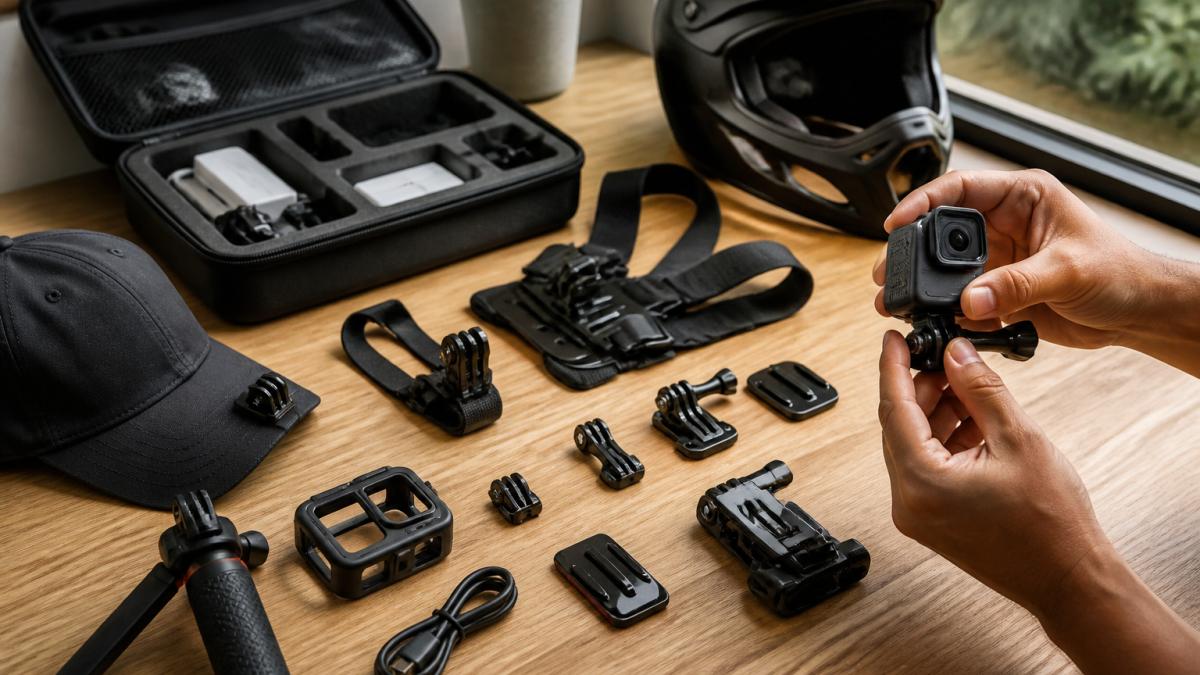
Setup and App Connection
Setup takes minutes. Charge the camera, check the storage, and confirm the mount is secure before you leave. Nothing ruins a ride faster than a camera that was never switched on.
Next, connect the camera to its companion app. The app handles three jobs: pairing the camera to your phone, transferring footage, and sharing clips. Setup is usually a case of pairing over Wi-Fi or Bluetooth, then importing the files you want.
Mounting and Framing by Activity
Mounting and framing change with the activity. The camera should sit where your eyes lead, not where it is easiest to clip. Here is how we approach it for common activities:
- Cycling: Cap or chest mount, angled slightly down to include the handlebars and the road ahead. A cap mount gives a natural eye-level view; a chest mount shows more of the bike and your hands but can bounce more on rough terrain, so check stabilization.
- Hiking and travel: Cap mount for a natural eye-level view; keep the horizon level. For travel, a bag or backpack mount at chest height keeps the camera discreet and captures candid moments without drawing attention.
- Gym and indoor training: Belt or bag mount, framed to include your hands and the equipment. Indoor lighting can be tricky, so test your camera's low-light performance before relying on it.
Privacy and Consent
The privacy side deserves more attention than it gets. For a wearable camera, the questions are simple: who appears in your footage, and where does it end up. Recording in public spaces is generally fine, but publishing footage of identifiable people is a different matter. Ask before you post. If you are using a digital disposable camera app at an event, guests are uploading photos to a shared gallery, and that means consent, storage, and download limits all matter.
Common Mistakes to Avoid
Most POV camera problems are avoidable, and they repeat across beginners and experienced users alike. Here are the ones we see most often:
- Buying resolution over usability. A 4K camera that is too heavy to wear beats nothing, but a 1080P camera you actually mount beats both.
- Skipping the mount. Handheld POV footage shakes and defeats the point of hands-free recording.
- Not testing battery life. Real recording time is shorter than the box suggests, especially at high resolution and in cold weather.
If you are coming from a phone-only setup, expect the first few clips to look wrong. That is normal. Adjust the angle, test again, and the footage improves fast. With our camera and mount working together, you have a complete system that works all year round.
POV Camera App: Setup, Sharing, and Privacy
A POV camera app handles three jobs: connecting the camera to your phone, transferring footage, and sharing clips. Setup is usually a case of pairing over Wi-Fi or Bluetooth, then importing the files you want.
The privacy side deserves more attention than it gets.
For a wearable camera, the questions are simpler: who appears in your footage, and where does it end up.
Common Mistakes to Avoid with Your POV Camera
Most POV camera problems are avoidable, and they repeat across beginners and experienced users alike. Here are the ones we see most often.
- Buying resolution over usability. A 4K camera that is too heavy to wear beats nothing, but a 1080P camera you actually mount beats both.
- Skipping the mount. Handheld POV footage shakes and defeats the point of hands-free recording.
- Not testing battery life. Real recording time is shorter than the box suggests, especially at high resolution.
If you are coming from a phone-only setup, expect the first few clips to look wrong. That is normal. Adjust the angle, test again, and the footage improves fast.
Conclusion: Your Next Steps with a POV Camera
The hardest part of POV recording is not the technology, it is remembering to bring the camera and mount it properly. Solve that and the footage takes care of itself, all year round.
At Asknik, we stock the Φορητή Κάμερα Προσωπικής Λήψης (POV) and the Μαγνητική Βάση Στήριξης Action Camera as a matched pair, so you get the camera, the mount, and everything you need to start recording in one order.
Get started with Asknik and capture your first POV clip this week.
Frequently Asked Questions
What is a POV camera and how does it work?
A POV camera is a compact, wearable device that records video from your point of view, giving a first-person perspective. It typically attaches to your body, clothing, or gear using mounts or clips. Most models record in 1080P or 4K, store footage on a microSD card, and connect to a mobile app for easy sharing. The Asknik Portable POV Camera weighs just 35 grams and captures hands-free 1080P video, making it ideal for cycling, travel, and everyday adventures.
What accessories are useful for a POV camera?
Useful POV camera accessories include magnetic mounts, cap clips, chest straps, and adhesive pads. A magnetic mount like the Asknik Magnetic Cap Clip Holder lets you attach your camera to a hat, belt, or bag in seconds without tools. It is compatible with Insta360 GO 3, GO 3S, and GO 2. Other helpful accessories are a microSD card, a power bank for longer recording, and a protective case. These extras make your camera more versatile across activities.
Can beginners use a POV camera easily?
Yes, beginners can use a POV camera with minimal setup. Most models have a single power button and start recording right away. The Asknik Portable POV Camera is designed for ease of use: clip it on, press record, and you are capturing hands-free video. The camera's companion app guides you through connecting via Wi-Fi, adjusting settings, and downloading clips. No advanced technical skills are needed, just a few minutes to get familiar with the controls.
Is a POV camera useful throughout the year?
A POV camera is useful year-round because it adapts to any activity. In summer, use it for cycling, hiking, and beach trips. In winter, mount it on a ski helmet or capture indoor family moments. Unlike seasonal gadgets, a POV camera helps you record daily life, travel, sports, and celebrations in any month. Its compact size means you can carry it everywhere, making it a practical tool for continuous use, not just a passing trend.