


Viral Gadgets: Worth Buying or Usually Low Quality?

Last Updated: October 24, 2026
Quick Summary
Viral gadgets are not usually low quality, and they are not automatically worth buying either. Whether a trending product earns its place depends on how carefully you check the listing, the seller, and the real cost of owning it. Score every gadget against the same criteria before you buy.
- Read the two- and three-star reviews first, where buyers describe what actually went wrong.
- Score gadgets 1 to 5 on verifiable specs, seller accountability, safety evidence, replacement cost, and real-use fit.
- Pay with a method that offers buyer protection, such as a credit card or protected checkout.
- Ask whether you would use the gadget at least once a week before buying it.
- If total cost of ownership is within about 20% of a mainstream alternative, the mainstream product usually wins.
Table of Contents
- Viral Gadgets: Worth Buying or Usually Low Quality?
- How to Spot Low-Quality Products Online
- A Side-by-Side Evaluation Framework for Trending Products
- Online Gadget Buying Tips That Actually Protect Your Money
- Viral Gadgets Worth Buying: What Separates a Keeper from a Fad
- Durability, Safety, and Total Cost of Ownership
- Conclusion
- Frequently Asked Questions
Viral Gadgets: Worth Buying or Usually Low Quality?
The honest answer is that viral gadgets are not usually low quality, and they are not automatically worth buying either. Whether a trending product earns its place depends on how carefully you check the listing, the seller, and the real cost of owning it.
Most buying advice fails because it treats "viral" as a quality signal. It isn't. Viral means a product got attention, usually through short clips showing it working in ideal conditions.
How to Spot Low-Quality Products Online
Low-quality products online usually reveal themselves before you buy. The warning signs sit in the listing: vague specifications, missing certification marks, stock photos that don't match the description, and sellers with no traceable identity. Spotting low-quality products online is a reading skill, not a lucky instinct.
Check the Listing, Not the Ad
The ad is designed to sell; the listing is where details hold up or fall apart. Open the full product page and look for specific, checkable information:
- Exact dimensions and weight. A gadget described only as "compact" or "portable" is hiding something.
- Materials named by type. "Premium material" means nothing. "Tritan body, stainless steel blades" means something.
- Battery capacity in mAh, motor power in watts. Numbers you can compare across listings.
If a listing can't answer these questions, that is your answer. A seller who won't state the specs either doesn't know them or doesn't want you to compare. For more on verifying labels and recalls, see our guide on how to verify safety certifications for kids gadgets.
Seller Reputation and Buyer Protection
A single glowing review proves nothing; patterns do. Read the two- and three-star reviews first, where people describe what actually went wrong. Then check whether the seller publishes a returns policy, a physical address, and clear contact details.
A Side-by-Side Evaluation Framework for Trending Products
Score every gadget you consider against the same five criteria, 1 to 5, to turn a vague feeling into a comparison you can act on.
| Criterion | What to Check | Score 1-5 | Weight |
|---|---|---|---|
| Verifiable specs | Dimensions, materials, power, capacity stated | High | |
| Seller accountability | Named seller, returns policy, contact details | High | |
| Safety evidence | CE mark, sensor cut-offs, battery certification | High | |
| Replacement cost | Consumables, cables, filters, batteries | Medium | |
| Real-use fit | Does it solve a problem you actually have weekly? | High |
Add the weighted scores and compare. Anything scoring low on safety evidence drops out regardless of total, because that is not a trade-off worth making.
A common mistake is scoring only the exciting criteria. Price and looks are easy to judge; verifiable specs and seller accountability predict whether you'll still be using the gadget in six months.
Online Gadget Buying Tips That Actually Protect Your Money
Good online gadget buying tips share one trait: they slow you down at the exact moment a deal is pushing you to hurry. Countdown timers and "only two left" banners are pressure tactics, not information.
- Pay with a method that offers buyer protection. A credit card or a platform's protected checkout gives you recourse. A direct bank transfer usually doesn't.
- Screenshot the listing at purchase. If the product arrives different from what was described, you have evidence.
- Check the shipping window before you commit. Long dispatch times often signal a seller who orders from a third party after you pay.
Asknik ships free on every order, and we'd rather answer a question about a cable or battery before you buy than process a return afterwards. For a broader checklist, see our guide to reliable stores for unique lifestyle gadgets.
Viral Gadgets Worth Buying: What Separates a Keeper from a Fad
A viral gadget is worth buying when it replaces a recurring annoyance with something you'll use at least weekly, and when the seller and safety evidence hold up. A fad is a gadget you use twice and then store. The difference rarely shows up in the video; it shows up in whether the product has a clear job in your routine.
A Category-by-Category Decision Guide
Not every category deserves the same risk tolerance. Use this guide to decide where a low-cost viral product is a reasonable experiment and where you should pay for reliability and safety.
Categories where trying a viral gadget can make sense:
Φορητό Μπλέντερ USB 350 ml για Smoothies – Ροζ ή Λευκό →
- Desk and bedside comfort items. Small fans, clip lights, cable organizers, and phone stands are low-risk, low-voltage, and easy to judge on arrival. If the build feels flimsy, the return is straightforward.
- Organization and storage tools. Drawer dividers, bag organizers, and cable management are simple products with few failure modes. The main risk is inaccurate dimensions, which the listing should state.
- Novelty kitchen helpers with no heat and no blades. Silicone strainers, measuring tools, and simple prep aids are usually safe to trial if the materials are named.
Categories where you should demand evidence before buying:
- Anything with a lithium battery that charges unattended. Portable blenders, mini vacuums, and power banks need battery certification and a charging cut-off, the category where a cheap imitation is most likely to fail dangerously.
- Heated devices. Mini heaters, heated mugs, and hair tools draw high current. Look for a recognized certification mark on the product and a thermal cut-off. If either is missing, skip it.
- Bladed appliances. Choppers, slicers, and blenders need a sensor interlock. A blade that spins without the guard in place is a design defect, not a feature.
The Weekly-Use Test
Before you buy any viral gadget, ask one question: would I use this at least once a week? If the honest answer is "maybe once a month," it is a fad for you regardless of how good the product is. A portable blender is worth it if you make smoothies away from home and clutter if you don't.
Real Examples from the Asknik Range
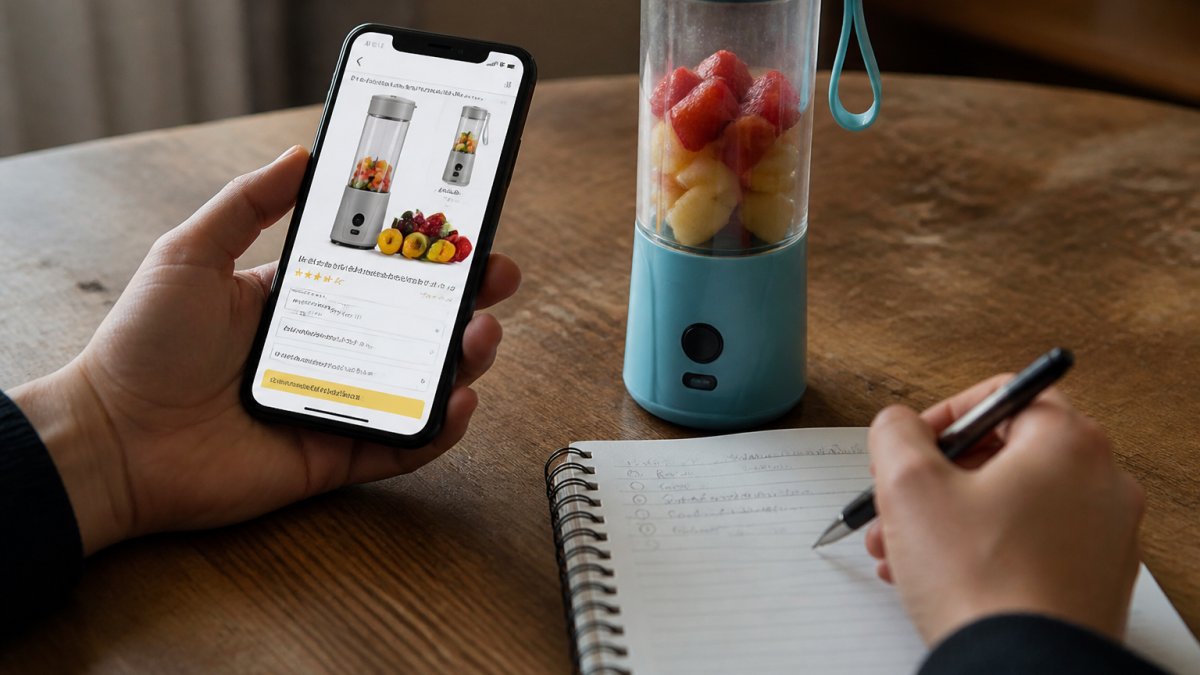
Take the portable USB blender in our range: a bottle and blender in one, with 350 ml capacity, a four-blade stainless steel base, and a 2000 mAh battery the supplier rates at roughly 15 blends per charge.
We are equally direct about the limits. For daily-use questions, our article on whether a portable electric juicer suits daily use goes deeper.
Durability, Safety, and Total Cost of Ownership
Most viral-gadget reviews stop at the unboxing, which is why so many buyers feel cheated six months later. Three questions decide whether a bargain gadget was worth buying: what does it cost to own, is it safe, and will it still work next year.
Total Cost of Ownership: The Real Price Tag
The listing price is only the first line of the receipt. Build a realistic total before you decide:
- Shipping and handling. A "cheap" gadget with paid shipping can land above a mid-priced alternative from a seller that ships free.
- Import fees and duties. Cross-border orders can attract customs charges that the seller does not show at checkout. Check your country's de minimis threshold before ordering.
- Accessories and consumables. Filters, replacement blades, proprietary charging cables, and pods are where budget gadgets quietly make their money back. If the accessory is proprietary, assume you will pay again.
A simple rule: if total cost of ownership is within about 20% of a mainstream alternative, the mainstream product usually wins on support and warranty. If the viral gadget is dramatically cheaper and you've verified the seller, it can be worth trying.
A Practical Safety Checklist
Safety is the one criterion where a low score should end the conversation, regardless of price. Use this checklist for anything electrical, battery-powered, heated, or for children:
- Compliance marks on the product, not just the photo. Look for a CE mark on the device itself and, where applicable, on the power adapter. A mark that appears only in marketing images is not evidence.
- Battery certification. Lithium cells should carry a recognizable certification (for example, UN 38.3 for transport and IEC 62133 for cells). If the listing does not mention battery certification, ask the seller directly.
- Charging cut-off and thermal protection. Cheap chargers and heated devices are the highest-risk category. A device that charges unattended overnight without a cut-off circuit is a fire risk, not a bargain.
Durability Signals You Can Read Before Buying
Durability is hard to test in a short review, but the listing gives clues:
- Named materials. "Stainless steel" and "Tritan" are checkable; "premium material" is not.
- Replaceable parts. Removable blades, user-replaceable batteries, and standard screws suggest the product was designed to be maintained rather than discarded.
- Sealed motors and IP ratings. For kitchen and bathroom gadgets, an IP rating (even a basic splash rating) signals the manufacturer thought about moisture.
The cheapest gadget is the one you only buy once. Score safety and build quality first, total cost of ownership second, and the headline price last.
Conclusion
The real challenge isn't finding viral gadgets, it's filtering them fast enough to avoid the duds. Asknik curates a range built around that filter: free shipping on every order, unique deals, and gadgets chosen for daily utility rather than short-lived hype. Browse our trending products to see what made the cut, and ask us before you order if you're unsure.
Frequently Asked Questions
Are viral gadgets worth buying, or are they usually low quality?
It depends on the category, not the trend. Viral gadgets split into two groups: products that solve a real, repeated task (portable blenders, mini projectors, desk coolers) and novelty items that lose their appeal after a week. Check whether the listing states real specifications (capacity in ml, resolution in pixels, battery in mAh), whether the seller offers returns, and whether the price matches the materials described. A 350 ml portable blender with stainless steel blades and a 2000 mAh battery at 36.99 is a different proposition from an unnamed gadget with no specs at all.
How can I tell if an online gadget is good quality before ordering?
Read the listing line by line and look for numbers. Vague claims like 'powerful motor' mean nothing; '20,000 rpm no-load, 14,000 rpm under load' is checkable. Look for material names (Tritan, ABS, 304 stainless steel), dimensions in millimetres, and what is included in the box. Then check the seller's return policy and whether the product carries a CE mark where relevant. If a listing shows no specifications and no clear seller identity, treat it as a warning sign rather than a bargain.
Is it safe to buy electronics and gadgets from online shops?
Safety comes down to certification and power specs. For anything that plugs in or charges, look for a CE mark, a stated voltage, and a charger requirement (for example 5V/2A). Avoid products that list no electrical specifications at all. Battery devices should state capacity in mAh, and water-adjacent devices should tell you what not to do, such as never submerging the base of a blender. If a seller cannot answer a basic safety question before you buy, that is your answer.
Why are the same viral gadgets cheaper on some websites?
Lower prices usually mean a different product underneath: thinner plastics, smaller batteries, no safety sensor, or no certification. A portable blender with a 2000 mAh battery and a safety cut-off is not the same item as one with an unlisted battery and no sensor, even if the photos look identical. Compare specifications, not just the price tag, and factor in shipping and returns. Free shipping plus a clear return window often costs less overall than a cheap item you cannot send back.
