
Greek homeowners face a unique challenge: thick stone walls that swallow WiFi signals, outdated electrical wiring without neutral wires, and a growing ecosystem of smart devices that often refuse to talk to each other. The good news is that these problems are very solvable. Using Matter-compatible devices creates seamless interoperability across Google Home, Apple HomeKit, and Amazon Alexa, cutting through the compatibility headaches that frustrate so many Greek households. In this guide, we walk you through every stage: assessing your home, fixing connectivity, managing energy costs, securing your network, and setting up voice controls that actually work in Greek.
Table of Contents
- Identifying and preparing your smart home for upgrades
- Step-by-step: Solving connectivity and compatibility issues
- Boosting comfort and efficiency: Energy management solutions
- Securing your smart home: Privacy and legal tips
- Smart control for Greek living: Ease of use and voice integration
- Our take: The smart path forward for Greek homeowners
- Find trusted smart home solutions at Asknik
- Frequently asked questions
Key Takeaways
| Point | Details |
|---|---|
| Solve device compatibility | Choose Matter-compatible devices to unify different smart systems effortlessly. |
| Boost connectivity | Mesh WiFi and Thread/Zigbee overcome thick walls and deliver stable coverage. |
| Cut energy costs | Smart thermostats and monitors can reduce energy use by up to 30%. |
| Secure your smart home | Segment your network and choose privacy-focused manufacturers for maximum protection. |
| Localize voice control | Google Home supports Greek language, making daily routines easier and more intuitive. |
Identifying and preparing your smart home for upgrades
Before buying a single device, take stock of what you already have. Walk through your home and note the age of your electrical panel, the location of your router, and whether your walls are concrete, stone, or brick. These details will shape every decision you make.
Older Greek homes often have two recurring obstacles. First, thick stone or concrete walls block WiFi signals aggressively, leaving dead zones in bedrooms and kitchens. Second, many installations lack neutral wires in switch boxes, which most smart switches require to function. Knowing these issues upfront saves you money and frustration.
Here is a quick comparison of what a traditional setup looks like versus an upgraded smart home:
| Feature | Traditional home | Smart home upgrade |
|---|---|---|
| Lighting control | Manual switches | App, voice, or schedule |
| Energy monitoring | Monthly bill only | Real-time usage data |
| Security | Physical locks | Smart locks and cameras |
| Climate control | Manual thermostat | Remote and automated |
| WiFi coverage | Single router | Mesh network |
To get started, gather these essentials:
- A mesh WiFi system or Thread/Zigbee hub to beat thick-wall signal loss
- A smart speaker or display as your central hub
- Smart plugs and bulbs for quick, no-wiring-required wins
- A voltage tester to check for neutral wires in your switch boxes
- Familiarity with the range of smart home device types available today
For a broader overview of practical strategies, our smart home tips resource covers the most common questions Greek homeowners ask before upgrading.
Pro Tip: If you are already planning a renovation, this is the single best time to run Ethernet cables and upgrade your electrical panel. Doing it later costs significantly more.
Step-by-step: Solving connectivity and compatibility issues
Once you have assessed your home, follow these steps to tackle the most common Greek smart home problems:
- Test your WiFi coverage using a free app like WiFi Analyzer. Mark every room where signal drops below a usable level.
- Deploy a mesh WiFi system in homes with thick walls. Brands like Eero, Google Nest WiFi, and TP-Link Deco handle multi-room coverage well.
- Check switch boxes for neutral wires. If they are missing, use smart bulbs or smart plugs instead of switches, or install Shelly relays behind existing switches. Upgrading old wiring this way avoids costly rewiring.
- Obtain a ΥΔΕ certificate (Υπεύθυνη Δήλωση Εγκαταστάτη) from a licensed electrician after any electrical work. This document is legally required in Greece and confirms your installation is safe and compliant.
- Choose a single ecosystem such as Google Home or Apple HomeKit, then add Matter-compatible devices that work across platforms.
Here is a comparison of the main connectivity options:
| Technology | Pros | Cons |
|---|---|---|
| Mesh WiFi | Easy setup, wide coverage | Higher cost |
| Thread/Zigbee | Low power, reliable mesh | Requires a compatible hub |
| Cat6 Ethernet | Fastest, most stable | Requires installation work |
Understanding the smart home advantages of each approach helps you invest wisely rather than over-spending on technology you do not need.
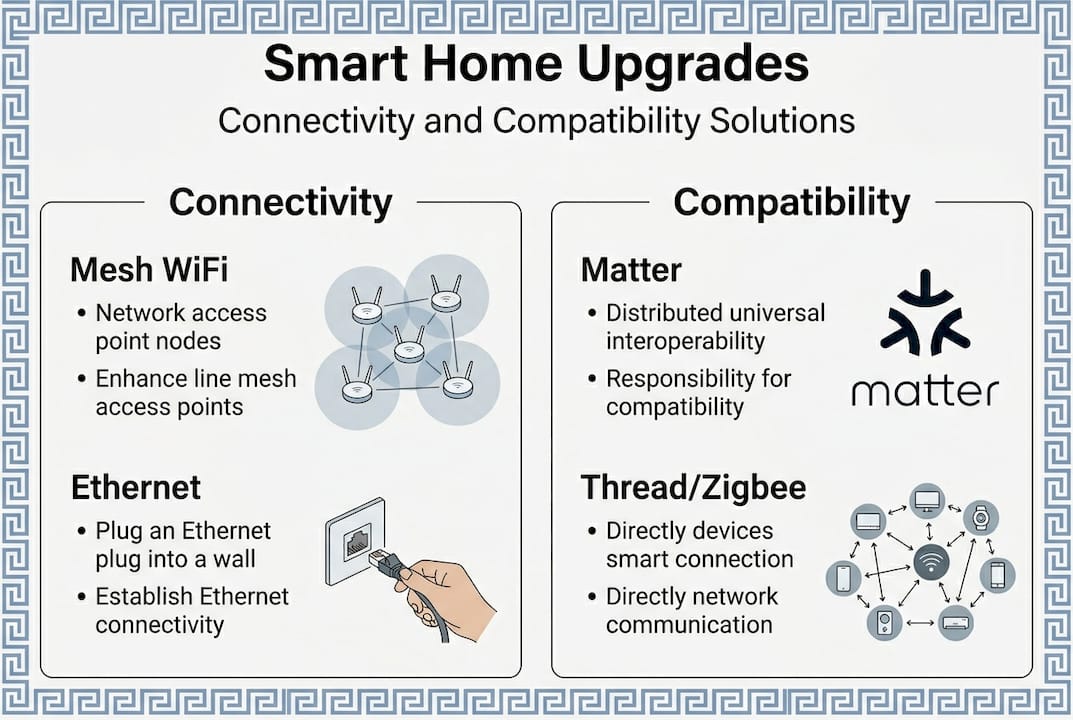
Pro Tip: During any renovation, run Cat6 Ethernet to your TV, office, and main living areas. A wired backbone makes your entire smart home faster and more reliable, regardless of which wireless protocol you use.
Boosting comfort and efficiency: Energy management solutions
Once your connectivity is solid, energy management becomes your highest-return upgrade. Smart thermostats and energy monitors can cut your consumption by 10 to 30 percent, with Nest data specifically showing 9.6% savings on heating and 17.5% on cooling across 1,000 homes.
For Greek homeowners, this matters even more given rising electricity prices. Here are the best tools to start with:
- Smart thermostats such as Nest or Tado, which learn your schedule and adjust automatically
- Smart plugs with energy monitoring to track which appliances consume the most power
- Whole-home energy monitors like Shelly EM, which connect to your electrical panel
- Smart power strips to eliminate standby power waste from entertainment systems
On the financial side, Greece offers real support. The Save Energy 2025 program carries a budget of €924 million, while the Renovate program provides up to €36,000 in subsidies with a total budget of €500 million. These programs focus on insulation, heating, and cooling upgrades, which pair naturally with smart thermostats.
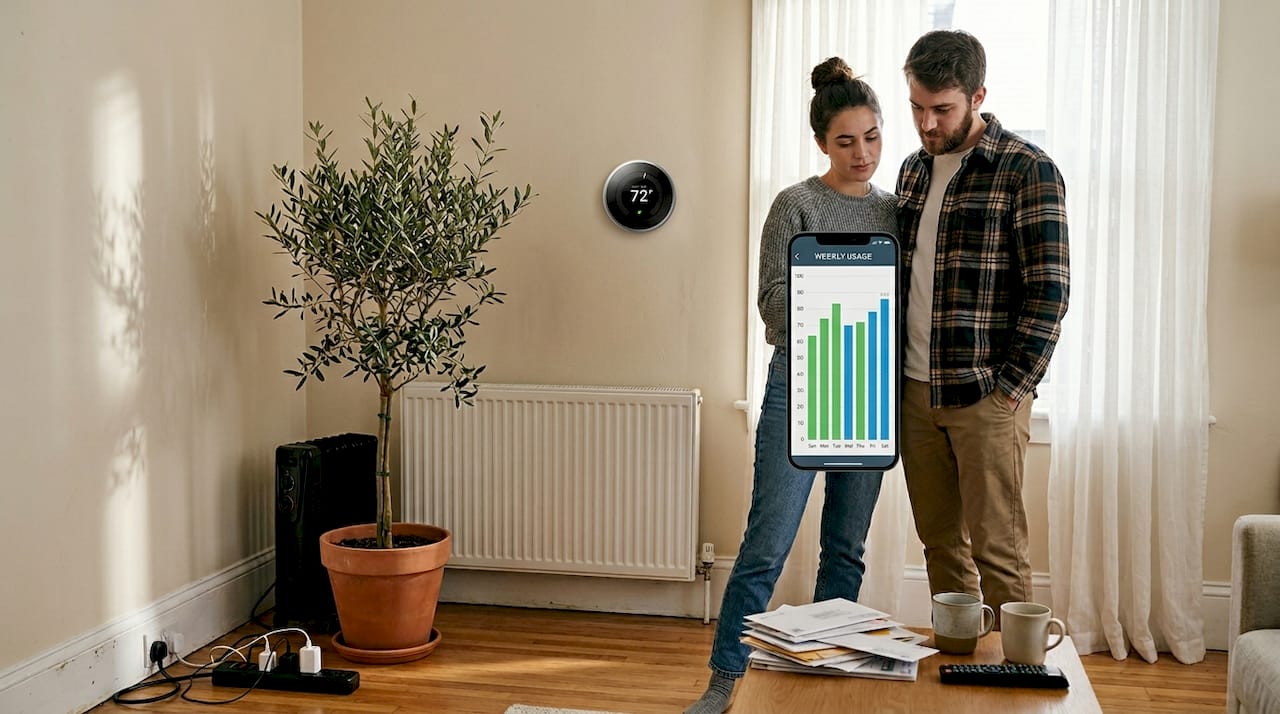
To monitor your usage effectively, set up weekly energy reports through your smart home app. Look for patterns: appliances left on overnight, heating running while windows are open, or lighting forgotten in unused rooms. Small adjustments add up to meaningful savings over a year.
For more ideas on cutting costs, our guide on smart energy savings covers the most impactful upgrades for Greek households specifically.
Pro Tip: Apply for Exoikonomo subsidies before purchasing your thermostat or insulation upgrades. Pairing both in a single application maximizes your reimbursement and reduces out-of-pocket costs significantly.
Securing your smart home: Privacy and legal tips
Comfort and efficiency are important, but security and privacy will ensure your smart home stays safe and legal. This is an area where many homeowners cut corners, and it creates real risk.
37% of smart home users worry about data sharing with third parties, and that concern is growing every year as more devices connect to home networks.
Here are the essential steps to protect your network and devices:
- Create a separate IoT network or guest network for all smart devices, keeping them isolated from your computers and phones
- Use unique, strong passwords for every device and your router admin panel
- Enable automatic firmware updates on all devices to patch security vulnerabilities quickly
- Activate multi-factor authentication (MFA) on your smart home apps and accounts
- Review manufacturer privacy policies before purchasing, as NIST recommends checking privacy practices and network segmentation as baseline steps
For outdoor cameras, Greek law applies GDPR strictly. Your camera must not record public sidewalks, streets, or your neighbor’s property. Violations carry real fines. Prefer cameras with local storage options over cloud-only models, so your footage stays on your property.
Choosing manufacturers with strong privacy track records also matters. Brands that offer local control, meaning the device works without an internet connection, give you more control and less exposure. Our resource on smart camera security explains what to look for when evaluating options for your home.
Smart control for Greek living: Ease of use and voice integration
With your smart home secure, let’s enhance everyday convenience through easy controls and voice integration. This is where the daily payoff becomes very real.
Google Home currently offers the most complete Greek language voice support among major platforms. You can control lights, thermostats, and routines entirely in Greek, which makes adoption much easier for the whole household, including older family members.
For split air conditioning units, which are the standard in most Greek homes, standard smart home protocols do not apply directly. Instead, use IR (infrared) controllers:
- SwitchBot Hub Mini for controlling any IR-based A/C, TV, or fan
- Broadlink RM4 Pro for multi-device IR control from a single hub
- Google Nest Hub as a central display and voice controller with Greek A/C integration
- Amazon Echo Dot as a budget voice assistant option for basic commands
Start with lighting and smart plugs before expanding to HVAC and security. These are the lowest-cost, easiest-to-install upgrades, and they give you immediate results. Once you are comfortable with the app and routines, adding more complex modern smart devices feels natural rather than overwhelming.
Automate your most repetitive routines first. Set lights to dim at 10 PM, the A/C to pre-cool before you arrive home, and the porch light to turn on at sunset. These small automations save time and energy every single day.
Our take: The smart path forward for Greek homeowners
Here is something most smart home guides will not tell you: the biggest mistake Greek homeowners make is trying to do everything at once. They buy a hub, six smart bulbs, a thermostat, two cameras, and a smart lock in the same week, and then spend months troubleshooting why nothing works together smoothly.
We believe incremental upgrades beat full overhauls every time. Start with lighting and plugs. Get comfortable. Then add energy monitoring. Then security. Each layer builds on the last, and you actually understand what you have installed.
Local compliance matters more in Greece than in many other European countries. The ΥΔΕ certificate requirement and strict GDPR enforcement for cameras are not optional. Skipping them creates legal and financial exposure that no gadget is worth.
On privacy, 37% of users worry about data sharing, and we think that concern is justified. Prioritize manufacturers with local control options over those that are entirely cloud-dependent.
Finally, do not chase the latest gadgets. Prioritize Google Home for Greek language support, choose Matter-compatible devices for longevity, and build a system that your whole family can actually use. Practicality and integration beat novelty every time. Our smart home practical tips page has more guidance on building a system that lasts.
Find trusted smart home solutions at Asknik
Ready to take the next step? At AskNik.gr, we have curated a range of smart home products that work well in Greek homes, from mesh WiFi systems and smart plugs to IR controllers and energy monitors. Every product goes through a quality check before it reaches you, and we offer free shipping on orders across Greece.
Whether you are starting with a single smart bulb or planning a full room upgrade, our team is here to help you choose the right products. We also stock a great selection of kitchen smart products for homeowners who want to extend their smart setup beyond the living room. Browse our store, explore our expert guides, and upgrade your home with confidence.
Frequently asked questions
What are the best smart home devices for Greek homes in 2026?
Matter-compatible devices, Google Home with Greek voice support, and IR controllers for split A/C units offer the best compatibility and everyday convenience for Greek households.
How can I improve WiFi coverage in an old Greek home?
Install a mesh WiFi system or use Thread/Zigbee protocols to overcome signal loss from thick walls. Running Ethernet cables during a renovation adds the most reliable long-term backbone.
Are Greek government subsidies available for smart home upgrades?
Direct smart home subsidies are limited, but energy upgrades like thermostats and monitors qualify for Save Energy 2025 and the Exoikonomo program, which can cover a significant portion of your costs.
How do I ensure my smart home camera setup is GDPR-compliant?
Avoid recording public spaces or your neighbor’s property, and prefer cameras with local storage over cloud-only options to meet strict Greek GDPR requirements.
What’s the top privacy tip for Greek homeowners upgrading smart tech?
Segment your network with a dedicated IoT guest network, use strong unique passwords, and choose manufacturers that offer local control. NIST recommends these as your first line of defense.