
TL;DR:
- Smart pet tech is widely accessible and used by 67% of Greek pet owners in 2026.
- Devices like GPS trackers and health monitors improve early illness detection and pet wellness.
- Successful use depends on owner engagement, proper device selection, and understanding technology limitations.
Smart pet technology is no longer just for veterinary clinics or tech-savvy early adopters. 67% of Greek pet owners used integrated pet tech ecosystems in 2026, a number that surprises most people who still think GPS collars and health monitors are niche products. The reality is that affordable, easy-to-use devices are now within reach for everyday pet owners across Greece. This guide walks you through the main device types, how they actually work, what the real benefits and limitations are, and how to choose the right solution for your specific pet and lifestyle. No jargon, no fluff, just practical information you can act on today.
Table of Contents
- Smart pet wellness devices: Types and features
- How wearable technology works for pets
- Benefits and limitations: Real-world impact for Greek pets
- Choosing and using pet wellness tech in Greece
- Expert perspective: What most guides miss about pet wellness tech
- Connect with wellness tech: Next steps for Greek pet owners
- Frequently asked questions
Key Takeaways
| Point | Details |
|---|---|
| Smart devices boost wellness | Pet owners in Greece benefit from early illness detection and proactive care using GPS trackers and health monitors. |
| Integration enables proactive care | Connecting feeders, trackers, and apps reduces vet visits and establishes helpful health baselines. |
| Select tech for local compatibility | Ensure devices support EU coverage and 2.4GHz WiFi to avoid performance issues in Greece. |
| Balance tech and intuition | Use technology alongside professional vet advice and attentive pet care for the best outcomes. |
| Subscriptions and sizing matter | Check ongoing subscription costs and proper device sizing for your pet before making a purchase. |
Smart pet wellness devices: Types and features
With the growing interest in smart pet tech, let’s break down the main device types Greek owners can use. The market has expanded quickly, and knowing what each category does helps you avoid buying something that doesn’t fit your needs.
GPS trackers are the most popular entry point. Devices like Tractive and the CAT mini attach to your pet’s collar and provide real-time location updates through a smartphone app. They also track daily activity, rest patterns, and some models offer virtual fencing with alerts when your pet leaves a set area. Tractive and PetPace provide trackers with real-time activity, health metrics, and virtual fencing, making them genuinely useful beyond simple location finding.
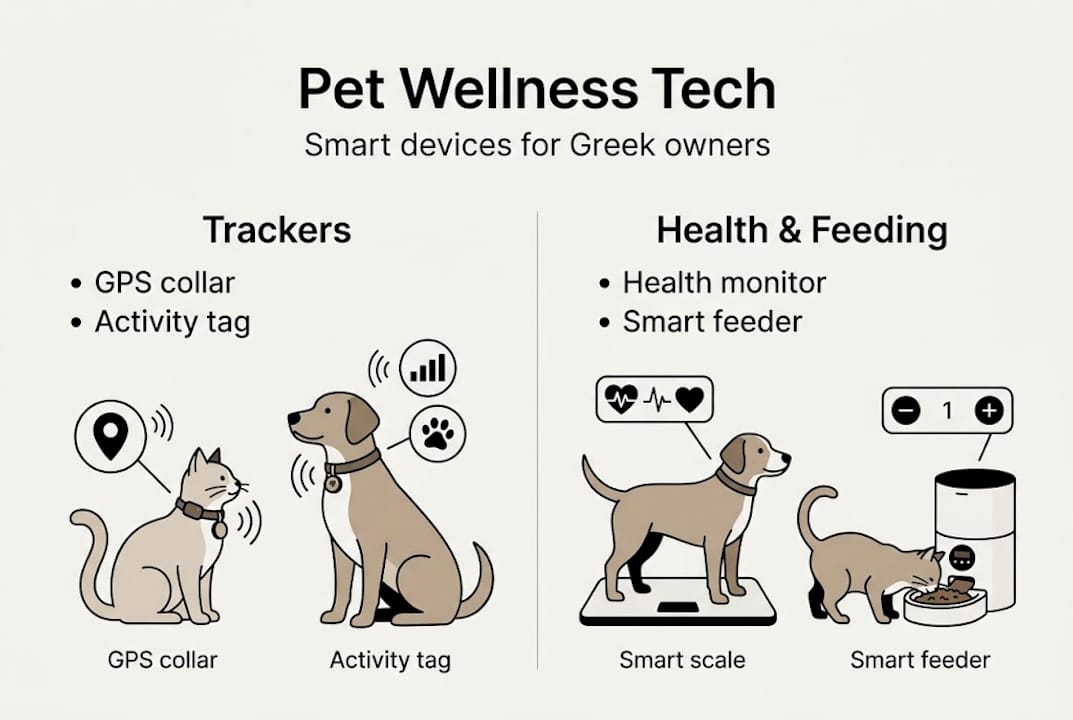
Health monitors go deeper. Products like FurCarer CGM and PetPace track vital signs, glucose levels, and behavioral patterns continuously. These are especially useful for pets with chronic conditions or older animals that need closer monitoring between vet visits.
Smart feeders and water fountains automate feeding schedules and portion control, reducing the risk of obesity, which is one of the most common preventable health issues in Greek pets today.
Here’s a quick comparison of the main categories:
| Device type | Key features | Best for |
|---|---|---|
| GPS tracker | Location, activity, virtual fence | Active dogs, outdoor cats |
| Health monitor | Vitals, glucose, behavior | Senior pets, chronic conditions |
| Smart feeder | Portion control, scheduling | Weight management |
| Smart collar | Multi-sensor, app integration | General wellness tracking |
Key things to check before buying:
- Battery life: Most trackers last 2 to 7 days per charge depending on GPS usage
- Subscription model: Real-time features almost always require a monthly plan
- Pet size compatibility: Many devices are optimized for medium to large breeds
- App ecosystem: Check if the app integrates with other devices you already use
Pro Tip: Always verify that a device supports EU wireless standards and 2.4GHz WiFi before purchasing. Some products sold outside Europe use frequencies that perform poorly in Greece. A local smart device retailer can confirm compatibility before you commit.
For a deeper look at location-based options, our pet GPS tracker guide covers the top picks available in Greece. You can also explore our pet health tracking devices guide for a more detailed breakdown of health-focused wearables.
How wearable technology works for pets
Now that you know the main device types, understanding how they work clarifies their usefulness. Most pet owners assume these devices are just glorified step counters. They are actually much more sophisticated.
The core of any pet wearable is its sensor array. Here’s what each sensor type does:
- Accelerometer: Measures movement in three dimensions. It detects walking, running, sleeping, and unusual stillness. This is how devices calculate activity scores and sleep quality.
- PPG sensor (photoplethysmography): Uses light pulses to measure blood flow through the skin, capturing heart rate and respiratory rate without any needles or wires.
- GPS and GLONASS: Dual satellite systems provide more accurate location data, especially in areas with buildings or hills that block signals.
- Temperature sensor: Monitors ambient and skin temperature to flag fever-like conditions.
The AI-COLLAR study established resting heart rate and respiratory rate baselines using accelerometers, PPG sensors, and GPS, confirming that continuous data collection produces clinically meaningful insights when paired with proper baseline setting.
Once sensors collect data, the app processes it against your pet’s personal baseline. A baseline is simply the normal range for your specific animal, not a generic average. If your dog’s resting heart rate is usually 65 beats per minute and it suddenly climbs to 90 for two consecutive nights, the app flags it.
“The shift from reactive to proactive pet care depends entirely on how well owners understand and engage with the data their devices generate.”
Ecosystem integration matters too. When your GPS tracker, smart feeder, and health monitor all connect to one app, you get a fuller picture. Activity data combined with feeding records and vital sign trends tells a story that no single device can tell alone. Our smart pet gadgets guide explains how to build a connected setup step by step. For plain-language explanations of how specific devices function, pet tech explained is a reliable resource.

Benefits and limitations: Real-world impact for Greek pets
Understanding the mechanics leads to practical questions. Is smart tech actually making Greek pets healthier? The evidence says yes, with important caveats.
Real benefits include:
- Early illness detection: A sudden drop in daily steps or changes in sleep patterns often appear days before visible symptoms. Owners who catch this early tend to get faster diagnoses.
- Glucose monitoring: For diabetic pets, continuous glucose data reduces dangerous spikes and helps vets fine-tune treatment plans.
- Seizure detection: Some advanced monitors flag unusual movement patterns consistent with seizures, giving owners critical information they would otherwise miss during nighttime episodes.
- Reduced emergency visits: When owners have data to share with their vet, consultations are faster and more targeted.
Trackers detect early illness and seizures with significant accuracy, though confirmation from a veterinarian is always required before drawing any clinical conclusions.
Limitations you need to know:
- Sensor accuracy drops for very small breeds (under 5kg) because the device-to-body ratio affects readings
- Dense or long fur can interfere with PPG sensors, producing inconsistent heart rate data
- Most advanced features require a paid subscription, which adds ongoing cost
- No device is a diagnostic tool. They flag anomalies; they don’t explain them
For independent pet tech reviews that test real-world accuracy across breeds, PCMag’s forward-thinking section is one of the most thorough sources available.
Pro Tip: Use smart tech as a layer of awareness, not a replacement for regular vet checkups. The best outcomes happen when owners bring device data to their veterinarian as a starting point for conversation, not as a final verdict. Browse our top smart pet products list to see which devices Greek owners are finding most useful right now.
Choosing and using pet wellness tech in Greece
Knowing what works, let’s cover how Greek owners can make confident decisions and maximize benefits. The biggest mistakes happen at the selection stage, not during use.
Step-by-step selection process:
- Identify your primary need. Is it location safety, health monitoring, or feeding automation? Pick one priority and build from there.
- Check device compatibility. Confirm EU certification and 2.4GHz WiFi support. Some devices sold on international platforms are not optimized for Greek networks.
- Review subscription costs. Factor in the monthly fee before comparing device prices. A cheaper device with a higher subscription can cost more over 12 months.
- Set up your ecosystem gradually. Start with one device, learn the app, establish your pet’s baseline, then add more devices if needed.
- Enable alerts thoughtfully. Too many notifications cause alert fatigue. Set thresholds that reflect genuine concern, not minor fluctuations.
Common mistakes Greek pet owners make:
- Buying a device sized for large breeds when they have a small dog or cat
- Skipping the wireless compatibility check and ending up with poor GPS performance
- Ignoring local support options when troubleshooting connectivity issues
- Expecting the device to work perfectly from day one without a baseline period
Local brand iPaw Tech complements global offerings with a focus on EU coverage and WiFi compatibility, making it a practical option for owners who want reliable local support alongside their device purchase.
For a broader look at what’s available, pet tech adoption stats show which device categories are growing fastest among Greek owners in 2026. Our pet tech gadgets guide also covers practical integration tips for everyday Greek pet routines.
One more thing worth mentioning: over-monitoring is a real issue. Some owners check their app every 20 minutes, which creates anxiety rather than peace of mind. Set a routine, check data once or twice a day, and trust the alert system to notify you when something genuinely needs attention.
Expert perspective: What most guides miss about pet wellness tech
With the practical tools covered, it’s time to step back and look at the bigger picture. Most guides focus on features and specs. What they miss is the mindset shift required to actually benefit from this technology.
Here’s the uncomfortable truth: smart pet tech is best at confirming that your pet is normal, not at diagnosing what’s wrong. The real value is in building a data history so that when something does change, you have a clear reference point. Without that baseline, alerts are just noise.
Veterinary consensus confirms that tech transforms care from reactive to proactive, but only when owners actively engage with the data rather than passively collecting it. That engagement requires a basic level of data literacy, knowing what a normal heart rate looks like for your specific breed, understanding what activity decline actually means, and being willing to bring that information to your vet.
The owners who get the most out of these devices are not the most tech-savvy. They are the most observant. Smart tech amplifies your existing attention to your pet. It doesn’t replace it. Our pet wellness tracking guide offers a practical framework for building that observational habit alongside your devices.
Connect with wellness tech: Next steps for Greek pet owners
Ready to take the next step? At AskNik.gr, we’ve made it easy to find smart pet gadgets that fit your pet’s size, your lifestyle, and your budget. From GPS trackers to smart feeders, our curated selection is quality-checked and ships fast across Greece.

Explore our range of pet-friendly gadgets and kitchen essentials for pets that make daily routines smarter and simpler. Whether you’re just starting out or building a full wellness ecosystem, our team is here to help you choose the right products. Discover more at AskNik and take advantage of free shipping on your next order.
Frequently asked questions
Are pet wellness devices available for all sizes and breeds in Greece?
Device accuracy declines for small breeds and very active pets, so most devices are optimized for average-sized animals. Always check the manufacturer’s size guidelines before purchasing.
Can smart tech alert me to serious health issues before symptoms appear?
Yes, trackers detect early illness such as activity decline or glucose spikes, but a veterinarian must confirm any diagnosis. Think of alerts as a prompt to call your vet, not a final answer.
Do pet wellness devices require a subscription in Greece?
Most do. Tractive subscriptions start at 4€/month for real-time updates, and most health monitors follow a similar model. Factor this into your total cost when comparing options.
Will my pet accept wearable tech, such as collars or sensors?
Most pets adapt within a few days, but some resist new devices. Check fit and approach by introducing the device gradually and ensuring the collar or sensor isn’t too tight or too heavy for your pet’s size.
How do I ensure compatibility with Greek wireless standards?
EU coverage and 2.4GHz WiFi support are the two key specs to confirm before buying. Devices without these certifications may have unreliable GPS or app connectivity in Greece.