
Losing sight of your pet, even for a moment, triggers immediate panic. Whether your dog slips through a gate or your cat wanders beyond familiar territory, the fear is universal among pet owners. Pet GPS trackers offer a technological solution to this age-old problem, combining satellite positioning with cellular networks to provide real-time location updates. For pet owners in Greece, where varied terrain ranges from urban centers to remote islands, these devices deliver peace of mind by turning your smartphone into a live map of your pet’s whereabouts. Understanding how these trackers work and choosing the right model can transform pet safety from constant worry into confident monitoring.
Table of Contents
- Key takeaways
- How pet GPS trackers work: technology behind the device
- Choosing the right pet GPS tracker in Greece: models, coverage, and features
- Maximizing GPS tracker use: tips for safety, battery life, and integration
- Where to buy pet GPS trackers in Greece and what to expect
- Explore essentials and tools for smart pet care
- FAQ
Key Takeaways
| Point | Details |
|---|---|
| Layered tracking tech | Trackers use GPS and cellular networks along with Bluetooth, WiFi and sensors to locate pets and monitor activity. |
| Greece LTE M coverage | Tractive provides a built in SIM with coverage across 175 countries including Greece. |
| Battery life tradeoff | Devices with longer battery life typically update less often, while shorter life models refresh more frequently. |
| Cellular first priority | Cellular network quality often drives real time tracking performance more than GPS signal alone. |
| Pricing and plans | Monthly costs typically range from €5 to €10 with annual prepayment discounts. |
How pet GPS trackers work: technology behind the device
Pet GPS trackers function through layered technology that pinpoints location and transmits data to your phone. At the core, satellite GPS systems including GLONASS and Galileo calculate your pet’s position by measuring signals from multiple orbiting satellites. This triangulation creates coordinate data accurate within 30 meters under ideal conditions. The device then routes this information through cellular networks using LTE-M, NB-IoT, or standard 4G connections to deliver updates to your smartphone app.
Beyond basic positioning, modern trackers integrate supplementary technologies for enhanced functionality:
- Bluetooth connectivity enables short-range detection when your pet is nearby, conserving battery by switching off cellular transmission
- WiFi positioning improves indoor accuracy where satellite signals weaken, using known network locations to refine coordinates
- Accelerometer sensors monitor activity patterns, distinguishing between rest, walking, and running to provide health insights
- Virtual fence alerts trigger notifications when your pet crosses predefined boundaries you set within the app
The physical design matters as much as the electronics. Collar attachment keeps the tracker accessible and secure, with rugged models offering water resistance and impact protection for adventurous pets. Battery capacity directly affects tracking frequency, you can choose between more frequent updates that drain power faster or longer intervals that extend operational time between charges.
Pro Tip: Position the tracker on the top of your pet’s collar rather than underneath to maximize satellite signal reception and improve location accuracy.
Cellular network quality determines real-time performance more than GPS accuracy. A tracker with perfect satellite reception becomes useless in areas without cellular coverage, making network compatibility your primary consideration when selecting a device for Greek geography.
Choosing the right pet GPS tracker in Greece: models, coverage, and features
Greek pet owners face unique geographic challenges that influence tracker selection. Tractive dominates the local market with built-in SIM cards offering coverage across 175 countries, eliminating the need to source compatible SIM cards separately. The LTE-M network technology these devices use penetrates rural areas and islands more effectively than standard 4G, addressing Greece’s scattered population centers and vacation destinations.
Consumer testing reveals accuracy within 100 feet for leading models under normal conditions, with GPS reliability scoring 9.1 out of 10 in real-world scenarios. However, dense urban environments with tall buildings or heavily forested areas can degrade precision temporarily. Battery performance presents the critical tradeoff: devices offering 5-day battery life typically provide updates every few minutes, while 14-day models reduce refresh frequency to conserve power.
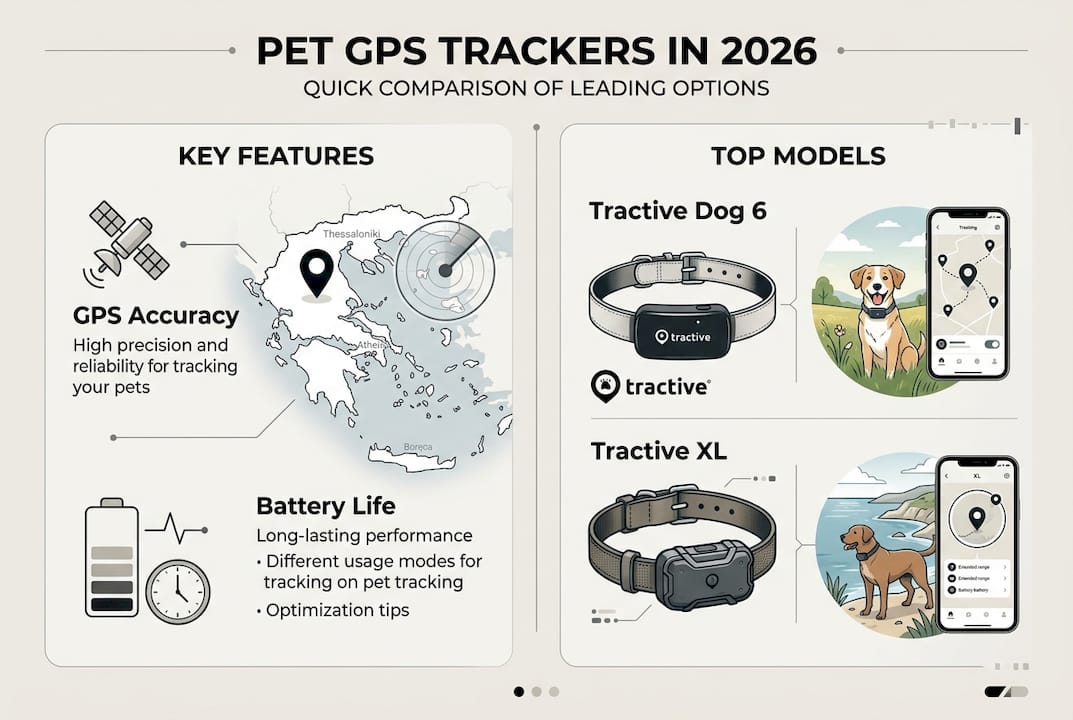
| Feature | Tractive Dog 6 | Tractive XL | Budget Alternative |
|---|---|---|---|
| Weight | 35g | 58g | 40-50g |
| Battery | 5-7 days | 10-14 days | 3-5 days |
| Update speed | 2-3 minutes | 2-3 minutes | 5-10 minutes |
| Waterproof | Yes (IPX7) | Yes (IPX7) | Variable |
| Best for | Small to medium pets | Large or active pets | Basic tracking needs |
Subscription plans fund the cellular data transmission that makes tracking possible. Monthly costs typically range from €5 to €10, with annual prepayment offering discounts. Some providers bundle the first month free with device purchase, giving you time to evaluate coverage in your specific location.
Key features to prioritize based on your situation:
- Live tracking mode for immediate location during active searches, though it drains battery rapidly
- Location history showing movement patterns over days or weeks, useful for understanding roaming behavior
- Activity monitoring tracking daily exercise levels and rest periods for health awareness
- Escape alerts notifying you instantly when your pet leaves designated safe zones
- Light and sound helping you locate your pet in darkness or dense vegetation
Pro Tip: Before committing to a purchase, test cellular coverage in your regular walking areas and vacation spots by checking your mobile carrier’s signal strength, since trackers rely on the same networks.
The refresh rate directly impacts both battery life and tracking usefulness. A two-minute update interval means your pet could travel 200 meters between position reports if moving quickly. For cats that roam gradually, longer intervals work fine. For energetic dogs prone to chasing, faster updates justify the battery tradeoff. Understanding your pet’s behavior patterns helps match device capabilities to actual needs.
Maximizing GPS tracker use: tips for safety, battery life, and integration
Effective tracker use extends beyond initial setup. Activating your subscription immediately ensures continuous monitoring, since devices arrive dormant to preserve battery during shipping. Download the companion app and complete account registration before attaching the tracker to your pet’s collar, allowing you to verify functionality in a controlled environment first.
Battery optimization requires strategic thinking about when precision matters most:
- Enable power-saving mode during routine days when your pet stays within familiar boundaries, extending operational time significantly
- Switch to live tracking only during active searches or when your pet enters unfamiliar territory
- Designate WiFi zones at home and frequent locations, allowing the device to use lower-power positioning when in range
- Schedule charging routines based on your device’s typical drain pattern rather than waiting for low battery warnings
- Update firmware regularly since manufacturers often release optimizations that improve battery performance
Virtual fence configuration demands careful boundary setting. Draw perimeters around your property and regular walking routes, but avoid making them so large that alerts become meaningless. Test the notification system by deliberately crossing boundaries with the tracker in hand, confirming that alerts reach your phone promptly and reliably.
Rugged models justify their premium cost for specific pet profiles. If your dog swims regularly, dives through brush, or plays roughly with other animals, standard trackers may fail within months. XL adventure models with reinforced cases withstand impacts and submersion that would destroy basic units, making them essential for highly active pets.
Pro Tip: Set up multiple user accounts within the tracker app so family members can all monitor your pet’s location, ensuring someone always receives alerts even if your phone battery dies or you lose signal.
Integrating GPS tracking with microchip identification creates comprehensive protection. Microchips provide permanent identification that proves ownership if someone finds your lost pet, but they require a scanner to read and offer no location data. GPS trackers actively show where your pet roams but depend on battery power and cellular coverage. Using both technologies covers scenarios where one system fails. Review essential pet gadget combinations to understand how different safety tools complement each other.

Regular testing prevents false confidence in untested systems. Monthly verification walks where you intentionally create tracking scenarios confirm that alerts function, boundaries trigger correctly, and battery life meets expectations under real conditions. This practice reveals coverage gaps in your area before an actual emergency exposes them.
Where to buy pet GPS trackers in Greece and what to expect
Greek retailers stock major tracker brands with local warranty support and Greek-language customer service, eliminating the complications of international purchases. Physical stores allow you to examine build quality and weight before buying, important factors since your pet wears the device constantly. Online retailers often provide detailed comparison tools and customer reviews that reveal real-world performance beyond manufacturer claims.
Purchasing considerations extend beyond initial device cost:
- Return policies allowing 14-30 day trials let you verify coverage in your specific area before commitment
- Warranty terms covering 1-2 years protect against manufacturing defects but rarely cover damage from pet activity
- Subscription flexibility permitting monthly cancellation versus annual commitment affects long-term costs
- Customer support availability in Greek helps troubleshoot technical issues without language barriers
- Replacement collar attachments sold separately matter if your pet damages or loses the mounting clip
| Retailer Type | Price Range | Shipping | Support Language | Return Window |
|---|---|---|---|---|
| Major electronics chains | €50-€120 | In-store pickup or 2-3 days | Greek, English | 14 days |
| Pet specialty stores | €60-€130 | 3-5 days | Greek | 14-30 days |
| Online marketplaces | €45-€110 | 1-7 days | Variable | 14 days |
| Direct from manufacturer | €50-€115 | 5-10 days international | English | 30 days |
Free shipping options reduce total cost significantly, especially for bulkier XL models where shipping fees otherwise add €5-€10 to the purchase. Some retailers bundle the first month’s subscription free with device purchase, effectively discounting the total first-year cost.
European SIM compatibility matters for pet owners who travel. Devices with pre-installed international SIM cards function across EU countries without additional setup, useful if you vacation with your pet or live near borders. Verify roaming coverage specifics before assuming seamless operation everywhere, since network partnerships vary by provider.
Questions to ask retailers before purchase:
- Which cellular networks does this specific model use in Greece?
- Can I test the device and return it if coverage proves inadequate in my area?
- Does the subscription auto-renew, and how do I cancel if needed?
- What physical damage does the warranty cover versus exclude?
- Are replacement batteries available, or must I replace the entire unit when battery capacity degrades?
Local retailers sometimes offer package deals combining trackers with premium collars, spare charging cables, or extended warranties at bundled discounts. Compare these packages against buying components separately to identify genuine savings versus marketing tactics. Check comprehensive pet gadget guides to understand which accessories add real value to your tracking setup.
Explore essentials and tools for smart pet care
Smart living extends beyond pet tracking into everyday convenience and efficiency. AskNik.gr specializes in innovative solutions that simplify daily routines, from tech gadgets to practical home essentials. Our curated collections focus on products that deliver genuine utility rather than gimmicks, with free shipping removing cost barriers to trying new solutions.
Whether you’re optimizing your kitchen workflow or seeking multi-purpose tools that save space and time, our kitchen and cooking essentials collection offers practical innovations. Tools like the folding measuring spoon demonstrate how thoughtful design transforms routine tasks. Explore our full range to discover how small upgrades create meaningful improvements in daily life, backed by our commitment to quality and customer satisfaction.
FAQ
Is a pet GPS tracker effective on Greek islands with spotty coverage?
LTE-M technology used in trackers like Tractive provides enhanced rural and island coverage compared to standard 4G networks. However, effectiveness depends on local cellular infrastructure quality, which varies significantly between major islands and remote areas. Testing coverage in your specific location before relying fully on the tracker remains essential, since network maps show general coverage but not real-world performance in all terrain types.
What subscription plans are needed for pet GPS trackers?
Cellular data subscriptions enable real-time tracking by transmitting location updates from the device to your smartphone app continuously. Monthly costs typically range €5-€10, with annual prepayment offering 15-20% discounts. Some manufacturers include the first month free with device purchase, while others require immediate subscription activation. Without an active subscription, the tracker cannot transmit location data, rendering it essentially non-functional for its primary purpose.
Can microchipping replace the need for GPS trackers?
Microchips and GPS trackers serve complementary rather than interchangeable functions. Microchips provide permanent identification proving ownership when someone finds your pet and scans the chip at a vet or shelter, but they offer no location tracking capability. GPS trackers actively show where your pet roams in real-time but depend on battery power and network coverage. Using both technologies creates comprehensive safety coverage, with microchips as permanent backup identification and GPS for active location monitoring.
How long do pet GPS tracker batteries usually last?
Battery life ranges from 5 to 14 days depending on model, settings, and usage patterns. Real-world performance often falls shorter than maximum manufacturer claims, especially with frequent location updates enabled. Power-saving features like WiFi positioning when at home, reduced update frequency during routine days, and automatic sleep modes extend operational time significantly. Trackers offering longer battery life typically update location less frequently, creating a tradeoff between monitoring precision and charging convenience.