


Are White Noise Machines Safe for Newborns: A Parent's Guide

Table of Contents
- Are White Noise Machines Safe for Newborns: The Evidence
- Safe Volume for White Noise Machine for Babies
- Where to Place a Sound Machine in a Baby's Room
- How Long to Use White Noise for Babies
- Can White Noise Cause Speech Delay in Babies
- Choosing and Using a White Noise Machine Safely
- Frequently Asked Questions
Last Updated: October 13, 2026
Are White Noise Machines Safe for Newborns: The Evidence
White noise machines are everywhere in nurseries. Parents use them hoping to help babies sleep better. But the big question remains: are white noise machines safe for newborns?
The short answer is yes, when used correctly. Most pediatricians agree white noise machines are safe for babies when you follow basic guidelines, the key is understanding what "safe use" means.
This guide breaks down what the research shows and gives you practical steps to use white noise safely.
What Research Actually Shows
The evidence on white noise machines for babies is more nuanced than "safe" or "unsafe." Studies show white noise can help some babies settle and sleep longer, but the research also highlights real concerns about volume and duration.
Babies respond differently to white noise: some sleep better with it, others seem bothered. Effectiveness depends on the individual baby, the volume level, and how long you use it.
The real risk isn't white noise itself, it's improper use. Machines that play too loudly or sit too close to the crib can damage developing hearing.
Hearing Safety Concerns and What Matters
Infant hearing is still developing. The inner ear structures that process sound are forming during the first months of life.
Prolonged exposure to loud noise can harm anyone's hearing, but babies' ears are more sensitive.
The real concern isn't a single loud sound. It's consistent exposure to elevated noise levels over time.
Many parents worry any white noise will damage their baby's hearing.
Safe Volume for White Noise Machine for Babies
The volume question is where most parents get confused: how loud is too loud?
Understanding Decibels and Infant Hearing
Decibels measure sound intensity on a logarithmic scale: a whisper is about 30 decibels, normal conversation 60, and a vacuum cleaner 80.
For white noise machines near babies, experts generally recommend keeping the volume at or below 50 decibels.
Some guidance suggests up to 65 decibels is acceptable, but lower is always safer.
Think of it this way: if you have to raise your voice to talk over the machine, it's too loud for the baby's crib.
How to Measure Sound in Your Nursery
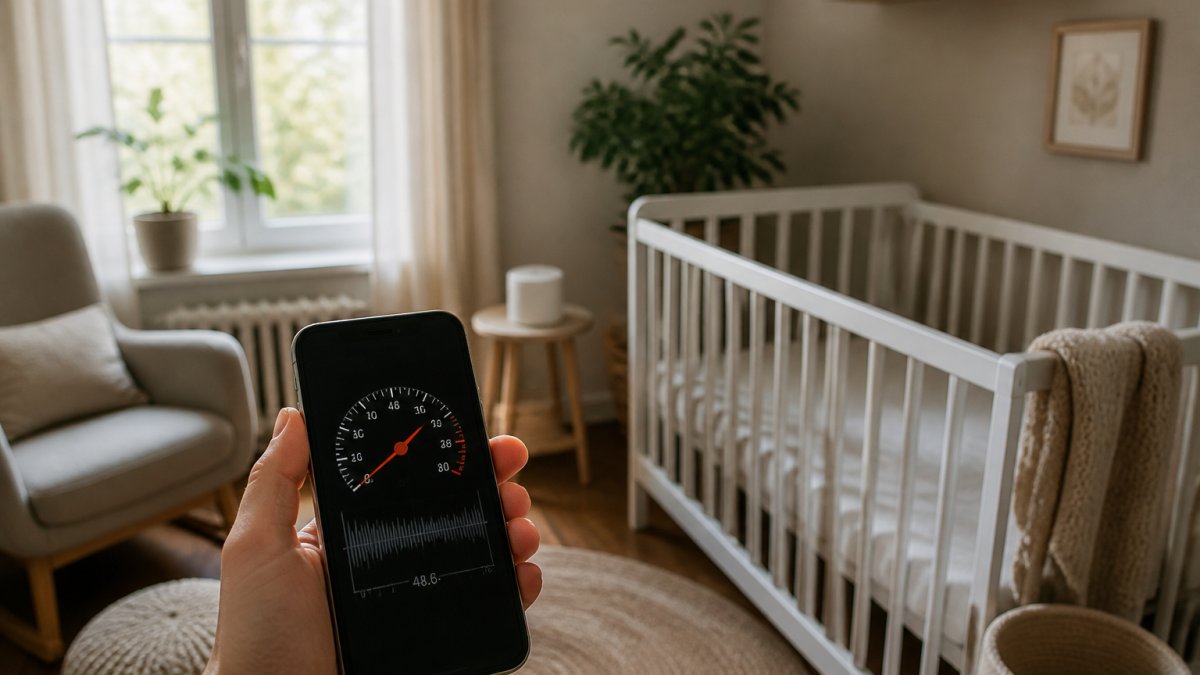
You don't need expensive equipment to check volume. Your smartphone has tools built in.
Many phones have free decibel meter apps. Download one and test your white noise machine:
- Place your phone where the baby's ear would be during sleep
- Turn on the machine at your preferred volume setting
- Check the reading on the app
This takes two minutes and removes all guesswork.
Write down the volume setting that gives you 50 decibels or less, and use it every night.
Where to Place a Sound Machine in a Baby's Room
Location is just as important as volume. A machine at the wrong distance can deliver unsafe sound levels even at low settings.
Distance and Placement Best Practices
Keep the white noise machine at least seven feet away from the crib.
Never place the machine inside the crib or on the crib rail, the baby could reach it or knock it over.
A good placement strategy:
- Place the machine on a dresser or shelf across the room
- Keep it away from the crib headboard
- Ensure it's out of the baby's reach as they grow
If your room is small and you can't achieve seven feet, move the machine farther away even if it means the sound is quieter.
Many parents worry the machine is too far away to help, but white noise doesn't need to be loud to be effective.
How Long to Use White Noise for Babies
Duration matters for hearing safety and for helping babies transition away from white noise dependence. But the right approach depends on your baby's age and sleep situation. A newborn in a bassinet next to your bed has different needs than a 9-month-old in a crib down the hall.
Newborns (0-4 Months): Focus on Safety, Not Weaning
For newborns, the priority is safe use, not how quickly you can stop. Newborn sleep is fragmented, and many parents find white noise helps everyone rest. There is no evidence it causes harm when volume and distance guidelines are followed.
At this stage:
- Keep the machine at least 7 feet from the bassinet or crib. In a small room, this may mean placing it across the room or just outside the door with the door slightly ajar.
- Use it for naps and night sleep if it helps. You don't need to limit duration for safety reasons as long as the volume is low.
- Don't worry about "dependence" yet. Newborns are not forming sleep associations in the way older babies do. The goal is meeting their needs.
If your newborn sleeps in a bassinet in your room, measure sound at the bassinet, not at your bed. The distance from the machine to the baby is what matters.
Συσκευή Λευκού Θορύβου με Φως Νυκτός & Αισθητήρα Αφής, 28 Ήχοι →
Older Infants (4-12 Months): Introduce Flexibility
Around 4-6 months, many babies develop more predictable sleep patterns, a natural time to consider whether white noise is still needed and how to use it more flexibly.
A gradual approach:
- Keep the same safe volume and distance. Don't increase volume to compensate for a baby who is becoming a lighter sleeper. Instead, consider whether other factors (teething, developmental leaps) are at play.
- Try one nap per day without white noise. Start with the nap where your baby seems most relaxed. If they settle fine, continue. If not, no pressure.
- Move the machine slightly farther away every few weeks. A few inches at a time reduces the sound level at the crib without a sudden change.
- Use a timer for naps. Instead of running the machine for the entire nap, set it to turn off after 20-30 minutes, once your baby is asleep. This reduces total exposure and helps them practice sleeping without it.
- Introduce nights without it once or twice a week. Pick a night when your baby is well-rested and you're not overly stressed. If it doesn't go well, try again in a week.
By 12 months, many babies can sleep without white noise, but there is no deadline. Some families continue for years because it helps everyone sleep. That's a valid choice as long as safety guidelines are followed.
Room-Sharing and Bassinet-to-Crib Transitions
When your baby moves from a bassinet in your room to a crib in their own room, the sound environment changes. A machine that was 7 feet away might now be 3 feet from the crib, re-measure and adjust.
If you room-share for longer (as many families do to reduce SIDS risk), keep the machine positioned so it's at least 7 feet from both your bed and the baby's sleep space. In a small room, this can be tricky. Options include:
- Place the machine in an adjacent hallway with the door open a few inches.
- Use a machine with a very low minimum volume and place it as far as possible.
- Consider a fan instead of a white noise machine; a fan provides gentle background sound and also improves air circulation, though it may not be as effective for masking household noises.
A Note on "Sleep Crutches"
White noise is sometimes called a sleep crutch, but that framing is unhelpful. Many sleep associations are normal and healthy: a dark room, a favorite blanket, a consistent bedtime routine. White noise is simply one more environmental cue.
If you decide to stop using white noise, do it gradually and without stress. If your baby protests, slow down or pause.
When to Stop or Reduce Use
Consider reducing or stopping white noise if:
- Your baby seems more agitated with it on than off.
- You notice you need to keep increasing the volume to get the same effect.
- Your baby's sleep is disrupted by the machine cycling on and off or changing sounds.
None of these are emergencies. They're just signals to reassess. White noise is a tool, not a requirement.
Can White Noise Cause Speech Delay in Babies
This is one of the most common worries parents mention. Does constant white noise exposure harm language development?
The short answer: there's no solid evidence that properly-used white noise causes speech delay.
The concern likely stems from the idea that babies learn language by hearing speech.
In practice, this doesn't happen.
What matters for language development is total speech exposure during waking hours.
Choosing and Using a White Noise Machine Safely
Not all white noise machines are created equal. Some are designed better for babies than others.
Features That Matter for Newborn Safety
Look for these features when selecting a machine:
- Volume control, You need the ability to adjust down to 50 decibels or lower
- Timer function, Lets you set it to turn off after a set time or run all night
- Cord safety, Keep cords away from the crib; use machines with short cords or wireless options
Asknik offers a Συσκευή Λευκού Θορύβου με Φως Νυκτός & Αισθητήρα Αφής, 28 Ήχοι that combines white noise with a gentle night light. It includes a timer and volume control, making it easy to use safely.

For parents who want a multi-function option, the Υγραντήρας Αρωμάτων με Εφέ Φλόγας, Λευκό Θόρυβο & Bluetooth combines white noise with a humidifier and Bluetooth speaker.

What to Do If Your Baby Doesn't Settle
Not every baby responds to white noise, some seem more bothered by it.
If your baby fusses when the machine is on, turn it off.
Try these alternatives:
- Soft lullabies, Some babies prefer melodic sounds over white noise
- Fan sounds, A small fan in the room provides gentle background noise without a machine
- Shushing sounds, Manual shushing or apps with this sound work for some babies
The goal is helping your baby sleep, not adhering to a specific method. If white noise doesn't work, move on.
Some babies respond better to white noise as they get older.
Pay attention to your baby's individual response.
White noise machines are safe for newborns when you follow basic guidelines: keep volume at 50 decibels or lower, maintain at least seven feet distance from the crib, and monitor your baby's individual response. The machines Asknik curates include volume controls and timer functions that make safe use straightforward.
Frequently Asked Questions
Is white noise good for newborns?
White noise can help some newborns settle and sleep by masking disruptive background sounds. However, evidence is limited and individual responses vary significantly. The main safety concern is hearing damage from excessive volume. If used correctly at safe levels (50 dB or below) and proper distance (at least 7 feet from the crib), white noise machines pose minimal risk for most newborns. Always monitor your baby's response and consult your pediatrician if you have concerns.
What is the safe volume for white noise machine for babies?
The recommended maximum volume is 50 decibels for continuous white noise exposure near a sleeping newborn. Some guidance suggests staying below 50 dB to minimize hearing risk. To measure this accurately, use a decibel meter app on your smartphone or a dedicated sound level meter positioned where your baby sleeps. Test the volume during the day before using it at night, and keep the machine at least 7 feet away from the crib to further reduce sound intensity at the baby's ear level.
Can white noise cause speech delay in babies?
There is no strong evidence that properly used white noise machines cause speech delay in babies. Speech development depends primarily on direct interaction, conversation, and language exposure from caregivers. White noise used as a sleep aid during nighttime hours is unlikely to interfere with daytime language learning. However, if white noise is used excessively throughout the day or at very high volumes, it could theoretically mask important speech sounds. Keep usage limited to sleep times and maintain safe volume levels to avoid any concern.
How long should I use white noise for my baby?
There is no strict time limit, but gradual reduction as your baby grows is sensible. Many parents use white noise during the newborn phase when settling is most challenging, then gradually wean the baby off it after 6-12 months as sleep patterns mature. If using all night, monitor your baby's sleep quality and adjust if the machine seems to prevent natural sleep transitions. Some babies settle without white noise, while others benefit from it longer. Watch your individual baby's response and discuss duration with your pediatrician if concerned.