


Are Digital Luggage Scales Worth It for Frequent Travelers?

Table of Contents
- The Real Cost of Overweight Baggage (and Why It Matters)
- Luggage Scales: Digital vs Manual vs No Scale at All
- Digital Luggage Scale Accuracy: What the Numbers Actually Mean
- How to Use a Travel Luggage Scale Correctly
- Weigh Luggage Without a Scale: 5 Ways That Work
- The Break-Even Math: When a Luggage Scale Pays for Itself
- What to Look For Before You Buy
- Conclusion
- Frequently Asked Questions
Last Updated: October 15, 2026
The Real Cost of Overweight Baggage (and Why It Matters)
Most travelers learn this the hard way: you pack at home, guess the weight, and discover at the airport that your checked baggage is over the limit.
At Asknik, we offer practical travel accessories. The fix is rarely complicated: a compact digital luggage scale costs very little and removes the guesswork.
But most guides get one thing wrong: they treat every traveler the same. A once-a-year vacation flyer and a weekly business traveler have completely different break-even points.
IATA baggage standards and guidance
Luggage Scales: Digital vs Manual vs No Scale at All
The three realistic options are a digital luggage scale, a manual spring scale, and no scale at all.
Digital luggage scale. A small battery-powered device with a hook or strap.
Manual scale. A spring-loaded mechanism with a dial or sliding indicator.
No scale. You rely on the airport scale at check-in. Free, but you find out too late to do anything except pay.
| Option | Accuracy | Portability | Best For |
|---|---|---|---|
| Digital scale | High, consistent readings | Fits in a pocket | Frequent travelers, carry-on packers |
| Manual scale | Moderate, can drift | Bulkier, mechanical | Occasional use, backup |
| No scale | Guesswork until check-in | Nothing to carry | Travelers who never approach the limit |
Digital Luggage Scale Accuracy: What the Numbers Actually Mean
A digital luggage scale measures a bag's weight by suspending it from a hook or strap and displaying the result on a screen, usually in kilograms and pounds. The interesting part isn't the display, it's the tolerance behind the number.
What "accuracy tolerance" actually means
Every scale has a stated accuracy tolerance, usually a range like "±0.1 kg" or "±0.2 kg" across a weight band.
In practice, a scale reading 22.9 kg with a ±0.2 kg tolerance could be measuring a bag weighing anywhere from 22.7 kg to 23.1 kg.
This is the mechanism most guides skip: the scale gives you a reading plus an uncertainty band, not a single true weight.
How to test your scale at home
You don't need lab equipment. You need one object with a known weight and a few minutes.
The water bottle test. A 1-litre bottle of water weighs approximately 1 kg at room temperature (Water Density).
The repeatability test. Weigh the same bag three times.
The reference-weight test. Weigh a known object on both your scale and a kitchen or gym scale.
Calibration drift: why scales go wrong over time
A scale that was accurate when new can drift. The causes are mechanical and environmental:
- Drops and impacts. The load cell inside a digital scale is a precision component. A hard drop can shift its zero point.
- Heat exposure. Leaving a scale in a hot car or a checked bag in summer can affect the sensor and the electronics.
- Battery degradation. A weak battery doesn't just shorten runtime, it can cause unstable readings and false zeros.
None of these are reasons to avoid digital scales. They're reasons to test yours before a trip where the weight matters.
The safety cushion: turning tolerance into a packing rule
The practical takeaway: if your scale has a ±0.2 kg tolerance and your airline limit is 23 kg, don't pack to 23.0 kg. Pack to 22.5 kg or below. That cushion absorbs three things:
- Your scale's tolerance, the reading could be low by up to 0.2 kg.
- The airport scale's tolerance, the check-in scale has its own accuracy band, and it may read slightly higher than yours.
- Handling variation, how the bag sits on the airport scale, whether a strap is included, and whether the agent rounds up.
A cushion of 0.5-1 kg below the limit is a common rule of thumb among frequent travelers. It costs almost nothing in packing flexibility and removes the entire category of "I was sure it was fine" surprises.
When accuracy matters less than you think
If you're a carry-on-only traveler whose bag never approaches the limit, precision is irrelevant. A scale off by 0.5 kg still tells you you're at 8 kg when the limit is 10 kg. Accuracy matters most for travelers who pack near the limit, exactly those for whom a tested, well-maintained scale earns its place. Reliable weighing tools represent only one category of travel convenience items that can simplify the logistical burdens of modern transit, much like the decision to pack a travel bidet.
How to Use a Travel Luggage Scale Correctly
Using a travel luggage scale correctly takes about thirty seconds per bag. Technique matters, because how you lift the bag changes the reading.
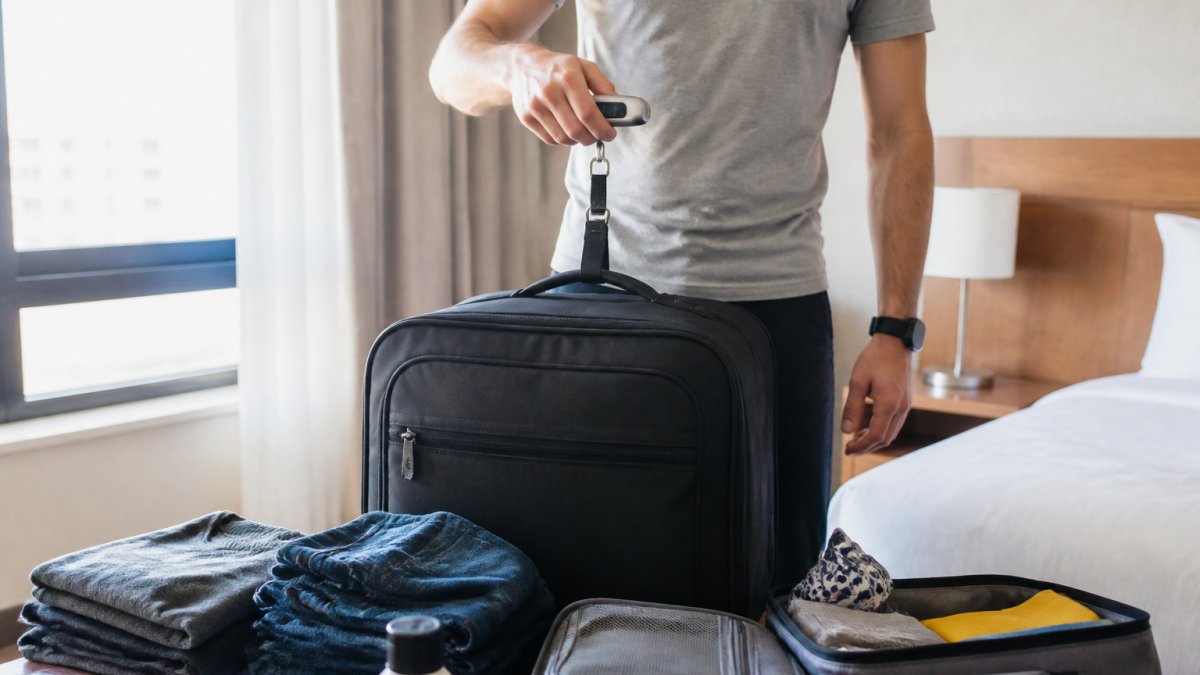
- Pack first, weigh second. Weighing a half-packed bag tells you nothing useful.
- Attach the hook or strap securely to the suitcase handle.
- Lift smoothly and hold still. Wait for the display to settle before reading it.
- Keep the bag off the floor. Resting it on anything transfers weight and skews the reading.
- Weigh each bag separately. Carry-on and checked baggage have different limits.
- Record the number and compare it to your airline's allowance.
- Repack if needed, moving heavy items to your carry-on or leaving them behind.
Expected result: a stable weight reading you can compare directly against your airline's checked baggage limit, with time to repack before you leave for the airport.
Weigh Luggage Without a Scale: 5 Ways That Work
If you've forgotten your scale, you still have options. None are as precise as a digital luggage scale, but they beat guessing.
- Bathroom scale method. Weigh yourself, then weigh yourself holding the suitcase. The difference is the bag weight.
- Hotel gym scale. Many hotels have a scale in the fitness room.
- Airport scale, early. Arrive with time to spare and use the check-in scale before the queue builds.
The bathroom scale method is the most reliable of the five: stand on the scale alone, note the number, then step on holding the bag and subtract.
The Break-Even Math: When a Luggage Scale Pays for Itself
Most guides tell you a luggage scale "pays for itself" and stop there. That's a slogan, not a calculation. Here's how to run the numbers for your own travel pattern, using three inputs.
The formula is simple:
Break-even trips = Scale price ÷ (Overweight fee × Probability your bag is over the limit)
That last variable separates frequent travelers from occasional ones. If you pack near the limit every trip, your probability is close to 1.
Worked example: the weekly business traveler
Imagine a consultant who flies twice a month with a checked bag usually within a kilogram or two of the allowance. She estimates her bag is over the limit on roughly one trip in four, and her airline charges a flat excess-baggage fee published on its website.
- Scale price: a one-time cost, typically in the range of a modest travel accessory
- Overweight fee: one avoided fee already exceeds the scale price for most consumer models
- Probability of being over: roughly 25% of trips
At that rate, the scale breaks even within the first year, often within months. Every avoided fee after that is pure savings, and the scale keeps working for years.
Worked example: the once-a-year vacation flyer
Now imagine a traveler who takes one two-week holiday a year and packs a half-empty bag. Her probability of being over the limit is low, maybe one trip in ten.
For her, the break-even math is weak. The airport scale at check-in is free, and the risk is small. A digital luggage scale isn't wrong for her, it's just not the obvious win it is for the business traveler.
The variable most guides ignore: fee structure
Overweight fees are not uniform. Some airlines charge a flat fee per overweight bag; others charge by weight band, a smaller fee for 23-32 kg, a larger one above.
This matters because the fee you're avoiding isn't a single number, it's a distribution. A flat-fee airline gives a simple calculation; a per-kilogram airline gives a granular one, and the scale's value goes up because small overages are cheap to fix before you fly and expensive at the counter.
A quick self-assessment
Answer these three questions honestly:
- How many trips per year do you check a bag? If zero, stop here, a scale won't help.
- On how many of those trips is your bag within 2 kg of the limit? This is your risk exposure. If it's most trips, the scale is doing real work.
- What does your airline charge for an overweight bag? Check the airline's own baggage page, not a third-party summary, fees vary by route and fare.
If your answers point to frequent near-limit packing on an airline with meaningful fees, the scale pays for itself quickly. If they point to occasional light packing, you can skip it.
What to Look For Before You Buy
Focus on five things: accuracy tolerance, display readability, battery type, build quality, and weight range.
- Accuracy tolerance. Look for a model that states its tolerance clearly.
- Display. A backlit screen helps in dim hotel rooms.
- Battery. Standard replaceable batteries beat proprietary ones.
Long-term reliability comes down to storage: remove the battery if you won't use the scale for months, and keep it out of hot cars. A well-treated scale lasts for years of trips.
Conclusion
The honest answer: a digital luggage scale isn't for everyone. If you fly once a year with a light bag, skip it.
Asknik stocks practical travel accessories designed to make trips simpler, including compact gear that fits in a carry-on pocket. Every order ships free, and our range covers smart, useful gadgets. Browse the Asknik travel collection and pack with confidence.
Frequently Asked Questions
Are digital luggage scales accurate enough for air travel?
A decent digital luggage scale typically reads within a small tolerance, often a few hundred grams, which is close enough for airline baggage limits when you leave a modest cushion below the allowance. Accuracy varies by model, so test yours against a known weight at home and note the difference. Manual spring scales drift more over time, so digital luggage scale accuracy is generally better for repeat use. Always allow a small buffer rather than packing right to the exact limit.
Can a luggage scale help you avoid overweight baggage fees?
Yes, in most cases. Overweight baggage fees are usually charged per kilogram or per bag over the allowance, and they can add up fast on a return trip. Weighing your suitcase before you leave home lets you repack, shift items to a carry-on, or wear heavier layers instead of paying at check-in. For frequent travelers, the savings from avoiding even one excess baggage fee often cover the cost of a scale many times over.
How do you use a digital luggage scale?
Hook the strap or clamp around your suitcase handle, lift the scale straight up until the bag is fully off the ground, and hold it steady until the reading locks. Keep the bag from touching anything and wait a second or two for the number to settle. Weigh each bag separately, and repeat once if the reading jumps. For best results, use a fresh battery and store the scale somewhere it will not get crushed in transit.
How can you weigh luggage without a luggage scale?
You can use a bathroom scale by weighing yourself first, then weighing yourself holding the suitcase, and subtracting the difference. This works reasonably well if your home scale is accurate and you stand still. Some airports have public scales near check-in, though you may have to hunt for them. A third option is estimating by comparing your bag to a known weight, but that is the least reliable method and leaves little room for error.