


How to Baby Proof a Small Apartment Room by Room

Table of Contents
- Start With an Eye-Level Hazard Walkthrough
- Zone Your Small Apartment Before You Buy Anything
- How to Baby Proof a Small Apartment DIY, Without Drilling
- Baby-Proof Living Room Ideas for a Shared Space
- Baby-Proofing a Room for a Floor Bed
- Prioritizing Hazards on a Limited Budget, With a Printable Checklist
- Your Next Step: Walk the Apartment Again at Each Milestone
- Frequently Asked Questions
Start With an Eye-Level Hazard Walkthrough
Learning how to baby proof a small apartment starts with the floor instead of a shopping list. Get down to where your baby crawls and look at your small apartment from there.
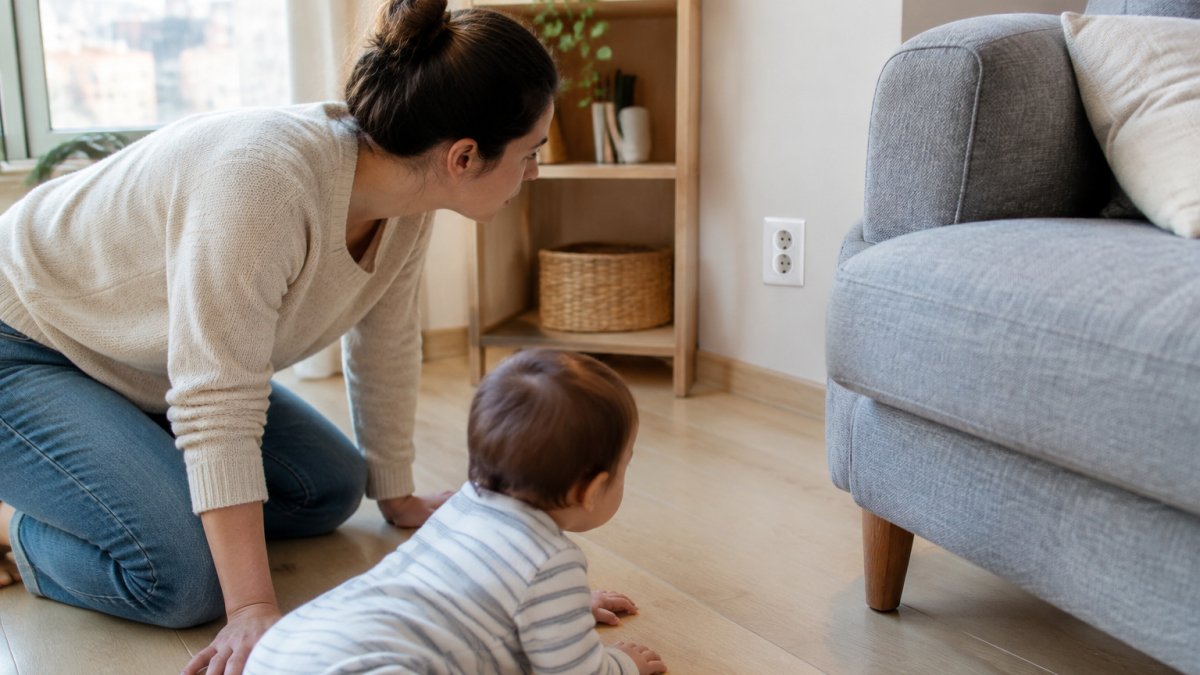
Get on your hands and knees and move slowly through each room.
Crawling and standing heights
Think about two heights, because babies change fast:
- Crawling height (about 0 to 30 cm off the floor): outlets, cords, floor heaters, small objects, cleaning products under sinks, and pet food.
- Standing height (about 80 to 100 cm): tabletop items, TV stands, lamps, hot drinks, and anything a baby can pull down while holding furniture.
Walk each room at both heights. A cup on a coffee table is a problem for a baby who can stand. A loose cord behind the couch is a problem for one who crawls.
Zone Your Small Apartment Before You Buy Anything
In a small apartment, the goal is not to baby-proof every square metre. It is to decide which spaces your baby can reach and which stay closed off. Zoning saves money, keeps your home usable, and, most importantly, reduces the number of hazards you have to fix. The layout decision comes first because it determines what you actually need to buy.
Map the apartment in three zones
Draw a simple floor plan and mark every room as one of three types:
- Safe zone: one or two areas where your baby plays and sleeps, fully baby-proofed. In a small apartment this is often a living-room corner plus the bedroom.
- Gated zone: rooms your baby can enter only with an adult, such as the kitchen or a shared bathroom. A gate or a closed, latched door controls access.
- Closed zone: rooms that stay shut, such as a home office, balcony, or storage room. A door latch is cheaper and more reliable than a gate.
Fewer open zones means fewer hazards to fix. If your apartment has an open-plan living and kitchen area, treat the kitchen as a gated zone and use a gate or a closed door at the boundary, do not try to baby-proof the whole open plan.
Handle rooms that serve more than one purpose
In a small apartment, the living room is often playroom, office, and adult lounge at once. Zone by time and by height rather than by walls:
- By time: set up a floor-level play area that you can clear at the end of the day, and return adult items (hot drinks, laptops, remotes) to a high shelf or closed cabinet when playtime ends.
- By height: keep the bottom 100 cm of every shared room baby-safe and move adult-only items above that line. A low, closed storage unit for toys doubles as a barrier in front of a TV stand.
- By furniture: use a sofa, a low bookshelf, or a playpen as a soft boundary where a gate will not fit. These are not substitutes for a gate at a stair or kitchen, but they work as visual and physical cues in a tight room.
Place gates where they actually fit
Measure every doorway and opening before buying a gate. Pressure-mounted gates need flat, parallel surfaces and a consistent width; angled or narrow openings often need a hardware-mounted gate or a closed door instead. In a small apartment, a gate that does not fit is worse than a latched door, because it gives a false sense of security.
Watch out: Do not stack gates or use tension rods as barriers, they can slip under a climbing toddler's weight. If a doorway is too awkward for a gate, close and latch the door.
Re-check the zones as your baby grows
A zone that works for a crawler fails for a climber. When your baby starts to pull up, re-walk the apartment and ask whether the safe zone still contains everything within reach at standing height. When your baby starts to climb, check that gates and furniture boundaries cannot be scaled, and move any climbable furniture away from the safe-zone edge.
How to Baby Proof a Small Apartment DIY, Without Drilling
Renters face two constraints at once: no drilling and no room for bulky gear. A suction-cup silicone sink splash guard can seal off one common kitchen hazard without any drilling. The good news is that most of the highest-risk hazards in a small apartment can be handled with removable products. Not every removable product suits every spot, so read the trade-offs before you buy.
- Outlets first. Sliding outlet covers or plug-in protectors on every outlet within a baby's reach. Sliding covers stay attached to the plate and are harder for a toddler to remove; plug-in protectors are cheaper but can be pulled out and become a choking hazard. Check that the cover seats firmly and cannot be levered off.
- Cords second. Adhesive cord clips and short cord concealers keep lamp and charging cables out of reach. Blind and curtain cords are a strangulation risk, fit a cord stop or tie them high, and never leave a loop hanging at crawling height.
- Furniture anchors third. Tall dressers, bookshelves, and TV stands must be anchored. Renter-friendly options include furniture straps that screw into a wall stud with a small bracket, and adhesive-and-strap systems that rely on a strong bonding pad. Adhesive anchors work best on smooth, clean, painted surfaces and are not a substitute for a wall anchor on a heavy dresser, if the furniture is tall and heavy, use a small screw-in strap and patch the holes at move-out.
- Cabinet and drawer locks fourth. Magnetic locks need no drilling and leave no visible latch to fiddle with; adhesive sliding locks are a cheaper option but may leave residue on finished wood. Put locks on any cabinet holding cleaning products, medicine, knives, or batteries.
- Gates last, and only where they fit. Pressure-mounted gates work in doorways and between rooms on flat, parallel surfaces, and they are the renter's default because they leave no holes. They are not safe at the top of stairs, use a hardware-mounted gate there, or close and latch the door instead. In a small apartment, a gate that does not fit a narrow or angled opening is worse than a closed door, so measure the opening before buying.
Watch out: Adhesive products can fail on textured walls, wallpaper, or surfaces that get warm (above a radiator, near a stove). Test each adhesive mount by pulling firmly before trusting it, and re-check monthly.
Furniture tip-over anchors and corner guards
Tall dressers, bookshelves, and TV stands can tip when a child pulls a drawer open or climbs. Anchor every unit taller than about 75 cm (30 in) that a child can reach. Anchoring furniture is one of the few safety fixes that needs a wall screw, while other apartment upgrades can stay drill-free with ideas from SATU-Market.
For sharp corners on coffee tables, TV stands, and fireplace hearths, use soft silicone or foam edge guards. Soft silicone or foam edge guards are one option for sharp corners. Clean and dry the surface first, adhesive guards fail on dusty or oily edges.
Outlets, cords and cabinet locks
Outlet covers are the cheapest high-impact fix. Use sliding covers or plug-in protectors on every outlet a crawling or standing baby can reach.
Keep cords short and tucked. Blind and curtain cords are the priority: fit a cord stop, tie them high, or replace them with a cordless blind. Lamp and charging cords should run behind furniture or through adhesive clips, not across the floor.
Cabinet locks come in magnetic, adhesive, and sliding styles. Magnetic locks suit renters because they need no drilling; adhesive sliding locks are cheaper but can leave residue.
Baby-Proof Living Room Ideas for a Shared Space
In a small apartment, the living room is often the family's shared space. It is also where many hazards gather: the TV, the coffee table, the sofa, the plants, and the remote control.
Choose a floor-level play area with a soft mat and move hazards out of its reach. Keep the TV on a low, stable stand and anchor it to the wall.
Think about shared routines too.
Houseplants deserve special attention. Many common plants are toxic if chewed. Move them to a high shelf or a room your baby cannot enter.
Baby-Proofing a Room for a Floor Bed
A floor bed, or a mattress placed low on the floor, is a popular choice for toddlers who climb out of cribs.
Clear the area around the bed of lamps, cords, and furniture that a child could climb. Readers unsure whether a night light is safe for a baby can check which night lights are safe for baby nurseries.
A small wall-mounted night light near the door, placed well out of reach, lights the path without creating a cord hazard. Check that any light is cool to the touch and kept away from bedding.
Prioritizing Hazards on a Limited Budget, With a Printable Checklist
You do not need to buy everything at once. Rank the hazards by how serious they are and how likely your baby is to reach them. Fix the worst ones first.
Use this order:
- Highest priority: outlets, cords, medicines, cleaning products, and cabinets with chemicals
- High priority: unanchored tall furniture and TVs, and the stairs
- Medium priority: sharp corners, small objects, and breakable décor
- Lower priority: cabinet contents that are not dangerous and furniture that is low and stable
Keep a simple printable version of this list on the fridge and tick off each item as you finish it. A wooden Montessori busy block with locks can keep a crawler occupied and away from these risks during the fixes. Review it again at each new stage of development.
The article ranks hazards by seriousness and how likely a baby is to reach them, so fix the worst ones first:
| Priority | Hazards |
|---|---|
| Highest | Outlets, cords, medicines, cleaning products, chemical cabinets |
| High | Unanchored tall furniture and TVs, stairs |
| Medium | Sharp corners, small objects, breakable décor |
| Lower | Non-dangerous cabinet contents, low stable furniture |
Your Next Step: Walk the Apartment Again at Each Milestone
Babyproofing is not a one-time job. A baby who only crawls becomes a toddler who climbs, opens doors, and reaches higher shelves within months. Each new skill brings new hazards.
Walk your apartment again at every milestone: when your baby starts to roll, crawl, pull up, cruise, and climb. Repeat the eye-level walkthrough, check your anchors and locks, and update your zones.
Start today with the highest-priority items on your list. Then book your next walkthrough for the day your baby first pulls up on the sofa.
Frequently Asked Questions
How do you baby-proof a small apartment?
Start with the places your child can reach first: floor level, furniture corners, outlets and low cabinets. Walk the apartment on your knees to see what a crawling baby sees. Then zone the space so that the kitchen, the living area and the sleeping area each have a clear safe boundary. Use pressure-mounted gates, outlet covers, cabinet locks and corner guards, which need no drilling and suit rented homes. Revisit the checklist every few months, because mobility changes quickly.
Do I really need to baby-proof my home?
Yes, if your child is crawling, pulling up or walking. Falls, burns, swallowed small objects and tip-over injuries are common in the home, and most of them happen when an adult is in the next room. You do not need to remove everything. Focus on the few hazards that are most likely: unsecured furniture and televisions, electrical outlets, medicines and cleaning products, hot surfaces and loose cords. These cover most of the risk at a modest cost.
How much does it cost to baby-proof a home?
Costs depend on the size of the home and how many items you need. A small apartment can often be covered with a few outlet covers, cabinet locks, corner guards, one or two gates and furniture anchors. Begin with the high-risk items and add others as your budget allows.
What should you baby-proof first when space is limited?
Begin with the hazards that cause the most serious injuries: heavy furniture and televisions that could tip, electrical outlets at crawling height, and medicines, chemicals and small objects within reach. Then secure the kitchen, where hot liquids, appliances and cleaning products are concentrated. Once those are done, handle sharp corners and loose cords. In a small apartment, a single gate across the kitchen doorway can restrict access to several risks at once.
