
TL;DR:
- Smart accessories can reduce household energy bills by up to 30% through automation and monitoring.
- Compatibility standards like Matter, Zigbee, and Thread ensure device interoperability and future-proofing.
- Practical considerations in Greece, such as thick walls and older wiring, require tailored, local-first smart home setups.
Think smart accessories are just overpriced novelties? They’re actually one of the fastest ways to cut your household energy bills by up to 30% and automate the routines that eat up your day. Internet-connected devices for automation, monitoring, and control are now mainstream, yet many Greek consumers still feel confused about compatibility, features, and where to start. This guide breaks it all down clearly: what smart accessories are, how they work, the real benefits they deliver, and how to choose devices that will last and work well together in your Greek home.
Table of Contents
- What are smart accessories?
- How do smart accessories work? Key technologies explained
- Benefits of smart accessories for home, lifestyle, and wellness
- Compatibility, interoperability, and future-proofing your devices
- What most guides miss about smart accessories in Greece
- Find the right smart accessories for your needs
- Frequently asked questions
Key Takeaways
| Point | Details |
|---|---|
| Smart accessories explained | These devices bring automation, monitoring, and control to everyday living using sensors and connectivity. |
| Clear benefits | You can save up to 30 percent on energy bills and enhance wellness with accurate, real-time data. |
| Choose for compatibility | Opt for Matter or Thread-compatible devices in Greece for future-proof and secure smart home setups. |
| Expert tip | A hybrid approach—combining Zigbee sensors with Matter/Thread controls—offers the best balance of cost and reliability. |
What are smart accessories?
Smart accessories are internet-connected devices designed to automate, monitor, and control everyday tasks, whether at home, at work, or on your body. They communicate through mobile apps, smart hubs, or voice assistants like Alexa and Google Assistant. The category is broader than most people realize.
You can explore the full range of types of smart home devices currently available, but here is a quick overview of the most popular categories:
- Smart plugs and power strips: Control any appliance remotely, set schedules, and monitor energy use
- Smart lighting: Adjust brightness and color, automate on/off times, and integrate with other devices
- Smart thermostats: Learn your preferences and cut heating and cooling costs automatically
- Wearables: Fitness trackers, smartwatches, and health monitors that track your body in real time
- Smart locks and security cameras: Manage access and monitor your home from anywhere
- Earphones and audio accessories: The accessories market trends show earphones and chargers hold a 31.5% market share, making them the leading segment globally
Here is a comparison of the major smart accessory categories:
| Category | Primary function | Controlled via | Key benefit |
|---|---|---|---|
| Smart plugs | Remote power control | App or voice | Energy monitoring |
| Smart lighting | Ambiance and automation | App, hub, voice | Comfort and savings |
| Smart thermostats | Climate control | App or hub | Reduced energy bills |
| Wearables | Health and fitness tracking | App | Wellness insights |
| Smart locks | Access control | App or keypad | Security and convenience |
| Smart speakers | Audio and home control hub | Voice | Central automation |
Every category has matured significantly in the last two years. Prices have dropped, and compatibility has improved. If you have been waiting for the right moment to start, 2026 is a solid time to do it.
How do smart accessories work? Key technologies explained
With a grasp of what smart accessories are, let’s look at how these devices actually work under the hood.
The core mechanics involve sensors, edge AI, wireless protocols, and power management working together in a continuous loop. Here is the typical operation flow:
- Sensing: A sensor (PPG for heart rate, IMU for motion, pressure for touch) detects a change in the environment or your body
- Processing: The device decides locally (edge AI) or sends data to the cloud for heavier computation
- Action: Based on the processed data, the device triggers a response, like dimming lights or sending a health alert
- Feedback: The result is logged and displayed in the companion app, often used to improve future automation
Edge AI keeps your data local, which means faster response times and better privacy. Cloud processing is better for tasks like voice recognition or complex pattern analysis.
Connectivity protocols are the language devices use to talk to each other. Here is how the main ones compare:
| Protocol | Range | Power use | Latency | Best for |
|---|---|---|---|---|
| Bluetooth LE | Up to 100m | Very low | Low | Wearables, audio |
| Wi-Fi | Up to 50m (indoor) | Medium-high | Very low | Cameras, hubs |
| Zigbee | Up to 75m (mesh) | Very low | Low | Sensors, lights |
| Thread | Up to 200m (mesh) | Very low | Very low | Future-proof IoT |
Power management is often overlooked. Modern smart accessories use thin-film batteries and inductive charging. A good wearable today can last 5 to 14 days on a single charge.
Pro Tip: For Greek apartments with thick concrete walls, Zigbee and Thread mesh networks perform far better than Wi-Fi-only setups. Each device acts as a signal repeater, giving you reliable coverage throughout the home without dead zones. Check out our curated innovative gadget ideas to find devices that use these protocols effectively.
Benefits of smart accessories for home, lifestyle, and wellness
Understanding the technology is useful. Now, let’s look at the tangible benefits Greek households and individuals actually experience.
Energy savings are one of the most immediate wins. Smart home accessories save 10-30% on energy bills, which translates to more than €250 per year for the average Greek household. With energy prices still elevated across Europe, that is a genuinely meaningful amount.
Wearables add another dimension. The same research finds that fitness wearables achieve 92% accuracy in injury risk prediction, helping athletes and everyday users alike stay healthier and avoid costly medical issues.
Here are the main benefits for Greek homes:
- Automation: Schedule lights, appliances, and heating to match your routine without any manual effort
- Safety: Smart locks, leak detectors, and smoke sensors alert you instantly through your phone
- Comfort: Adjust climate and lighting from your couch or remotely before you arrive home
- Energy monitoring: See exactly which appliances use the most power and act on it
- Wellness: Track sleep, heart rate, and activity levels with devices that learn your patterns over time
- Cost savings: Reduce waste through automation and smarter scheduling
The lifestyle impact is real too. Automating simple tasks like turning off forgotten lights or preheating the home before you arrive adds up to dozens of hours saved each year. Discover more about energy savings with smart gadgets specifically for Greek households.

Pro Tip: If you are just starting out, smart plugs and a single smart thermostat give you the fastest return on investment. They require no wiring changes, work with most appliances, and start saving energy from day one. You can read more about the real benefits of gadgets to make a confident first purchase.
Compatibility, interoperability, and future-proofing your devices
To maximize the value and lifespan of your investment, you need to understand how different devices and ecosystems work together.
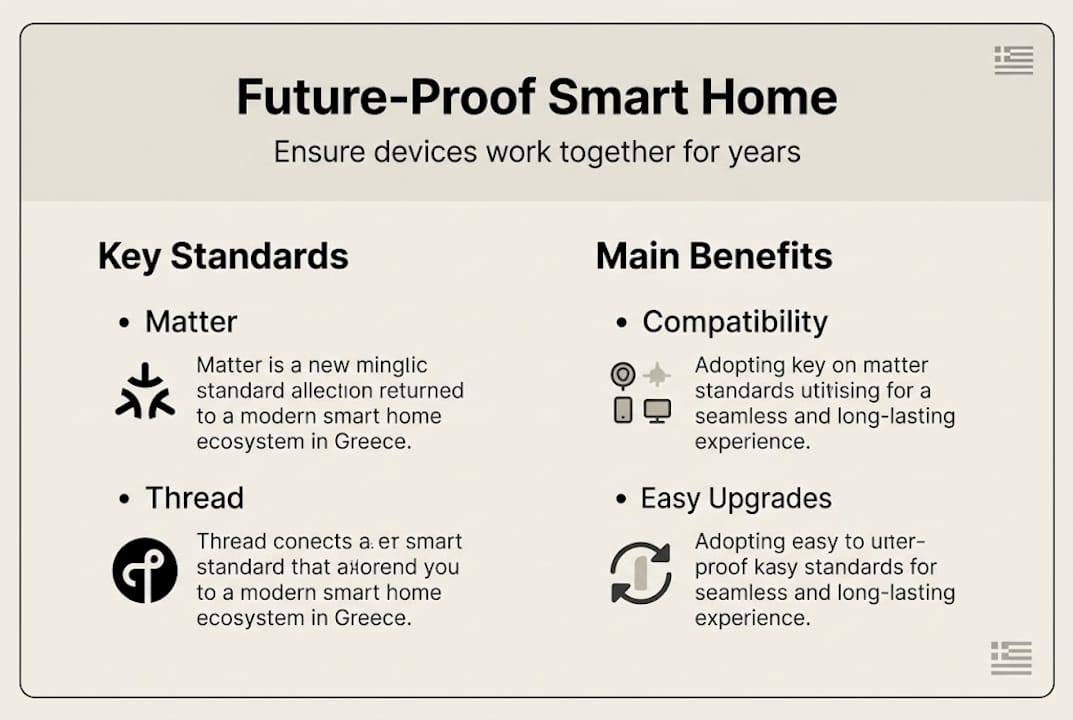
Standards like Matter, IEEE 1451, and Thread ensure interoperability across brands and platforms. Without them, you risk buying devices that do not talk to each other, forcing you into one vendor’s closed ecosystem.
Here is how the three main standards compare:
| Standard | Type | Pros | Cons | Best for |
|---|---|---|---|---|
| Zigbee | Mesh wireless | Mature, affordable, low power | Not IP-native, needs coordinator | Sensors, lighting |
| Thread | IP-based mesh | Low latency, self-healing, secure | Fewer devices currently | Future-proof IoT |
| Matter | Application layer | Multi-brand, cloud-optional | Still maturing, onboarding issues | Cross-ecosystem control |
“A hybrid Zigbee plus Matter or Thread setup is currently the most reliable and future-proof approach for most homes. Use Zigbee for affordable sensors, and Thread or Matter for premium controllers that you expect to use for years.”
Common mistakes to avoid:
- Buying Wi-Fi-only devices for every role: They consume more power and can overload your router
- Ignoring the hub requirement: Some Zigbee devices need a coordinator hub to function
- Choosing closed ecosystems: Proprietary platforms lock you in and limit your choices later
- Skipping firmware updates: Security patches keep your devices safe from vulnerabilities
- Not checking EU certification: Always confirm CE marking and EU plug compatibility before buying
For Greek consumers specifically, the EU-wide push toward Matter means that devices certified today will remain compatible with future platforms. Check out our top gadget trends tips to see which categories are leading the charge in 2026.
What most guides miss about smart accessories in Greece
Most articles focus on feature lists and broad compatibility promises. But living in Greece adds layers of practical complexity that these guides never address.
Greek apartments often have thick reinforced concrete walls that kill Wi-Fi signals two rooms away. Many buildings have older electrical infrastructure that makes certain smart switches incompatible without a neutral wire. The local resale and support market is still developing, so choosing a brand with solid EU-wide support matters more here than it does in Northern Europe.
Our view, backed by real customer feedback, is that a hybrid approach works best. Use affordable Zigbee sensors in a reliable local setup for lights and motion detection, and invest in Thread or Matter-compatible controllers for the devices you rely on most. Local-first control (where processing happens on your hub, not in a distant cloud server) is more reliable, faster, and far more private than cloud-dependent setups. Most guides skip this point entirely.
The smartest move is not buying the flashiest device. It is understanding your home’s specific constraints and building a setup that actually works, day after day. We cover practical scenarios for smart gadget adoption in Greece to help you do exactly that.
Find the right smart accessories for your needs
Ready to take the next step and put smart accessory knowledge into action?
At AskNik.gr, we have curated a range of smart accessories designed to work in real Greek homes, with EU-compatible standards, trusted brands, and genuine energy-saving potential. Whether you want to upgrade your living space, kitchen, or personal wellness routine, we have options that fit your budget and goals.
Explore our kitchen and cooking essentials collection for smart kitchen upgrades, or browse the full site to find devices across Smart Home, Tech and Gadgets, and Pet Accessories. We offer free shipping and exclusive offers, and our team is always here to help you choose the right fit.
Frequently asked questions
What makes an accessory ‘smart’?
A smart accessory is internet-connected and automates tasks through apps or hubs using sensors and wireless protocols. The key distinction is two-way communication: it sends and receives data, not just performs a single function.
Are smart accessories worth the investment?
Yes. Smart home accessories save 10-30% on energy and wearables help reduce injury risk with 92% accuracy. For most Greek households, the payback period for energy-saving devices is under two years.
How do I know if devices will work together?
Look for Matter, Thread, or Zigbee compatibility. Standards like Matter ensure interoperability across most platforms, but always check for confirmed cross-brand support before purchasing.
What’s the difference between Zigbee, Thread, and Matter?
Zigbee is an affordable, mature wireless standard. Thread is low-power and IP-based. Matter adds secure, multi-brand interoperability at the application layer. A hybrid Zigbee plus Matter setup offers the best balance today.
What are potential drawbacks or limitations?
Battery limits, wireless interference, and onboarding issues can affect performance. Choose devices with strong local EU support, check for neutral wire requirements before buying smart switches, and always verify CE certification.