


How to Use Motion Sensor Night Lights for Home Security

Last Updated: November 5, 2026
Quick Summary
Motion sensor night lights improve home security by lighting dark approaches and removing hiding spots, and they only switch on when someone is nearby. They work best as one layer alongside locks and an alarm, not as a replacement for them.
- They remove dark hiding spots and signal that the area is not empty.
- Mount the sensor across the walking path, not at the street, to avoid constant triggers.
- Keep sensors away from vents, radiators and draughty windows to prevent false activations.
- Use two small lights for long corridors or L-shaped routes to cover blind spots.
- Test placement after dark by walking the route from several directions before fixing it.
Table of Contents
- How Motion Sensor Night Lights Work
- Security Benefits of Motion Sensor Night Lights
- Do Motion Sensor Lights Raise the Electric Bill?
- Disadvantages of Motion Sensor Lights to Weigh Up
- Where to Place Motion Sensor Lights for Layered Security
- Choosing a Motion Sensor Night Light for Older Adults
- Choosing Your Motion Sensor Night Light Next
- Frequently Asked Questions
How Motion Sensor Night Lights Work
Most motion sensor night lights use a passive infrared (PIR) sensor. The sensor detects changes in heat energy in its field of view, which is typically produced by a moving person or pet, and switches the LED on. After the last detected movement, the light stays on for a set delay and then turns off by itself.
The Asknik LED Night Light with PIR motion sensor, for example, has a switch-off delay of about 15 seconds according to its supplier. Check the detection range against your own space before relying on it.
Security Benefits of Motion Sensor Night Lights
It also helps the people inside: you can see a figure on the path or in the hallway without flipping a switch in the dark.
Intruder Deterrence and Its Limits
A night light is not a substitute for a full alarm system or locks. Its main value is that it removes dark hiding spots and signals that the area is not empty. Treat it as one layer in a broader plan rather than a guaranteed barrier.
Visibility Around Entrances and Pathways
The most practical use for a night light is lighting a route you walk often: a bedroom door to the bathroom, the bottom of the stairs, or the step by the back door. Because it activates only when someone is nearby, it lights your path without leaving a room bright all night. The same approach can extend beyond the doorway, where safe outdoor lighting helps make the route to the back door easier to navigate after dark.
Do Motion Sensor Lights Raise the Electric Bill?
A night light draws only a small amount of power, and because it runs only when motion is detected, it costs less to operate than a light left on all night. Power use depends on the bulb's wattage and how often the sensor triggers, so a busy hallway will use more than a rarely visited closet. If you want exact figures for your home, check the wattage on the product and estimate from how often the light activates.
Disadvantages of Motion Sensor Lights to Weigh Up
A motion sensor night light is a small, cheap layer of security, not a replacement for an alarm, camera, or lock.
False triggers and nuisance activations
- Pets: A PIR sensor detects heat in motion, so a cat walking through the hallway will trigger the light. Mount the sensor higher than the pet's path, or choose a unit with adjustable sensitivity and a short timer.
- Passing traffic and pedestrians: An outdoor sensor aimed at the street will fire all night. Angle it across the walking path instead, and use the ambient-light setting so it only activates after dusk.
- HVAC airflow and curtains: Warm air from a vent or a moving curtain can look like a heat source to a PIR sensor. Keep the sensor away from vents, radiators, and draughty windows.
- Neighboring properties: A sensor that looks into a neighbor's yard or window is both a nuisance and a privacy problem. Keep the field of view inside your own boundary.
Sensor types and detection range
Most night lights use a passive infrared (PIR) sensor, which detects changes in heat energy in its field of view. PIR is cheap and low-power, but it can be fooled by warm air and does not see through glass. Microwave sensors detect motion by radio reflection and can see through thin walls and glass, which makes them more prone to false triggers in a home. Dual-technology sensors combine PIR and microwave and only trigger when both agree, which cuts nuisance activations at a higher cost and power draw.
Limited coverage and blind spots
A single sensor covers a defined cone, so corners, areas behind furniture, and the far end of a long hallway may be missed. For a long corridor or an L-shaped route, two small lights usually work better than one large one.
Battery life and maintenance
Rechargeable units need periodic charging, and battery life varies with how often the sensor triggers and how bright the light runs. A busy hallway will drain faster than a rarely visited closet. Keep a spare charged unit or choose a plug-in model for high-traffic spots.
Not a security system
A light does not alert anyone, record anything, or call for help. It improves visibility and can make an area feel less inviting to an intruder, but it does not detect an intrusion in the way a door sensor or alarm does. Treat it as one layer in a broader plan.
Watch out: placing a sensor where it faces a heater, vent, or busy road is the most common cause of constant false triggering. Test the spot at night before fixing it permanently, and use the sensitivity and timer settings to tune out nuisance triggers.
The article's main drawbacks come down to a few recurring problems, each with a cause and a practical fix.
Φωτιστικό Νυκτός LED με Αισθητήρα Κίνησης – Ξύλινο & Μαγνητικό →
| Problem | Cause | Fix |
|---|---|---|
| Pets trigger the light | PIR sensor detects heat in motion | Mount higher or use adjustable sensitivity |
| Constant outdoor triggering | Sensor aimed at street or traffic | Angle across the walking path |
| False triggers from air | Warm air from vents or curtains | Keep sensor away from vents and radiators |
| Blind spots in coverage | One sensor covers a limited cone | Use two small lights for long routes |
| Battery runs down quickly | Frequent triggering and bright output | Keep a spare charged unit or use plug-in |
Where to Place Motion Sensor Lights for Layered Security
!A family's front porch at dusk with a small wooden motion sensor night light mounted beside the door, warm light falling on the entry steps
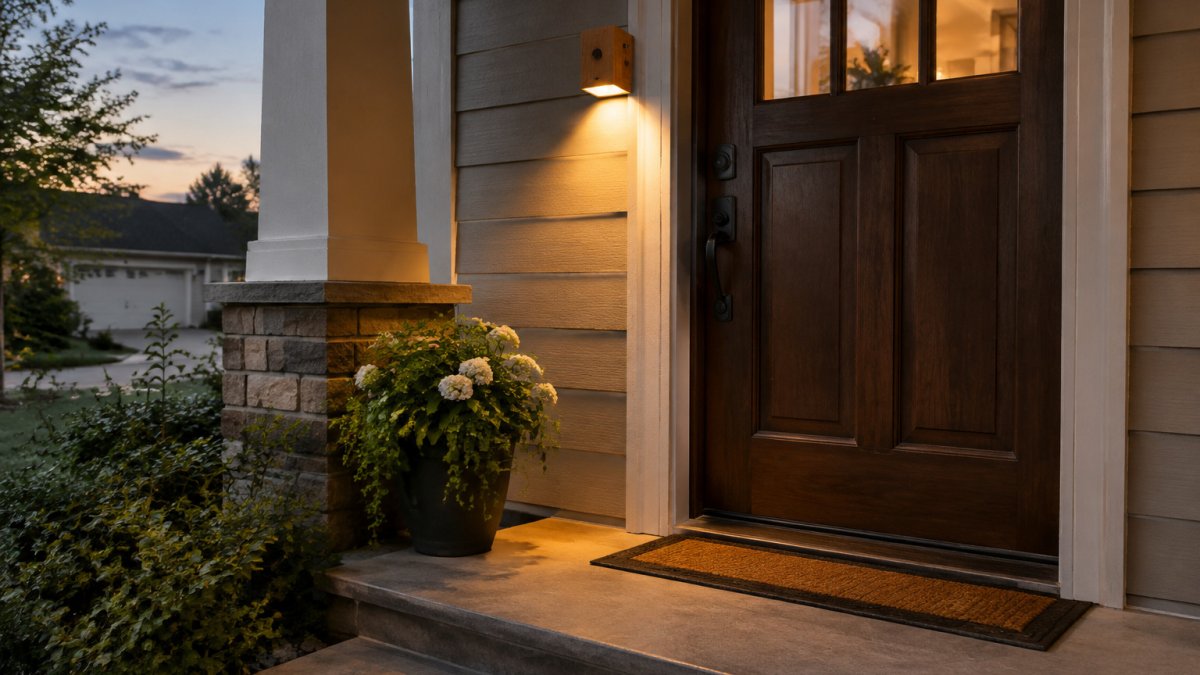
Placement is where a motion sensor night light earns its keep or becomes a nuisance. The goal is to light the routes people actually walk at night and the approaches an intruder would use, while keeping the sensor aimed away from triggers you do not care about. Think in layers: exterior approach, entry threshold, interior transition, and the night route between bed and bathroom.
Exterior placement
- Front and back entry steps: Mount the light beside the door at roughly waist-to-chest height, angled across the step rather than straight out at the street. This lights the threshold and the person standing on it without catching every passing car.
- Driveway or gate to door: Use a light where the path meets the building, not at the far end of the drive. A sensor aimed down the driveway will trigger on every arriving vehicle; one aimed across the walking path triggers on people.
- Side gates and blind spots: A light at a side gate or the dark corner beside a garage closes a gap that locks and cameras may not cover. Keep the sensor field of view parallel to the fence or wall so it does not look into a neighbor's yard.
- Avoid aiming at the street, HVAC vents, or reflective surfaces. Traffic, furnace exhaust, and swinging tree branches are the most common causes of constant false triggering outdoors.
Interior placement
- Hallways and stairs: Mount at the top or bottom of a stair run so the light comes on before the first step. A sensor aimed along the hallway, not across it, gives a longer detection run and fewer triggers from doors opening.
- Bedroom door to bathroom: This is the classic night-light route. A low-level warm light at ankle or skirting height lights the floor without glare into sleepy eyes.
- Kitchen and utility areas: A light over the counter or near the fuse box helps during a nighttime power check or a glass of water, and it doubles as a safety light during a power cut if the unit is rechargeable.
- Blind spots inside the home: The end of a corridor, the turn into a living room, or the top of a basement stair are places where a small light improves awareness without lighting the whole floor all night.
How lights fit a layered plan
Pair lights with locks, door and window sensors, and any alarm you already have. Lights work best when they make the approach visible and the rest of your system does the detecting and alerting.
Watch out: mounting a sensor at the wrong height or angle is the most common placement mistake.
For a compact option, the Asknik wooden magnetic motion sensor night light uses 3M adhesive pads on its base for wall mounting, or can be set upright on furniture.

Choosing a Motion Sensor Night Light for Older Adults
Lights along nighttime routes, such as bedroom to bathroom and the stairs, can help older adults move safely.
Asknik's wooden, magnetic motion sensor night light switches on as someone passes, uses warm light, and can be removed from its base to use as a handheld torch. Check the battery figures and mounting method against the person's needs before buying.
Beyond lighting, a thoughtful gift for an older relative can also include other practical home-safety items. You can find more ideas in our 10 Unique Housewarming Gifts Under $50 (2026 Guide).
For tasks around the bathroom, a long-handled electric bathroom cleaning brush can help with cleaning without bending, which suits many households looking to reduce strain.

Choosing Your Motion Sensor Night Light Next
Start with the routes you use most at night, decide whether you need indoor or outdoor coverage, and check the detection range and switch-off delay against your space. Test the placement after dark, then combine the light with your other security measures. For more on building a connected setup, see Smart Lighting for Home Security: A 2026 Guide and Easy Setup Smart Home Safety Devices for Beginners.
Frequently Asked Questions
What are the downsides of using motion sensor lights?
The main drawbacks are false triggers from pets, moving branches or passing cars, a short delay before the light switches on or off depending on the model, and limited coverage if the sensor's detection range is smaller than the area you need to watch. Battery-powered models also need recharging on a schedule. Check the detection range and the off-delay before buying, and position the sensor away from areas where wind-blown vegetation or heat sources will keep triggering it. Most of these issues are solved by choosing the right placement and adjusting sensitivity during setup.
Do motion lights raise the electric bill?
A motion sensor light only draws power while it is on, so it costs less than a light left burning all night. The Asknik night light used here runs on a rechargeable 500mAh battery charged over USB, so it adds no mains electricity cost at all. Mains-powered outdoor motion lights use more energy when they trigger often, so for them the real cost depends on how frequently they activate and the wattage of the bulb.
Do motion sensor lights deter intruders?
A sudden light can startle an intruder and make a property look occupied, which is why motion lighting is a common deterrent. However, evidence that lights alone stop burglary is limited, so treat them as one layer of a security plan rather than a complete solution. Combine them with locks, visible entry points and, where relevant, cameras or an alarm system. Placing lights so that approach paths and entry points are covered gives the deterrent effect the most value.
Where should you place motion sensor lights around your home?
Focus on entrances, the path from the driveway or gate to the door, side and rear access points, and dark corners that offer cover. Mount the sensor at a height and angle that covers the walking route rather than pointing straight at the street, which reduces false triggers from passing traffic. Keep the sensor clear of heat vents, direct sunlight and moving foliage. For indoor use, hallways and bathroom routes at night are the most useful spots, and a magnetic wall-mounted model with self-adhesive backing can be placed without drilling.
Ready to light up your home? Browse the Asknik collection and find a motion sensor night light that fits your routes and your household.
