
TL;DR:
- A true smart lifestyle makes homes adapt to routines, saving energy and increasing convenience.
- Smart thermostats and plugs provide quick energy savings and practical daily automation benefits.
- Compatibility and proper setup are essential; start small, test automations, and build gradually.
Smart home adoption in Greece has tripled in just three years, driven by rising energy costs, new compatibility standards, and a growing range of products available locally. Yet most people still confuse a “smart lifestyle” with simply buying the latest gadgets. The reality is much more practical and rewarding. A true smart lifestyle means your home works for you, not the other way around. In this guide, we break down exactly what that means, what devices make the biggest difference for Greek households, and how to get started without wasting money or time.
Table of Contents
- What is a smart lifestyle? Core concepts explained
- Smart lifestyle benefits: Efficiency, convenience, and savings
- Core devices and getting started in Greece
- Balancing benefits and risks: What Greek consumers need to know
- A Greek perspective: Why smart lifestyle success is about informed choices
- Bring smart living home with innovative solutions
- Frequently asked questions
Key Takeaways
| Point | Details |
|---|---|
| Smart lifestyle defined | It means integrating technologies like IoT and AI to transform routines and boost daily comfort and efficiency. |
| Major benefits | Greek households can save 10–23% on energy and gain added convenience and security with smart home solutions. |
| Get started wisely | Begin with compatible, high-impact devices—like thermostats and smart plugs—for the best returns. |
| Balance risks | Choose reputable brands, check compatibility, and be mindful of privacy and ongoing costs before investing heavily. |
What is a smart lifestyle? Core concepts explained
A smart lifestyle is not about filling your home with tech for the sake of it. It is about creating a living environment that adapts to your routines, saves energy, and reduces friction in your daily life. Smart lifestyle integrates IoT devices, AI automation, sensors, and connectivity protocols to build an environment that responds intelligently to your needs.
The foundation rests on three core technology categories:
- IoT (Internet of Things): Physical devices, from lights to thermostats, connected to the internet and each other.
- AI and automation: Software that learns your patterns and triggers actions automatically, like turning off lights when you leave a room.
- Connectivity protocols: The “language” devices use to communicate, including Wi-Fi, Z-Wave, Zigbee, and the newer Matter standard.
For Greek users, connectivity choice matters a lot. The core mechanics involve a networking layer, AI-driven automation, and unified control via apps or voice assistants. Matter is especially important because it allows devices from different brands to work together seamlessly. Google Home is widely used in Greece thanks to strong Greek language support, making voice control genuinely useful rather than frustrating.
Here is a quick overview of the main technology layers:
| Layer | What it does | Example |
|---|---|---|
| Networking | Connects devices to each other and the internet | Wi-Fi router, Zigbee hub |
| Automation engine | Triggers actions based on rules or AI | “Turn off AC when window opens” |
| Control interface | How you manage everything | Google Home app, voice commands |
| Sensors and devices | The physical hardware | Smart plug, thermostat, camera |
“The smart lifestyle adapts to you, not vice versa. The best systems are the ones you stop noticing because everything just works.”
If you want a deeper look at how all this comes together, our guide on what is a smart home covers the full picture for Greek homeowners. The key takeaway here is that the technology is a means to an end. Comfort, savings, and peace of mind are the actual goals.
Smart lifestyle benefits: Efficiency, convenience, and savings
Understanding the basics, let’s look at the actual advantages a smart lifestyle can bring to your everyday life. The numbers are more compelling than most people expect.
Energy savings are the most immediate win. Smart thermostats save 10 to 17% on heating and cooling, and when you combine them with smart plugs and sensors, total energy reduction in Greek homes can reach 23%. Given that Greek electricity bills have surged in recent years, this is a real financial benefit, not just a marketing claim.
Here is what smart devices deliver in everyday terms:
- Smart thermostats: Automatically adjust AC and heating based on your schedule, occupancy, and even outdoor temperature.
- Smart plugs: Cut standby power from TVs, chargers, and appliances, which quietly drain electricity 24/7.
- Motion sensors: Ensure lights and devices are only active when someone is actually in the room.
- Security cameras and door sensors: Send instant alerts to your phone if anything unusual happens, whether you are at home or away.
- Automated routines: One tap or voice command can trigger a sequence, like dimming lights, locking the door, and setting the thermostat for bedtime.
Convenience is the other major draw. Imagine your coffee maker starting before you get out of bed, or your front door unlocking automatically when you arrive home. These are not futuristic concepts. They are available today and work reliably with the right setup. For more on how Greek households are cutting costs, check out our coverage of energy savings in Greek homes and practical energy-saving gadgets tips.
Security and peace of mind are equally important. Remote monitoring means you can check your home from anywhere. Smart locks eliminate the stress of wondering whether you left the door unlocked. Leak sensors can prevent water damage before it becomes a costly repair.

Pro Tip: If Greek electricity bills are your main concern, start with a smart thermostat and two or three smart plugs on your highest-draw appliances. This combination delivers the fastest return on investment and gives you a solid foundation to build on.
Core devices and getting started in Greece
Ready to apply the benefits? Here is how to choose and set up your first smart devices, tailored to Greek needs.
Basic setup in Greece costs between €150 and €400, with thermostats being the single most impactful device for summer AC savings. That budget gets you a meaningful system, not just a single gadget.
Here is a practical starting sequence:
- Start with a smart thermostat. This is the highest-ROI device for most Greek homes. Look for models compatible with Google Home and Matter.
- Add smart plugs. Affordable and immediately useful. Use them on your TV, washing machine, and any device you forget to turn off.
- Install smart lighting. Bulbs or switches that you can automate and control remotely. Philips Hue is a reliable, widely available option.
- Set up a security camera or doorbell. Even a single outdoor camera adds significant peace of mind.
- Expand with sensors. Motion, door, and window sensors let you build smarter automations over time.
Here is a comparison to help you plan your budget:
| Budget level | What you get | Best for |
|---|---|---|
| €150 to €200 | Smart thermostat plus two plugs | Energy savings focus |
| €200 to €300 | Above plus smart lighting | Comfort and convenience |
| €300 to €400 | Full starter kit with camera | Security and full automation |
Compatibility is the detail most beginners overlook. Before buying, check that devices support Matter or at least work within the same ecosystem (Google Home is the most practical choice in Greece). Our breakdown of smart device types in 2026 can help you navigate the options. You can also find practical smart home tips to avoid common setup mistakes.
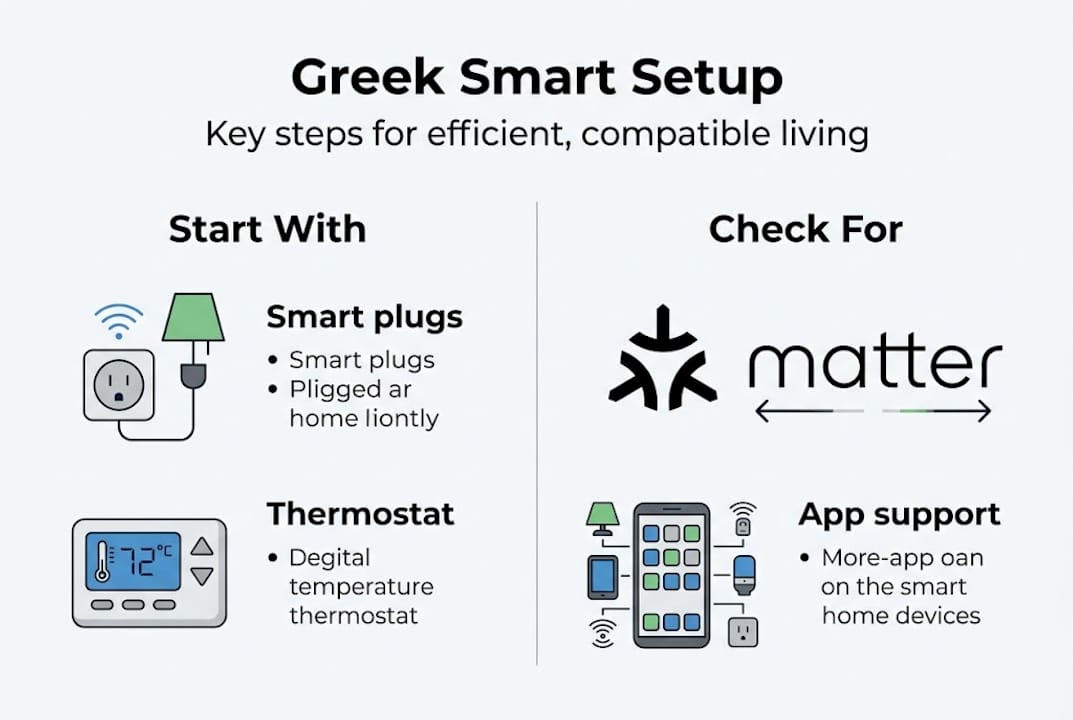
Pro Tip: Favor Matter-ready devices whenever possible. Matter ensures your devices will work together even if you switch ecosystems later, protecting your investment long-term.
For a broader look at how devices can boost home efficiency, comfort, and security, we have a dedicated guide that walks through real-world scenarios.
Balancing benefits and risks: What Greek consumers need to know
While the upsides are significant, it is important to consider the risks and how to protect your lifestyle investment.
The honest picture of smart living includes both clear gains and real challenges. Pros include convenience, energy savings, and enhanced security. Cons include hacking risks, privacy losses, cost, compatibility issues, and over-reliance on connected systems.
Here is a balanced breakdown:
Advantages:
- Measurable energy and cost savings
- Greater comfort through automation
- Enhanced security with real-time alerts
- Remote control from anywhere in the world
Risks to manage:
- Privacy: Smart devices collect data. Choose brands with clear, transparent privacy policies.
- Hacking: Any internet-connected device is a potential entry point. Use strong passwords and keep firmware updated.
- Compatibility headaches: Mixing brands without checking protocols can result in devices that simply do not work together.
- Cost creep: Subscriptions for cloud features can add up. Check ongoing costs before buying.
- Over-reliance: If your internet goes down, some automations may fail. Test critical systems and have manual backups.
The good news is that technology is moving in the right direction. Edge AI and local processing reduce privacy risk and dependency on cloud services, meaning more of your data stays on your device rather than a remote server. This is an emerging but growing trend in 2026.
“Local AI processing is the next frontier for smart home privacy. The less your data travels, the safer your home.”
For Greek consumers, the long-term outlook is positive. Government incentives for energy efficiency and the growth of hybrid renewable energy systems mean that smart home investments are increasingly supported at a policy level. Pairing smart devices with solar panels, for example, creates a genuinely self-sufficient and cost-effective home. For more on home security and efficiency, our resource covers practical strategies for Greek households.
A Greek perspective: Why smart lifestyle success is about informed choices
We have seen a lot of enthusiasm around smart home tech in Greece, and that is genuinely exciting. But we have also seen the frustration that follows when someone buys a bundle of devices that do not talk to each other, or sets up automations that fail at the worst moment.
Most guides focus on the possibilities. We want to focus on the reality. Compatibility is the single biggest issue Greek consumers face, and it is rarely explained clearly. Matter and Google Home are not just buzzwords. They are the practical difference between a system that works and one that becomes a source of daily irritation. Choosing practical Greek device choices that are verified compatible is worth far more than chasing the cheapest price.
Do not trust automations blindly. Test them. Run them for a week before relying on them for something important, like your security system or your heating schedule. Real success with a smart lifestyle is gradual. Start with one or two devices, get comfortable, then expand. The people who get the most value are not the ones who buy everything at once. They are the ones who make informed, realistic choices and build steadily.
Bring smart living home with innovative solutions
Ready to upgrade your lifestyle? Here is how you can bring smart living to your home with trusted options.
At AskNik.gr, we have curated a range of smart home products that are compatible with Matter and Google Home, fully supported in Greece, and backed by our quality check process. Whether you are starting with your first smart plug or looking to upgrade your kitchen with connected appliances, we make it easy to find the right fit.
Browse our kitchen and cooking essentials for smart kitchen upgrades, or explore the full range of smart devices for your home across every category. We offer free shipping and exclusive offers, so your first step into smart living is as smooth as possible. Our team is always available if you have questions about compatibility or setup.
Frequently asked questions
What is a smart lifestyle and how is it different from just owning gadgets?
A smart lifestyle integrates devices and automations so your home adapts to your routines, making life more efficient and secure. It goes well beyond collecting individual gadgets, as IoT devices, AI automation, sensors, and connectivity protocols all work together as a unified system.
How much does it cost to get started with smart home tech in Greece?
A basic setup costs €150 to €400 in Greece, covering essentials like a smart thermostat and automation-ready plugs. This entry-level investment delivers the fastest return, especially for managing summer AC costs.
What are the biggest risks of adopting a smart lifestyle?
The main risks are privacy concerns, hacking, high costs, and compatibility issues. As hacking risks, privacy losses, and compatibility issues are real downsides, choosing Matter-enabled, reputable brands significantly reduces these problems.
Which smart devices should Greek consumers buy first?
Start with a smart thermostat and smart plugs for the biggest impact on electricity bills. Prioritize Matter-compatible devices like Google Nest and Philips Hue for the best interoperability, then expand to lights, cameras, and sensors.
Does Matter or Google Home matter for smart homes in Greece?
Absolutely. Matter and Google Home ensure better compatibility across brands and provide strong Greek language support. Google Assistant excels with Greek support, making voice control practical and reliable for everyday use in Greek households.